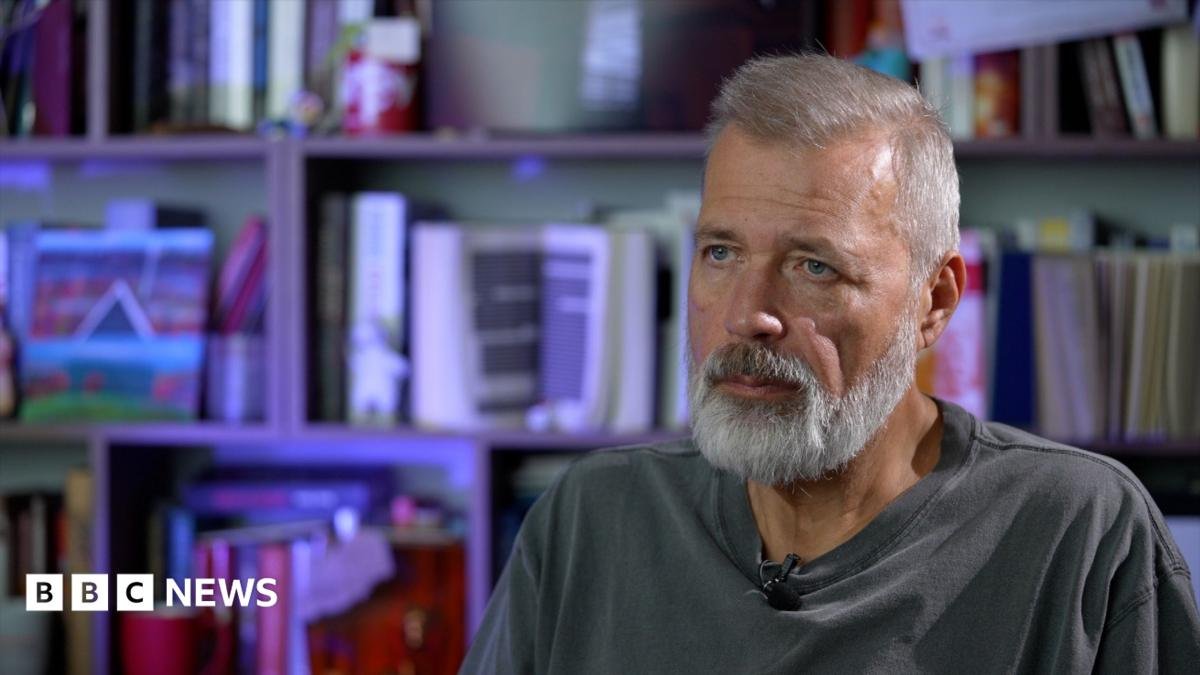
He opens a folder and takes out a stack of large photographs: portraits of prisoners.
One shows four journalists – Antonina Favorskaya, Konstantin Gabov, Sergey Karelin and Artyom Kriger – convicted and jailed on extremism charges. They’d been accused of links to the anti-corruption organisation of the late opposition leader Alexei Navalny.
There’s a photo of Alexei Gorinov: a city councillor jailed for “knowingly spreading false information” about the Russian military after he spoke out against the war in Ukraine.
“And here’s a wonderful pianist, Pavel Kushnir,” says Dmitry Miratov. “An outstanding performer of Rachmaninoff and Schubert.”
The musician was arrested after posting anti-war videos. Dmitry Muratov holds up a second video.
“And this is him in his coffin.”
Pavel Kushnir died in a pre-trial detention centre during a hunger strike. He was 39.
The stream of photos and prison stories highlights the dangers for individuals framed as opponents of those in power. It’s a reminder of the risks that public criticism of the authorities and the war carry.
“Does being a Nobel Prize laureate give you at least some protection to say what you want?” I ask.
“This is not a question for me,” replies Mr Muratov. “Whenever you have the opportunity, ask the authorities that.”
There is one more photo. From April.
“This is the newspaper’s lawyer when she was waiting to get into the building. The police were searching our office. Thirteen hours it took. And they wouldn’t let the lawyers in. Our managing editor Oleg Roldugin is now under house arrest.”
Dmitry Muratov paints a bleak picture of life in Russia for critics of the authorities.
Yet there are moments of hope.
“We live in a time when you stay quiet. But so many people support what we do. On the streets of Mocow, my colleagues and I hear only words of gratitude. They are spoken in a whisper. But what people think is very important.”
Source: https://www.bbc.co.uk/news/articles/c74grmy2v7ko?at_medium=RSS&at_campaign=rss
About the Author