Among his previous credits, the director of this mini-series Joe Pearlman can count the revelatory and hilarious 2018 film, Bros: After the Screaming Stops. That documentary worked brilliantly because its subjects seemed so sweetly but devastatingly lacking in discretion or self-awareness that everything they said landed like a line from a Christopher Guest parody. They couldn’t help themselves.
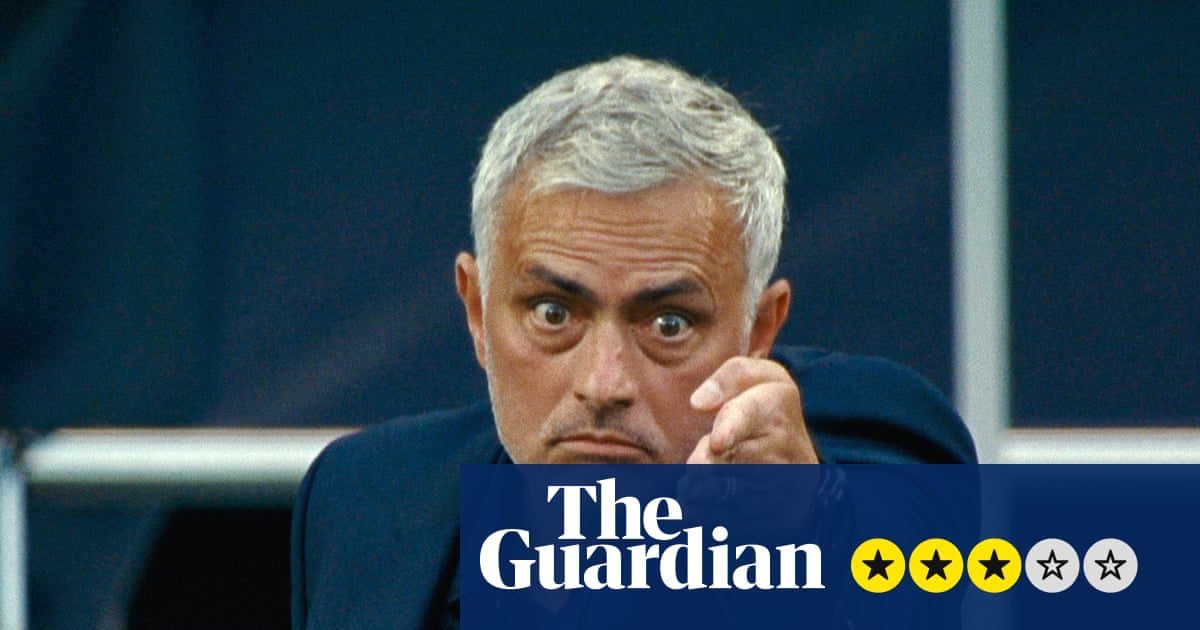
In terms of a character study, storied football manager José Mourinho is a very different kettle of cold fish. Like the Goss twins, he takes himself very seriously indeed, but that’s pretty much where the similarities end. He’s something of a closed book. “You are pushing me to speak about myself,” he says, towards the end of the final part of this series. “And I don’t want to.” Which is fair enough but it does beg the question: why then, would you agree to be the subject of an in-depth three part documentary series?
The answer, you suspect, has a lot to do with setting various records straight. Mourinho clearly feels he has been misunderstood and misrepresented. When he arrived in England, he self-applied the nickname The Special One. But, straight away, he bridles at the origins of this. “The Special One,” he claims, “is some special shit some guys in England thought up for me.” Mischievously, Pearlman then cuts directly to a clip of Mourinho describing himself thus at his first press conference as Chelsea manager. Although, to be pedantic (which Mourinho has every intention of being), he does say “A special one”. This is a distinction he insists upon: it seems typical of a man who wants to establish his own narrative; have his cake and eat it.
Many would argue that the next couple of hours of his story proves he has earned the right to do exactly that. For years, Mourinho was a fearsomely effective manager. In 2004, he won the Champions League from nowhere with FC Porto. His first spell at Chelsea was a tale of almost uninterrupted glory (although there might usefully have been a little more interrogation of both the sporting and moral implications of its bankrolling by Russian oligarch Roman Abramovich). While he was manager of Real Madrid, he single-handedly reversed the polarities of Spanish club football and won a frequently heated personal battle with then-Barcelona manager Pep Guardiola.
The documentary doesn’t shy away from his frequently appalling behaviour along the way but nor does it ever quite get to the bottom of it. He seemingly relished battles with officials that were so acrimonious that his accusations against referee Anders Frisk led to Uefa having to officially rule to clear him of any responsibility for Frisk’s subsequent resignation due to his family receiving threats from members of the public. His dealings with the media became the stuff of legend – he was paranoid, haughty and scornful. And he built teams in that image: sour, often spiteful, as difficult to like as they undeniably were to beat.
Cultivating a siege mentality is an age-old tactic among managers of sports teams, but it’s fascinating to see how this works from the inside. Eventually, it becomes clear that being as insufferable as Mourinho on his worst days constitutes its own kind of courage. Because imagine if he failed? There was always a long way to fall. For a time, players responded. At various points, you’ll begin to tire of ex pros telling you how many walls they’d have run through for the gaffer – John Terry typically one-ups the rest of them by stating he’d have left the pitch “in a coffin” for Mourinho. The routine hyperbole of the beautiful game is embraced. Player after player claims that he created a family. But if these were families, they were frequently barely functional ones, without much staying power.
For a while, this high wire act is gripping. But the patterns embodied by Mourinho’s managerial career soon become a little limiting for documentary purposes. He’s a manager of boom and bust; of diminishing returns. Why has he been unable to build anything more lasting? There’s plenty in Mourinho’s past that hints at vulnerability – his almost non-existent playing career clearly troubled him (“I still think I don’t belong to the tribe”), and he seems to carry an inferiority complex in relation to his father who was also a football coach – although a markedly less successful one. “I was so proud to be Mourinho’s son,” he says at one point. “He’s the opposite of me in that everybody loves him.”
It’s almost certainly not Pearlman’s fault but these moments of confession; of vulnerability; of dropped guard don’t come quite often enough – or go quite deep enough – to make this film gripping to anyone beyond football aficionados. Mourinho freely admits that he doesn’t have much else in his life. We briefly meet his family for the first time about 15 minutes before the end of the concluding episode. “I know that they enjoy life much more without me,” he confesses.
Like most prodigiously successful people, José Mourinho is clearly quite odd, and possibly, even now, as he prepares to take over once again at Real Madrid, slightly unfulfilled. You suspect he doesn’t want the world to see too much of this. Success is relative, in life, in football and in documentary making. Sometimes, it’s about the journey, not the arrival. One assumes that making a film about Bros was less exacting than this. It was probably a lot more fun too.
Source: https://www.theguardian.com/tv-and-radio/2026/aug/11/mourinho-review-if-he-didnt-want-to-open-up-maybe-he-shouldnt-have-starred-in-a-docuseries
About the Author