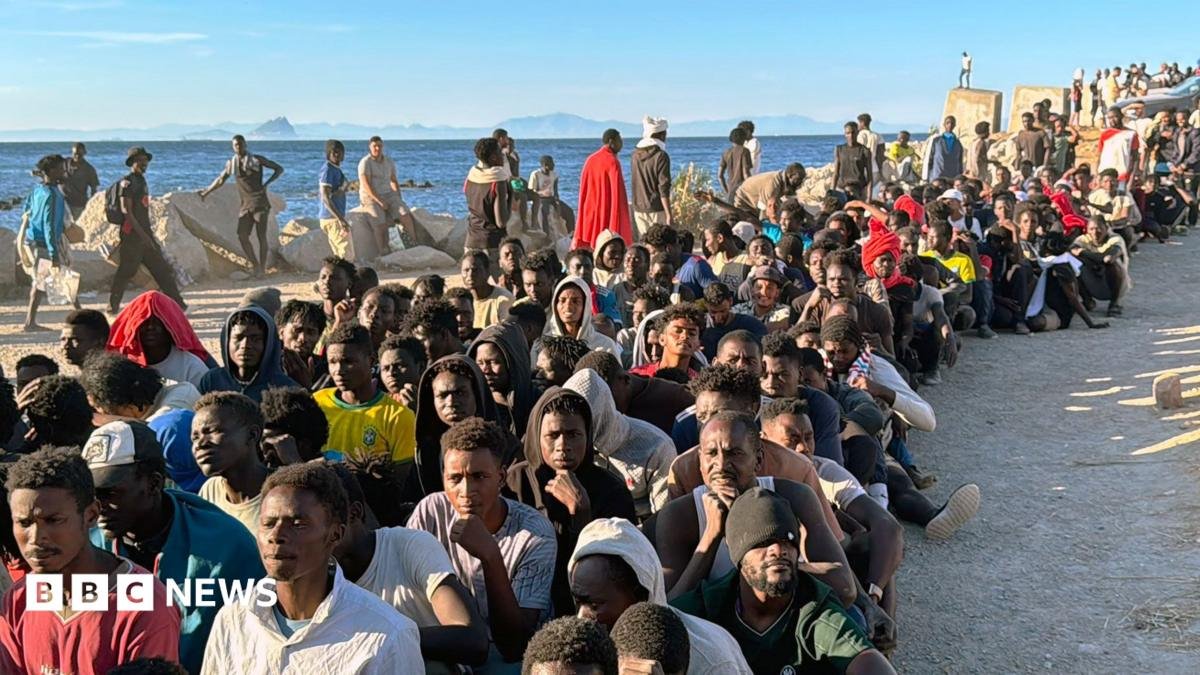
It remains unclear exactly why tens of thousands of migrants attempted to cross into Ceuta, but the EU’s Migration Commissioner Magnus Brunner has suggested criminal networks spreading disinformation were to blame – an assertion the Spanish government has agreed with.
The crossings came after Spain’s Supreme Court ruled that migrants stopped at sea while trying to reach Ceuta or Melilla cannot be summarily returned to Morocco.
Morocco, for its part, has laid blame for the crisis on the court, with an unnamed government source briefing local outlets that “the deterrent element of the system collapsed and the dam gave way, not under the weight of the criminals, but of a judge’s decision”.
The number of people swimming to Ceuta at once has raised questions about why Morocco’s border guards did not attempt to stop them.
Nearly 1,400 minors, some of them “very young boys and girls”, still remain in Ceuta following last week’s crossings, Spanish Youth Minister Sira Rego said on Friday.
She added: “There was a situation in which the system was overwhelmed, but it is now being brought under control. It is true that there are many boys and girls, and the procedure takes time.
“We wanted to make clear that we have prioritized the most vulnerable cases.”
The two exclaves have long been a bone of diplomatic contention between Spain and Morocco, which does not recognise Spanish sovereignty over them.
The Ceuta crossings have also caused a diplomatic rift among EU nations that share open borders as part of the Schengen area.
Italy’s decision to suspend its agreement was backed by Finland and Denmark, while the Czech Republic called for Spain’s membership to be temporarily suspended.
Italian officials have said local authorities carrying out checks do “everything possible” to ensure maximum comfort for both Spanish and other European citizens arriving in Italy from Spain.
Rome has also reiterated that Spanish citizens are exempt from additional checks when arriving in Italy, with these extra steps only for non-EU residents.
However, El Pais reported that several airport terminals have seen long queues and waiting times in recent days, with passengers arriving from Spain directed to a specific line for checks.
Temporary suspensions of the Schengen agreement are not unprecedented. Italy also maintains controls on its border with Slovenia.
Source: https://www.bbc.co.uk/news/articles/c5yv5l6yr5ko?at_medium=RSS&at_campaign=rss
About the Author