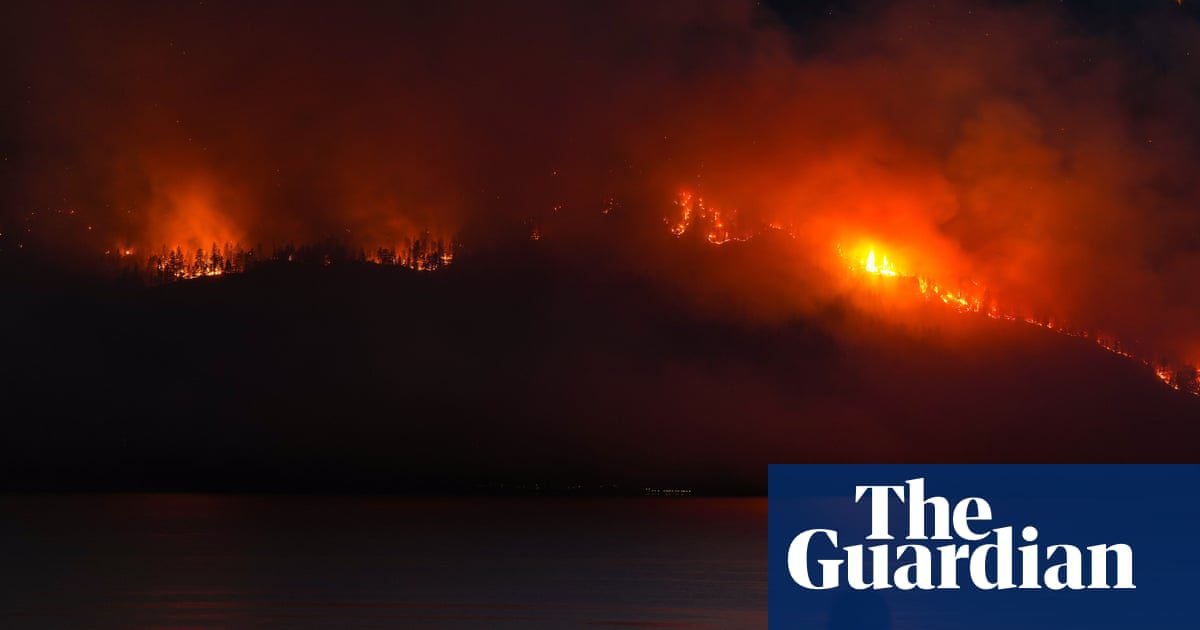
The human-driven climate crisis made the conditions that led to blazes roaring across Canada, which have caused toxic smoke to spew throughout the country and into the US, twice as likely to occur, a new analysis has found.
Heightened global temperatures, caused by the burning of fossil fuels, amplified the risk of fire-prone weather in Ontario and the Northwest Territories, scientists found. These provinces have been racked by fires this summer, causing towns to be evacuated and unhealthy smoke to unfurl across multiple cities in North America.
There are currently nearly 700 fires ablaze across Canada, with a huge 3.8m hectares of the country, mainly in its sprawling boreal forests. But the study by World Weather Attribution, a consortium of scientists that analyses climate change’s influence upon extreme events, found that fire weather seen in Canada this year is no longer a rare event.
The climate-influenced conditions that dry out vegetation and soils, making them more prone to combustion, are now expected every two to six years in the Northwest Territories and every six to 15 years in Ontario. If humanity hadn’t overheated the planet by burning coal, oil and gas, the scientists determined, such extreme fire conditions would occur less than once every 40 years.
Canada, which has a quarter of the world’s boreal forests, has always experienced fire. But the climate crisis has made fire conditions more extreme and since 2023, when huge fires also spread across Canada, the country has suffered a “fundamentally different” scale and intensity of blazes, according to Theodore Keeping, an expert in extreme weather at Imperial College London and part of the WWA research team.
“The geographic spread of these fires is scary and shows that despite preparedness from wildfire governance, adaptation alone is not enough,” Keeping said. “We need to rapidly move away from fossil fuels to avoid events like this becoming even more of a reality.”
The WWA group finalized the study of Canada’s fire conditions shortly after unveiling findings showing the climate crisis had an even larger role in record fires raging in Spain and France, which has staged its largest ever peacetime evacuation due to the flames.
“What is going to be next?” said Friederike Otto, a climate scientist at Imperial College London and WWA study co-author.
“Time and again we see the same results: climate change is a key driver behind uncontrollably large and unprecedented fires. This shouldn’t come as a surprise. The science has been clear for decades: burning fossil fuels is making these wildfires more frequent, more intense and more difficult to contain.”
Despite the clear science linking the climate crisis to wildfire conditions, Donald Trump has sought to pin the blame upon Canada for not better controlling fires that are burning, often in wild, inaccessible areas.
after newsletter promotion
Trump, who has dismissed established climate science as “crap” and “a con”, said last month that the US was “being unnecessarily invaded by filthy, polluted and unhealthy air” and threatened reprisals such as new tariffs against his country’s northern neighbor.
Asked what “punishment” Canada will receive, the US president said on Sunday: “You’ll find out about it.”
Experts have condemned Trump’s remarks, with WWA scientists pointing out that most of Canada’s boreal forest is unmanaged and is being warped by planet-heating emissions coming from around the world, with the US the historic largest emitter.
“I don’t think we should blame Canadians for that,” Jonathan Boucher, a researcher at the Canadian Forest Service, said.
The fires continues to cause havoc across Canada, beyond the provinces studied by the new research. In British Columbia, 8,000 people are under an evacuation order amid “explosive and extremely dangerous” fire conditions.
Source: https://www.theguardian.com/world/2026/aug/06/canada-wildfires-climate-crisis
About the Author