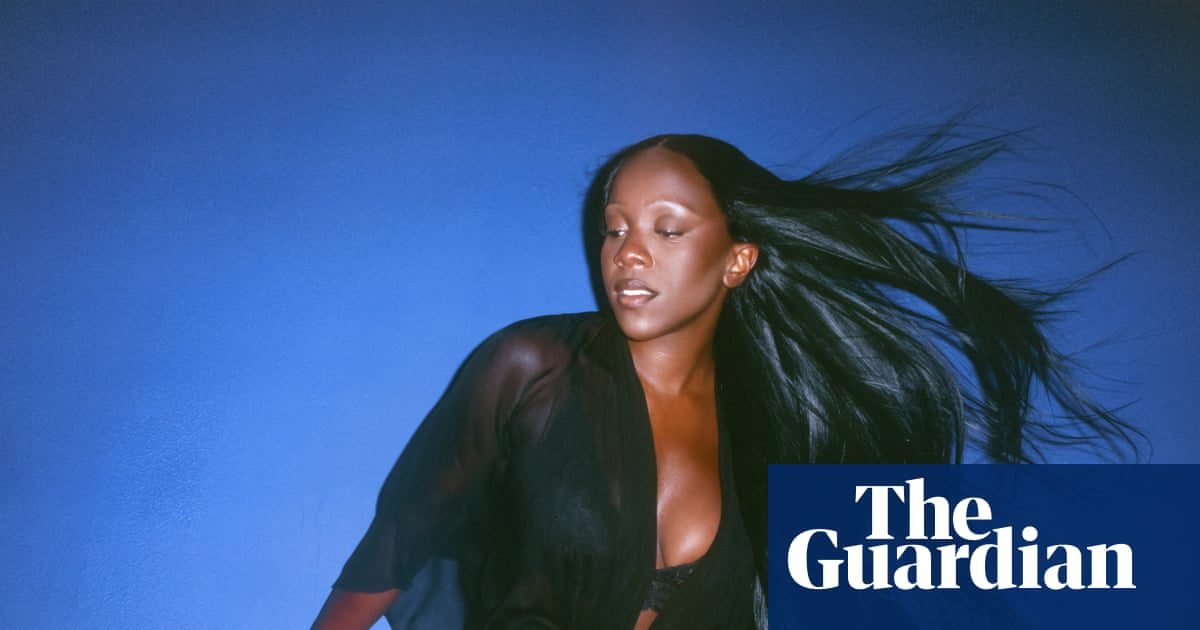
In October 2017, Rachel Chinouriri had her first panic attack. It couldn’t have come at a worse time. She’d just landed her first major gig as a professional musician, supporting Celeste at the London members’ club Laylow. Out of nowhere, she began to spiral. “I don’t know what happened,” she says. “I just started having a mental breakdown.” Her manager told her to go home, try again next time. But that only made things worse. “I started feeling like I was wasting everyone’s time,” she says. “I started feeling ashamed.” It would be better, she decided, to go on stage and sing, “half crying”.
Tears were already a familiar response to Chinouriri’s performance anxiety: the first time she sang in front of her classmates at the Brit school – the performing arts institution that trained Adele, Amy Winehouse and more – she burst into sobs afterwards. A rather inconvenient habit for an aspiring pop star, but at least she front-loaded the humiliation at the start of her career. “That was a big milestone for me,” she says of the Celeste show. “The fact that I could stand up there completely embarrassed, with people looking at me like, ‘Don’t really know what’s up with this girl’, but I still got through it and everything was fine.” The experience taught her that the catastrophic scenarios in her head rarely come to pass. “I’d given myself this pressure of, ‘This is the music industry. If they think I’m rubbish, I’m never gonna perform again.’” Chinouriri rolls her eyes at herself.
The 27-year-old’s triumph over stage fright has been more impressive than most. It’s a sweltering Friday in July – 30C outside and even hotter in the small restaurant she’s chosen for our interview – and Chinouriri is having an excellent week. On Sunday, she performed to a crowd of 45,000 at Wolf Alice’s homecoming show in Finsbury Park – the latest artists to select her as a support act, after Sabrina Carpenter, Olivia Rodrigo, Gracie Abrams, Florence + the Machine and more have all been drawn to the fearless, bare-souled lyricism that charges through her contemporary twist on indie music. Last night, her former Brit school headteacher handed her the trophy for best new music at the O2 Silver Clef awards: her first-ever award win, after nominations at the 2025 Brits and 2021 Ivor Novellos. Melanie C was at the ceremony and later followed her on Instagram (“I will absolutely message her straight after this”).
How did she celebrate her big win? “I put on my glasses and left! I was in the heaviest metallic dress and it was like a sauna in there. Looking back at all the images, I’m just, like, wet on stage.” Today, Chinouriri is dressed in more appropriate heatwave attire: red micro shorts, a strapless top and flip-flops. She scans the breakfast menu, though she hardly needs to: Café Palestina is one of her favourite spots in London, a short ride from her home in Camden. She orders a Palestinian breakfast and an assortment of kibbeh and stuffed vine leaves to share, then leans back into her seat.
There’s another reason for Chinouriri’s good mood: this afternoon, she’ll hand in the final version of her forthcoming second album, I Think I Spoke Too Soon. The title is quite literal. “In my early 20s, I was so self-assured of who I was, then my frontal lobe hit and I went: ‘Nah, I’m actually not that person,’” she says. Chinouriri says she has recently learned about her Saturn return, the astrological milestone said to upend your late-20s. “I feel the shift. I thought I knew myself. Now I look in the mirror and I’m like: ‘Is this actually who I am?’”
It’s a big question, but not a new one for Chinouriri. Growing up in Croydon, she was the only one of five siblings to be born in the UK, after her family moved from Zimbabwe. Her mother ran a strict Christian household while caring for her sick father. Both parents had fought as child soldiers in Zimbabwe’s war for independence. In the UK, they struggled to make ends meet. “But they always turned it into a giggle,” she says – even when the power went out. “Games would start getting invented. You’d get given the electricity meter key and walk to the shop to put £5 on.” She smiles fondly at the memory of them all sprinting to complete the task. “They found a way to turn struggle into something beautiful in order to survive.”
At a majority white secondary school, Chinouriri faced her own battles, enduring racist bullying so extreme that one pupil was suspended and another excluded. She was spat on, called the N-word and tormented with monkey noises as she walked through the corridors. Eventually, Chinouriri enrolled herself at a more diverse school, pretending to be her mother on the application form. “The first school taught me: don’t stay where you’re not wanted,” she says. “I hit points where I felt like dying. But afterwards, I was like: ‘I can leave here with my head raised high.’”
A few years later, she made it to the Brit school, the state-funded incubator for British pop stars and actors. Chinouriri was in the same school year as Olivia Dean and Cat Burns; Lola Young was just a few years below. “I wasn’t in any of their classes, but they were three names I heard constantly – the rumours were right!” At home, her musical tastes stuck out. Forbidden from listening to non-Christian music, she and her siblings would row over which TV music channels to watch while their parents were at work. “My sisters were big lovers of B2K, Brandy and Destiny’s Child. When I was in charge of the TV, it would be Oasis and Coldplay.” But at the Brit school, the singer found a place where being different was kind of the whole point. “There was a girl who used to paint herself like an anime character every single day and walked around the school like it was normal,” she says. “I loved that level of expression and freedom.”
When Chinouriri released her debut album, What a Devastating Turn of Events, in 2024, she laid everything bare. The title track recounts her cousin’s suicide after an unwanted pregnancy; another song wrestles with self-worth and body dysmorphia; on My Blood, she sings about self-harm. The candour resonated and its songs were streamed hundreds of millions of times. “All my songs feel a bit like a journal entry, even if I make it sound like a pop song,” she says. “It’s always deeply embedded in my thoughts.” It also resonates when her lyrics turn to romance: her song Dumb Bitch Juice has become an anthem for fans weathering toxic relationships. As Chinouriri’s friend and collaborator PinkPantheress tells me, “Her youthful, melodic approach truly encapsulates the state of modern romance among people our age. She makes heartbreak warm and tolerable, even in the most painful situations.”
Chinouriri is now in a healthy, long-term relationship. These days, she sings about heartbreak from a distance: reflecting on past flings to better understand herself, instead of “writing through something I’m trying to survive,” she says. “I began asking myself: ‘Why do I attract these people?’ The fun obsessions or meet-ups I used to love actually came from a place of desperation, loneliness and seeking validation.”
When her album was released, much of the media attention focused on Chinouriri’s presence as a Black woman in indie music, a genre that’s historically associated with white men. This was partly her own doing. In 2022, she called out the industry’s inaccurate – and, frankly, racist – miscategorisation of her music as R&B or soul on Instagram: “You see my colour before you hear my music.” What a Devastating Turn of Events doubled down on guitar sounds to make a point. “That had to happen because I was really fighting for my place in indie pop,” she says. But still, I wonder, did she ever tire of answering questions about race?
“I feel like …” Chinouriri squints upwards as if the answer might be hovering above the table, then begins to speak slowly. “It was an important and necessary part of the story to pave the way for myself in pop, indie and alternative music. I’m glad that I’ve played a part in that. I love going on TikTok and seeing a new Black pop or indie girl with 10,000 likes and no one’s questioning it.” So the industry’s made progress, then? Another pause. “I can say that there’s been progress because I’ve benefited from it. But when I look to my left and right at festivals, I’m still the only Black girl on the lineup – or it will be me and Cat [Burns]. The fact that two Black pop girls who went to the same school are [being booked] around the UK … That’s interesting.”
I Think I Spoke Too Soon turns the conversation inward. “My first album was about how I was perceived as a Black woman in this space. Now it’s about how I perceive myself in this space,” she says.
The record is a near-total gear shift from Chinouriri’s previous output, drawing from her longtime pop heroes, Madonna, Kylie Minogue, Donna Summer, Prince and LCD Soundsystem – influences that would have perhaps complicated her fight against pigeonholing during her last album rollout. “As much as I love indie sleaze, I love me some Madonna,” she says, laughing. “I wanted [to recreate] the level of carefreeness I got when I listened to songs like Hung Up for the first time.”
Bright synths replace Britpop-inspired guitars; melancholy hooks are transformed into singalong sad bangers. There are still flickers of her old self: rich harmonies, confessional lyrics, the odd indie track thrown in for good measure. But as she sings on lead single, One Song Away from Crying, this is principally an album that’s designed to “work it out on the floor”.
If anything, Chinouriri’s darkest moments are made all the more cathartic when contrasted with a danceable beat. When she confronts her relationship to alcohol on Broken Chair, for example, she sings its euphoric chorus from the perspective of pitying an abandoned piece of furniture on the side of the road: “You look lonely, but not me / I’ve got plenty of friends until the last call”. The same theme is explored on The Good Fight, one of the first songs she wrote for the album. Around the same time, she decided to go sober. “I didn’t have too much of an issue with drinking, but I just looked at myself and thought: ‘This is not my happy place,’” she says. Up until that point, her party-girl image had become a running joke with her fans. “I was out with a friend and she posted a selfie of us. My fans were like, she’s about to tweet: ‘I’m tipsy!’” Without seeing their prediction, she did exactly that. “It was pretty funny. They know me well.”
Chinouriri replies to group chats with her fans more often than her family. Recently, her team analysed her audience and found it skews overwhelmingly queer. “I was like: ‘This is fantastic!’” She went straight to the group chat to deliver the news. “I was like: ‘Announcement: everyone in here is gay and this is beautiful.’”
Chinouriri is looking ahead to a busy few months of concerts, including a slot at Rodrigo’s inaugural Daisy Chain Fields festival in California and supporting Abrams on tour across the US. She’s already briefing fans on what to wear to align with her new era: “Blue, silvers, purple, shimmy-shimmy iridescence. It’s going to be so fun.”
When supporting Carpenter on tour around Europe last year, Chinouriri “felt like I was travelling in this Sabrina universe”. Every billboard had Carpenter’s face on it; every person seemed to be wearing merch; every cafe was playing her music. “It was so cool to see how she’s thought about her fans, even at that level, and the community they’ve built. I’d love to have that one day.”
At the Finsbury Park show, one fan held up a sign that read: “When I don’t belong, her music calls.” Perhaps that feeling is a happy byproduct of Chinouriri’s own fight to be heard. “Whatever happens, if I do get pigeonholed again, so be it. I fought really hard. I tried my best,” she says. “But I need to trust that it won’t happen because I have found a way to know who I am.” At least for now. “You can change who you are at any moment, as long as you reflect and forgive yourself first.”
Source: https://www.theguardian.com/music/2026/jul/31/rachel-chinouriri-interview-favourite-uk-pop-star-second-album
About the Author