A 6.8-magnitude earthquake has shaken south Japan, killing at least two people and leaving at least 100 people injured. Some are trapped and presumed dead inside a shopping mall.
The earthquake hit Kumamoto prefecture on the southern Kyushu island late on Tuesday afternoon, knocking out power to thousands of homes and damaging roads, bridges and buildings.
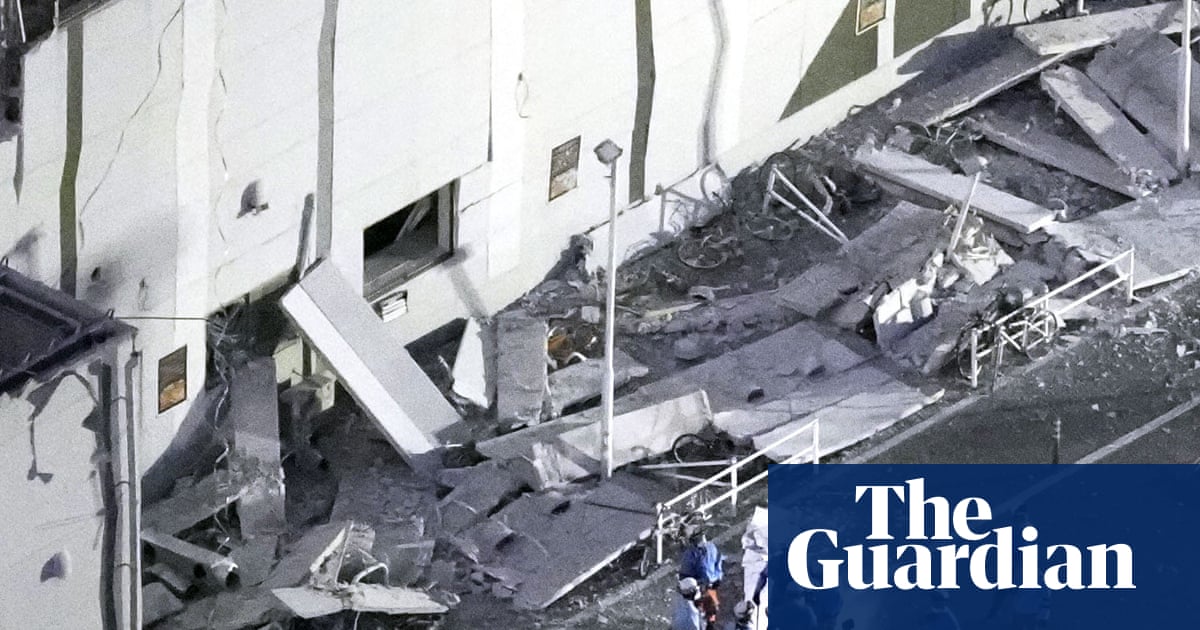
The prefectural government said rescuers working at the scene overnight had taken eight people out of the Aeon Mall Kumamoto shopping centre.
Of those eight, two women in their 20s were confirmed dead, while one other person was reported to be in cardiopulmonary arrest. The five others were injured but officials said their condition was not life-threatening.
Firefighters said earlier that an explosion had occurred in the mall shortly after the earthquake, with a government official telling reporters that a gas leak had been reported but the cause was not known.
Footage showed one side of the mall, the prefecture’s largest with roughly 200 shops, was torn away, exposing steel beams and leaving debris strewn across the neighbouring car park. Several ambulances and fire engines were parked outside as rescue teams searched for survivors.
Japan’s prime minister, Sanae Takaichi, told reporters authorities were still assessing the extent of the damage in the area, which was devastated by another deadly quake a decade ago.
“We have already been informed that people have been injured. Power outages and fires have occurred in some areas, and there has also been damage to roads and bridges and the collapse of buildings,” Takaichi said. “I ask everyone to take action to protect themselves, including evacuating to a safe location.”
About 300,000 people have been instructed to go to evacuation centres, the disaster management agency said. The areas with the biggest tremors will remain at risk of further strong quakes and landslides for about a week since the shallow earthquake is triggering seismic activity in the area, according to the Japan Meteorological Agency (JMA).
So far there have been more than 60 aftershocks ranging in magnitude from 1 to 4, the agency said. A tsunami warning was issued immediately after the quake, but was lifted within two hours.
One person was killed in south-west Japan when a house collapsed during the earthquake, Kyodo News reported.
Two hospitals reported more than 50 injuries each, including 10 in a serious condition, the public broadcaster NHK said.
“People are coming in with burns and fractures from being trapped under objects due to the earthquake, and ambulances are constantly bringing in injured people,” NHK quoted one hospital employee as saying.
“Inside the hospital, there are water leaks and electrical system failures.”
Several people on a high-speed train at the time of the quake were also injured and more were missing after a chimney collapsed at a Nippon Paper Industries factory, according to local media reports.
Takaichi pledged late yesterday that emergency responders would work “tirelessly” through the night “starting with the rescue and lifesaving of those affected”.
Footage from NHK showed several other buildings on fire or partly collapsed, along with large fissures on major roads, including an elevated highway. TSMC, the world’s largest contract chip maker, Sony and Fujifilm evacuated workers from their factories in the area.
Chiharu Hara, a 35-year-old recruitment agent who was in Kumamoto, told AFP that she was “terrified” when the quake struck.
“The office swayed violently side to side. I was afraid it would collapse. Everyone panicked,” Hara said.
The quake’s epicentre was about 12 miles (20km) south of Kumamoto, central Kyushu island’s largest city, with a population of about 700,000. The US Geological Survey initially said the earthquake had a magnitude of 7.1, but revised it later to 6.8. The tremor at 4.27 pm local time had a magnitude of 7.1, the JMA said, but reached the highest level of 7 on Japan’s shindo scale. A subsequent aftershock with a magnitude of 6.1 was registered at 5.08pm.
Japan, which is located along the “ring of fire” of volcanoes and oceanic trenches in the Pacific basin, is one of the world’s most earthquake-prone countries, with a tremor occurring at least every five minutes. The country accounts for about 20% of the world’s earthquakes of magnitude 6 or more.
The massive earthquake in Kumamoto 10 years ago killed 275 people and injured a further 2,739. It damaged thousands of buildings including the city’s castle, a popular tourist site. Some of the castle’s stone walls were damaged in the most recent quake.
Kyushu Electric Power said 48,000 homes had lost power, while the railway company JR Kyushu suspended services, including its high-speed bullet trains. Kumamoto airport also shut its runway as airlines diverted and cancelled flights.
The telecoms operators KDDI and NTT Docomo said there was disruption to their mobile phone services owing to power shortages and transmission-line failures. There were no irregularities reported at the nuclear power stations in the area, Japan’s nuclear regulation authority said.
The Japanese military has mobilised 3,600 personnel for disaster relief operations and sent 20 aircraft to assess the damage from the air, the defence minister said.
Japan is haunted by the memory of a massive 9.0-magnitude undersea quake in 2011, which triggered a tsunami that left around 18,500 people dead or missing and wrecked the Fukushima nuclear plant.
Source: https://www.theguardian.com/world/2026/jul/28/japan-earthquake-traps-people-collapsed-shopping-mall
About the Author