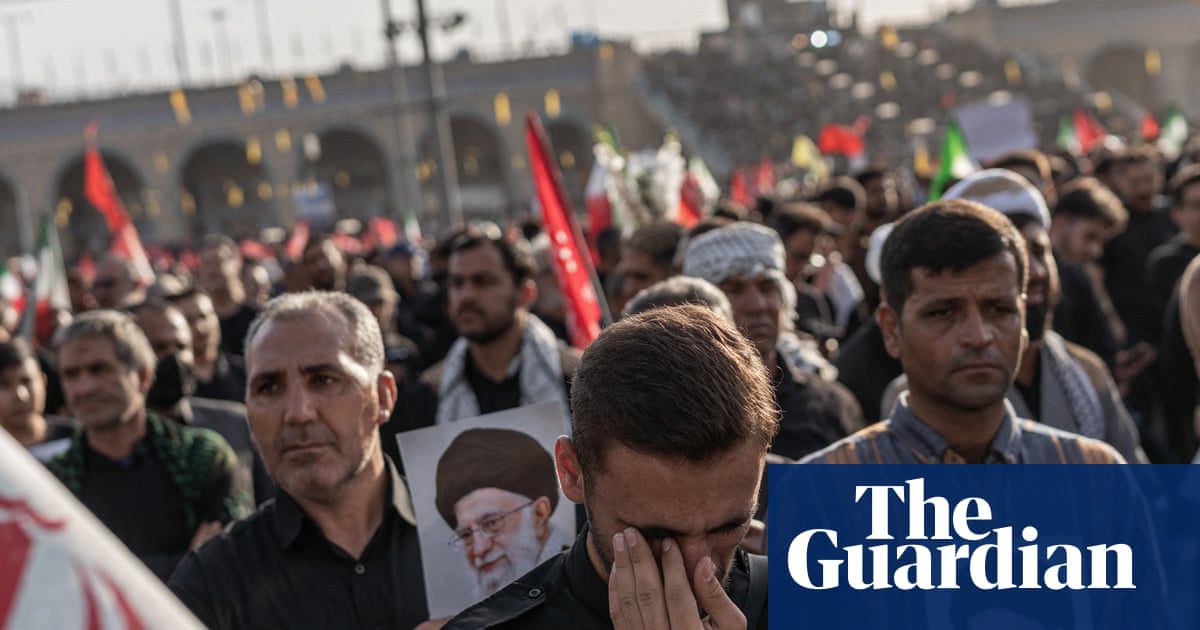
Huge crowds gathered at the funeral of the former Iranian supreme leader once the gates of the sprawling Grand Mosalla mosque in central Tehran let in thousands of mourners who had been waiting through the night to enter the grounds.
Iran is staging mass funeral processions for Ali Khamenei – whose 37-year reign was brought to an end in February by the first airstrike of the war launched by the US and Israel. By 5.30am on Saturday, the Tehran streets surrounding the mosque were already filling up as Iranians, some travelling for hours and many carrying flags or posters of Khamenei, made their way to an event designed to emphasise the country’s sense of loss at the killing of the supreme leader and desire for revenge. Emotions filled the air as the crowds chanted Death to America and Israel.
Khamenei, 86, was assassinated by Israeli jet planes and the raised stage showing his coffin also found room for the coffins of other members of his family killed in the raid, including his 14-month-old granddaughter.
By 8am, the open-air mosque contained as many as 10,000 people, segregated in equal numbers with men to the right and women to the left.
The scale of the six-day, five-city funeral has been conceived to relay political and religious messages of resistance to the rest of the world. Up to 30 million people may attend at some point, the organisers claim. At the request of Iraqi politicians, Khamenei’s body will also be carried through the Iraqi Shia cities of Karbala and Najaf.
The banner erected where the bodies were placed read: “Say, I only advise you with one thing: that you stand up for Allah singly or in pairs.” Before the religious part of the ceremony started the predominant sound was the beating of cymbals and tambourines, and cries of “Death to America” and “Death to Israel.”
As religious songs, the national anthem and eulogies reserved for martyrs started to dominate even in the areas reserved for the media, anguished grown men sat cross-legged, beating their chests or for long periods sobbing uncontrollably, their shoulders heaving. Metres away, reporters tended their Instagram accounts, with selfies showing the mass of mourners behind.
Officials, eager to avoid the crushes that have marred previous funerals in Iran, had urged mourners not to remain in the mosque for too long to ensure the crowd and by lunchtime as temperatures reached 36 degrees the numbers had thinned.
In the surrounding streets, banners stretched across the road proclaiming Khamenei’s martyrdom and his indelible place in Iranian history. The yellow flags of Hezbollah were visible among the crowd, while the flag of Iran was festooned around mourners’ shoulders as if they were on the way to a football match.
Hundreds of mokebs (food stations) offered free boiled eggs, halim soup with cinnamon, lemonade, water melon, kebabs, tea and endless plastic bottles of water. The helpers slept in schools, cars or tents overnight. Alms for the poor could given as gifts by credit cards at desks. Sprays of water mist tried to cool the crowds. At one stand school students offered passersby the chance to be photographed alongside a picture of the new supreme leader – the son of Ali Khamenei.
One of the women, Fatima Khavari, said: “I felt like I had been crushed on the head when our leader was killed. He is the only true guide we have known”. Another stall holder, a university professor, demanded to know why America interfered in the Middle East. “How would you feel if we came to steal your minerals and bomb your leaders?”
On the streets around the mosque, music – some revolutionary, some religious – had begun blaring from competing sound systems well before dawn. Men handed out posters reading: “We are the revenge seekers of Ali Khamenei.”
British and American journalists have officially been advised not to speak to the mourners, but in reality most are delighted to talk – if only to convey the contrast between the US president, Donald Trump, variously described as a megalomaniac and a yellow dog, and their own martyred, learned leader.
One white turbaned cleric, Hossein Ajorlu, standing outside the mosque, explained: “There is a brush with which we clean toilets. It grows filthy in time with what the body has processed and rejected. Then there is the clean water of renewal from a spring. That is how I compare the two men.
He appeared genuinely surprised by any suggestion that the army was currently supplanting the clergy in Iran.
Inevitably, the crowds filling the mosque represented a certain section of the Iranian population, with all the women wearing the chador, a large, full-body cloak that drapes from the head to the ground, while in the shops or on motorcycles or in restaurants more than half the women in Tehran do not wear the hijab or scarf.
By no means every Iranian is joining what one described as “this victory parade”. The roads out of Tehran on Thursday were busy despite the government calls to attend the final farewell. One sceptic who stayed in the capital this weekend had returned from the US recently to be with family. Asked if he was going to the mosque he explained “it is not my thing”. An admirer of Marco Rubio, the US secretary of state, he said: “Trump should have finished what he started, but he is bipolar. He thought Iran was Venezuela but this government is deeply rooted. Religion is deeply rooted.
“The country is a deep mess. Prices in the shops change every day and sometimes as a store owner it is impossible to get hold of basic things. A society cannot survive like that. Maybe a government can, but a society cannot”.
It will be for the government to calculate the truth of their claim that the long delayed funeral will help reunify and refocus a nation in part divided by Khamenei’s conservative and often unbendingly religious rule. The grandeur of the ceremony has distracted from announcements French and the British may be preparing to send war ships to clear mines in the strait of Hormuz. Khamenei dedicated much of his life to a keeping Iran independent from America. That trial of strength does not end with his demise.
Source: https://www.theguardian.com/world/2026/jul/04/crowds-gather-six-day-funeral-former-iranian-supreme-leader-ali-khamenei
About the Author