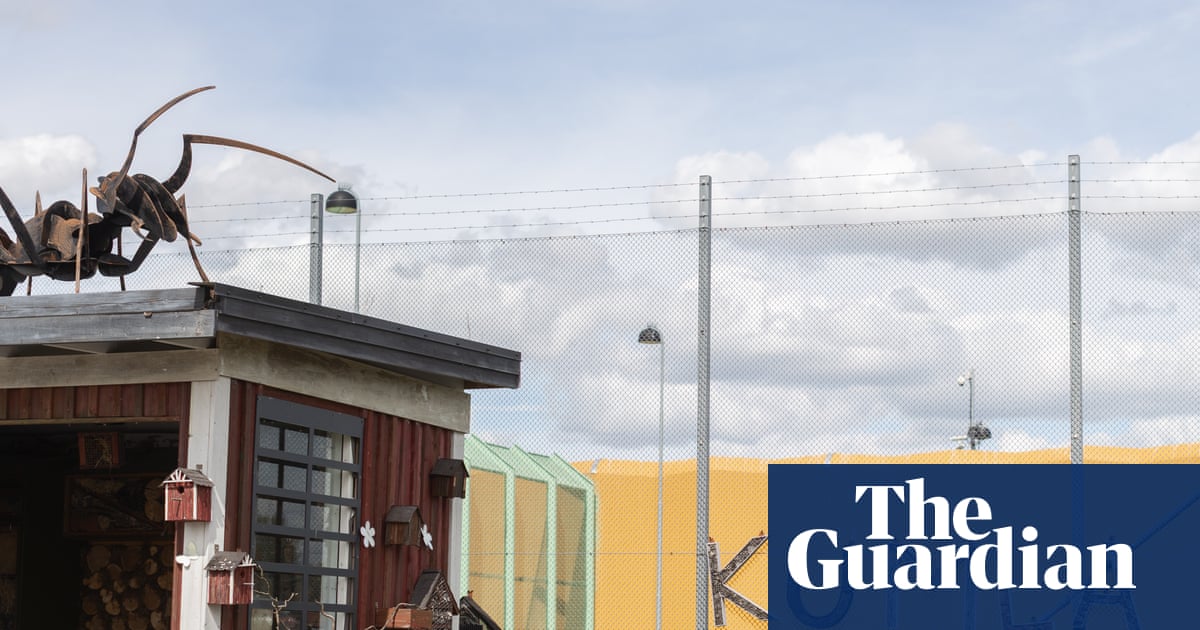
Inside H block, staff at Sweden’s largest jail are preparing for the arrival of the first child prisoners in the institution’s 60-year history. New furniture has been ordered, extra beds have been removed from what were previously double-occupancy adult cells and classrooms are under construction. There are plans to repaint the walls from red to a shade of light green.
In a matter of weeks, Kumla, a high-security prison on the edge of a small town in central Sweden, is expected to start receiving boys as young as 13. The Swedish parliament has already voted through plans for 15- to 17-year-olds convicted of serious crimes to serve their sentences in prison, which will come into force in July. And in June, it is expected to also vote to lower the criminal age of responsibility from 15 to 13 for crimescarrying a minimum sentence of four years’ imprisonment.
Sweden faces “an emergency situation that we need to manage”, the justice minister, Gunnar Strömmer, said, referring to the gang violence that has flared up across the Nordic country in the past decade, with criminal networks active in drug dealing, large-scale fraud and robbery.
Like most experts consulted on the plan, the Kumla prison chief, Jacques Mwepu, is against putting children in prison. But now he and other critics have been overruled and the government is going ahead, he wants to “do as much as we can” to help them feel comfortable.
“Here it should look just like a home environment,” Mwepu said on a tour of the new facilities, over the sound of whirring power tools.
Currently, under-18s in Sweden serve sentences for serious crimes such as murder, rape, kidnap and weapons offences largely in secure care homes run by the Swedish National Board of Institutional Care (Statens institutionsstyrelse, or SiS). The homes have come in for heavy criticism for their security and management.
The changes, which will come into effect as politicians go into campaign mode before the general election in September, are part of a wider push by Ulf Kristersson’s centre-right minority-run coalition government to take action on gang crime.
Fatal shootings appear to have fallen, with five in the first quarter of this year. But experts say gangs are grooming increasingly young and vulnerable children to commit violent crime for money.
The prison population has almost doubled in the past decade, and Sweden has gone from closing prisons to building them, largely as a result of increased sentences. There are plans to expand prison places from 12,000 today to 19,500 by 2035.
According to Council of Europe figures, the average age of Sweden’s population in penal institutions last year was 34 – among the lowest in the continent.
The decision to incarcerate children, which marks the biggest change to the Swedish justice system in decades, has been condemned by researchers, lawyers and NGOs including Unicef and Save the Children. The Swedish prison and probation service has also warned of potentially negative consequences.
The move represents a big shift in Swedish society, which has long prided itself on being a leader for children’s rights and is often held up for its humane approach to criminal justice. Opponents have decried it as a kneejerk, ill-considered response to crime, driven largely by the pressure exerted on the government by the far-right Sweden Democrats, upon whose support the Kristersson cabinet relies.
The UN convention on the rights of the child and the EU’s Agency for Fundamental Rights (FRA) stipulate that child imprisonment should only be used as a “last resort”, while the UN says children who are detained should be treated “in a manner which takes into account the needs of persons of his or her age”.
Li Melander, a children’s rights lawyer for Unicef Sweden, said it was a “very big setback for children’s rights”.
Peter Helenius, the head at Eknäs SiS home in north-east of Kumla, said the decision to place children in prisons was purely a “political decision”. Thirteen-year-olds, he said, “have no place in a prison”, and added: “Science says a 13-year-old’s brain is not developed in such a way that they can take responsibility in the same way as an adult.”
It was also unlikely to work as a deterrent, he said, because that age group did not yet have the capacity to consider the consequences of their actions.
Children at Kumla will be locked up separately from the rest of the prison population, in individual 11 sq metre cells containing a shower, toilet, desk and TV. There is a small gym on the corridor and at the entrance is a dayroom and kitchen area. Unlike the adults, who work in the prison laundry, children will be required to go to school in classrooms being built upstairs, as well as to structured activities and treatment. Each unit has capacity for eight children, with the potential to expand to 32 places overall if they reduce the prison’s adult population.
However, like many Swedish prisons, Kumla is already stretched. Since 2020 the prison’s population has almost doubled, from 432 to 757, meaning that many of the prisoners are now in double cells.
Compared with the existing SiS system, Kumla would implement “much more boundary setting”, said Mwepu, and place more demands and conditions on child offenders. Staff would work with them on small behaviour changes, he said, in an attempt to stop children from “thinking criminally”.
What was often missing from public debate, he said, was that children caught up in crime were often victims as well as perpetrators. “There are two dimensions to those children. That complicates the handling of them. Many of them are victims of big criminals who exploit them,” he added. “They have gone through a lot, pressures, risk of death if they don’t do what they should do, they have been abused sometimes, there has been trauma.”
This went against the popular belief of who a victim could be, said Mwepu, which was usually “somebody who is well behaved and who has been attacked”.
A recent report by the Swedish National Council for Crime Prevention (Brå) found that nine in 10 children under the age of 15 who were investigated for serious crimes were already known to social services and close to half had a previous psychiatric diagnosis. Interventions needed to be made much earlier in life, it said.
The justice minister, Strömmer, who has twice visited Kumla, acknowledged that some children might be victims as well as perpetrators, but also suggested that some children sought out criminal gangs.
The SiS system had “seriously failed with children who commit serious crimes”, he said, referencing statistics showing that 90% of those with connections to gangs returned to serious crime.
If he were asked for recommendations by the minister, Mwepu says he would advise against putting 13-year-olds in prison at all and instead look at alternatives. But now it is on the verge of happening, he is resigned to it.
“I say it is not a good idea but what I am saying now has no meaning. Now that it has been decided we must make sure that they have as good conditions as possible,” he said. “It is very important for society that we succeed with this.”
Source: https://www.theguardian.com/world/2026/jun/06/sweden-prisons-children-gang-crime
About the Author