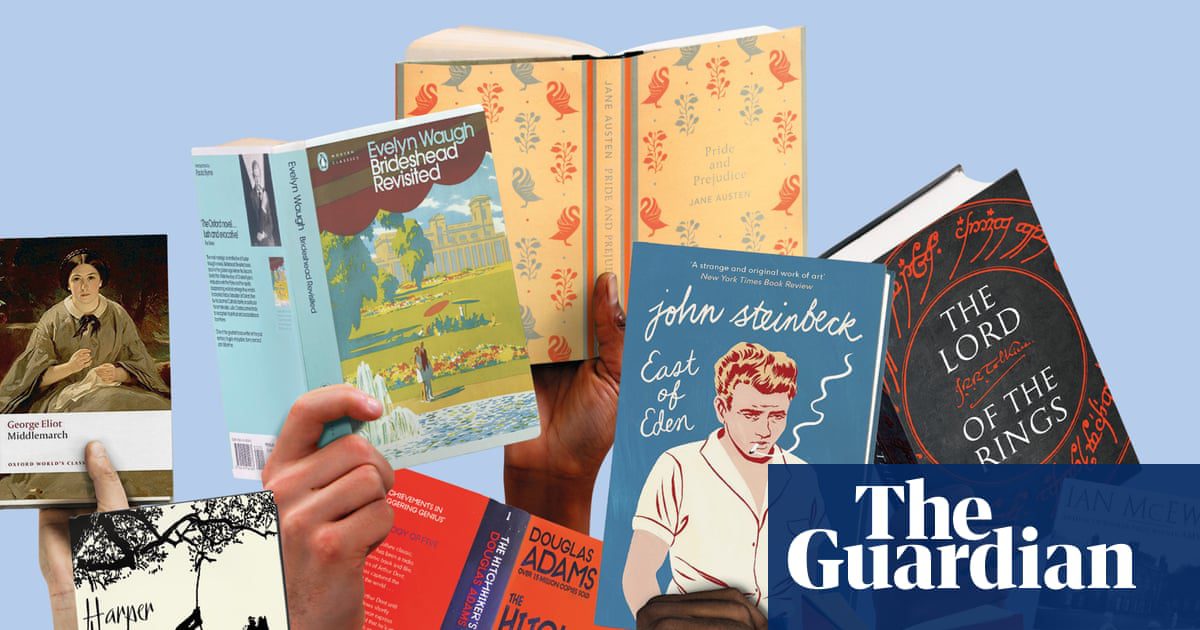
The hobbits have it: topping the chart of what Guardian readers declare the 100 greatest novels published in English is a work of literature that didn’t even feature when authors, critics and academics made their selection. JRR Tolkien’s The Lord of the Rings is, strictly speaking, a trilogy, although that was by no means fixed during the work’s bumpy journey towards publication in 1954, as author and publisher wrangled over how best to present it. It was composed over the course of many years, and although it was written in English, and in prose, the influence of other languages, storytelling traditions and poetic forms are key to its achievement.
It was chosen by readers from Uruguay to the Isle of Skye, Albuquerque to Sydney. Andrea Clark in Courtland, Alabama, voted for it because: “It has profound meaning about the importance of life, sacrifice, the natural world, corruption of power, the evils of war, generosity of spirit – and a lot more. I don’t know of any novel that is reread so often by so many as this one. It connects with all sorts of people on a very fundamental level.”
She’s not wrong. It was a hit with voters old and young; from a retired primatologist in New Mexico to a farmer in Hawaii and a violinist in Cardiff. Casting her vote from Paris, Geri writes: “When living in London, English became my beloved second language, osmotically ‘absorbed’ through The Lord of the Rings. Every evening after work I read page after page and was submerged in words, poems, descriptions of a world that still persists in my memory. I read the book again every few years, and the magic of it always pervades me. Not so much the epic battles, the heroes, but the quiet descriptions of everyday life, a beer quaffed, Gandalf making smoke rings.”
How has a fantastical tale of imagined worlds, epic battles and constant quests achieved such cultural ubiquity? One might argue that all those borrowings from ancient myth provoke a deep form of recognition in us – that we are primed to enjoy the story of a long and dangerous journey undertaken to vanquish the forces of darkness. And there is, too, the hold of childhood; many will have entered Middle-earth during their formative years as readers, when the immense length and gripping complexity felt like a secret to be treasured, a reward for literary ambition. Michael, a doctor in London, writes: “In my teens I wanted to be transported to Middle-earth to join the Fellowship … and still do.”
The presence of Harper Lee, JD Salinger, Ernest Hemingway and John Steinbeck may also point to the pull of the novels we encountered at the start of our lives as readers. Watership Down, first published in 1972, and Richard Adams’s debut novel, is perhaps the clearest case in point.
Though if we were to be guided by the sheer love of readers for their favourite authors, we would surely have seen a place for Terry Pratchett, as we do for Douglas Adams with The Hitchhiker’s Guide to the Galaxy.
Adaptation is another driver to widespread popularity: as well as Tolkien, it powers the enduring popularity of Jane Austen, readers’ most nominated writer overall, even if Emma slipped behind a host of modern novels, including Donna Tartt’s The Secret History, Ian McEwan’s Atonement and Blood Meridian – your preferred Cormac McCarthy novel at No 28 (although The Road still ranks at 80). And perhaps the timing of film releases also provides a clue as to why Emily Brontë’s Wuthering Heights places above her sister Charlotte’s Jane Eyre. Although when it came to Thomas Pynchon, readers opted for Gravity’s Rainbow, rather than Vineland, the inspiration for Paul Thomas Anderson’s film One Battle After Another.
Pynchon at least made the cut: staggeringly, there was no recognition, by either critics or readers, for work by any of the male titans of recent American literature – no Bellow, no Roth, no Updike, no DeLillo. There is the question of the waxing and waning of reputation and the speed with which literary fashion forms and reforms; 10 years ago, perhaps all these writers would have been represented. Larry McMurtry’s Lonesome Dove and Stoner by John Williams have both enjoyed renewed popularity in recent years and appear here. But there is a curious blankness around some English novelists who were once central to our cultural lives – no Iris Murdoch, or CP Snow, or Angus Wilson.
And yet the hold of canonical Victorian literature remains strong, even if the literary foundations on which it was built – works by Defoe and Richardson, for example – have yielded ground to Laurence Sterne, Mary Shelley and Austen. It took Tolkien to dislodge George Eliot from the top spot, but Middlemarch’s consistent showing in this and similar enterprises owes much to its fans’ unshakeable belief that it remains unchallenged as the best novel ever written; Eliot’s other novels don’t attract the same devotion, distinguishing her from the more evenly distributed attachment readers feel for the work of Dickens, Hardy and, in the 20th century, Virginia Woolf. On this last author, you were markedly less convinced than were our authors and critics.
Victorian literature certainly has what one reader, getting in touch after the critics’ list was published, called the “thud factor”; “By the time life affords me the hours to tackle these heavyweights,” wrote Dr James Taylor, “I fear I will have lost the requisite upper‑body strength.” Dr Taylor, we hear you, and sympathise; in this predicament, perhaps ebooks are our friend.
Another reader was particularly struck by the absence of lightness on the original list. “Why does ‘best’ often equate to misery?” asked Sarah Steiner, citing by way of example Bleak House and Jude the Obscure. And it’s true that while “lightness” doesn’t simply mean “jokes”, one of the funniest books of all time, The Secret Diary of Adrian Mole, Aged 13 ¾, by the late, lamented Sue Townsend, made neither the original list nor yours. Also overlooked on both lists were PG Wodehouse, Nancy Mitford, Jerome K Jerome, Jilly Cooper, Helen Fielding and Damon Runyan. No shade to Stendhal, but would you really rather spend an afternoon in the company of Julien Sorel than Harry the Horse? Neither Amis père or fils made it in. No Michael Frayn or Nora Ephron for her only novel, Heartburn.
However, Guardian readers did exercise their power to effect a serious bit of leapfrogging: Joseph Heller’s Catch-22 – a sobering and savage novel of war but also filled with farce and wordplay – just squeaked into the first list. By your reckoning, it is the eighth best novel (jointly with One Hundred Years of Solitude). In fact, you rate it more highly than Ulysses, Anna Karenina or The Great Gatsby. And you also rectified another sin of omission: David Foster Wallace’s Infinite Jest, absent from the first list, now sits in 31st position, sharing its ranking with The Master and Margarita, The Poisonwood Bible and The Remains of the Day, an eclectic quartet by anyone’s definition. Following immediately behind them is another new entry, John Kennedy Toole’s A Confederacy of Dunces – famously, a novel that remained unpublished during its author’s anguished lifetime, but one whose protagonist, Ignatius J Reilly, is one of 20th-century literature’s great comic creations.
Humour is not only subjective, but also a matter of perception, and of reputation. Many books are wreathed in an aura of seriousness that banishes any thought that they might also amuse or divert. But Middlemarch is funny, as another correspondent pointed out. Here’s Mrs Cadwallader on Dorothea’s engagement to Edward Casaubon: “She says, he is a great soul. –A great bladder for dried peas to rattle in!” And here’s Eliot on feckless Fred: “That he should ever fall into a thoroughly unpleasant position – wear trousers shrunk with washing, eat cold mutton, have to walk for want of a horse, or to ‘duck under’ in any sort of way – was an absurdity irreconcilable with those cheerful intuitions implanted in him by nature.” Fine: it’s not the Marx brothers, but still.
We will all cleave to our favourites. This is not the time for me to relitigate the scandalous omission of some of the novels in my own top 10, and yet I must: no space for Italo Calvino’s If on a Winter’s Night a Traveller, have you all taken leave of your senses? You voted for Possession plentifully, and why not, but to ignore AS Byatt’s most affecting novel, Still Life, which forms part of her magnificent Frederica Potter quartet?
Ultimately, even the longest list will prompt thoughts of what we might have included had we been making our selection on a different day, in a different mood. Even a top thousand would result in regret, because the greatest thing about books is that there are an awful lot of them; too many to read in a single lifetime, too wildly various to contemplate in a single frame of mind. Called on to isolate what they think of as the best, readers often feel a flicker of panic – how to whittle it down? – followed by the deep pleasure of contemplating all this evidence of roiling creativity and imagination. We know that the world won’t leave us in peace long enough to read everything we want to – but that doesn’t deter us from the attempt. If lists such as these can never be complete, nor perfect, then they at least remind us that we’ll never run out of reading material.
To buy any of the readers’ top 100 novels, visit guardianbookshop.com. Delivery charges may apply.
Source: https://www.theguardian.com/books/2026/jun/06/move-over-middlemarch-readers-top-100-novels
About the Author