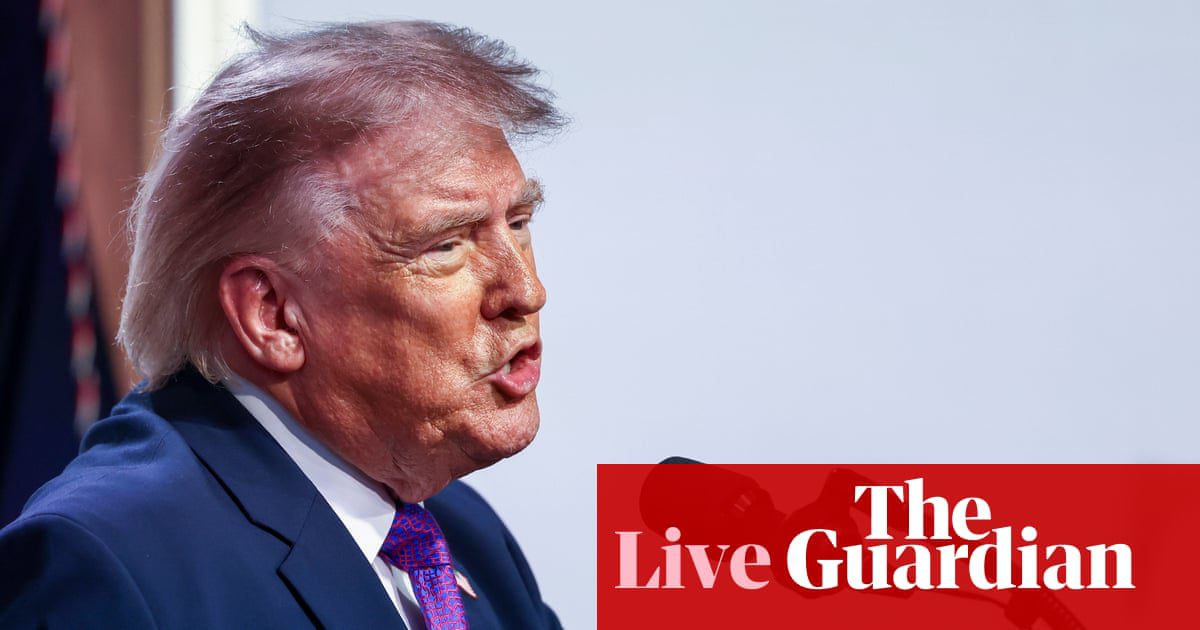
Trump says US may need to hit Iran again
US president Donald Trump said on Tuesday that the United States may need to hit Iran again and he was only an hour away from deciding on a strike before he postponed the attack.
“I was an hour away from making the decision to go today,” Trump told reporters at the White House.
He also said Iran’s leaders are begging to make a deal.
Key events
The day so far
-
US president Donald Trump said on Tuesday that the United States may need to hit Iran again and he was only an hour away from deciding on a strike before he postponed the attack. “I was an hour away from making the decision to go today,” Trump told reporters at the White House.
-
Trump told reporters he is giving Iran until the weekend to make a deal to end the war. He said he was within an hour of deciding to resume bombing the Middle Eastern country but that his negotiators had reported progress in talks.
-
Iran’s army has warned it would “open new fronts” against the US if it resumes attacks on the country amid reports that Donald Trump is weighing up restarting military operations in Iran amid an impasse in negotiations. “If the enemy is foolish enough to fall into the Zionist trap again and launches new aggression against our beloved Iran, we will open new fronts against it, with new equipment and new methods,” army spokesperson Mohammad Akraminia said, according to Iran’s ISNA news agency.
-
The United States has imposed new sanctions on Iran, a posting on the US Treasury department’s website showed on Tuesday. The list published includes 12 new individuals, a host of companies and several shipping vessels.
-
Top Nato commander Alexus Grynkewich said on Tuesday that a potential mission of the military alliance in the strait of Hormuz would be a political decision. “The conditions under which Nato would consider operating in the strait of Hormuz are ultimately a political decision,” Grynkewich said, speaking in Brussels where he met with military chiefs from Nato countries.
-
In an update carried by the country’s National News Agency, the Lebanese health ministry said since 2 March Israeli attacks have killed at least 3,042 people and injured 9,301 others. As a reminder, the renewed Israeli assault on Lebanon was launched as a response to Hezbollah firing missiles at Israel on 2 March after the US-Israeli bombing of Iran in late February.
-
British Airways (BA) has delayed resuming flights to Dubai, Doha and Tel Aviv by a month to 1 August as departures continue to be disrupted by the joint Israeli and US war on Iran. “Due to the ongoing situation in the Middle East, we have made further changes to our flying schedule to provide greater clarity for our customers,” a spokesperson for British Airways told the Reuters news agency when approached for comment.
-
The United Arab Emirates said on Tuesday that the drones that targeted its nuclear plant last week came from Iraq – from where Iranian-backed groups have launched several attacks since the Middle East war began. “As part of the ongoing investigation into the blatant attack on the Barakah Nuclear Power Plant on May 17, 2026, technical tracking and monitoring confirmed that the three drones… all originated from Iraqi territory,” the Emirati defence ministry said.
-
Bezalel Smotrich, Israel’s far-right finance minister, has revealed he was informed that the international criminal court (ICC) in The Hague requested an arrest warrant against him. “Issuing arrest warrants against the prime minister, the defense minister and the finance minister is a declaration of war – and in the face of a declaration of war, we will respond in kind,” Smotrich said, according to comments carried in Israeli newspaper Hareetz.
-
Gaza’s health ministry said in its latest update that two people were killed and three others injured in Israeli attacks across the territory over the past day despite the supposed ceasefire between Israel and Hamas. One other person – who was already injured from an Israeli attack – was pronounced dead over the same period, the ministry added.

Dan Sabbagh
A drone strike that cut off external power to a nuclear reactor in the United Arab Emirates this week has revived concerns over the safety of nuclear plants during wartime.
Reactor no 3 at the Barakah nuclear plant lost off-site power, which is critical for its own functioning, for about 24 hours after the attack on Sunday, forcing it to rely on emergency diesel generators.
Iran, or one of its regional proxies, is likely to have been behind the strike. One of three drones got through from the west, causing a fire close to a four-reactor plant that supplies the UAE with quarter of its electricity.
The UAE said the strike hit an electrical generator “outside the inner perimeter”, raising fears it could have hit the switch yard which lies just beyond a wall around the site’s reactors.
It is the first time a fully operating nuclear power plant has had to rely on backup generators as a result of a military attack, at a time when reactors in Ukraine and Iran are also threatened by war.
Top Nato commander Alexus Grynkewich said on Tuesday that a potential mission of the military alliance in the strait of Hormuz would be a political decision.
“The conditions under which Nato would consider operating in the strait of Hormuz are ultimately a political decision,” Grynkewich said, speaking in Brussels where he met with military chiefs from Nato countries.
The United Arab Emirates said on Tuesday that the drones that targeted its nuclear plant last week came from Iraq – from where Iranian-backed groups have launched several attacks since the Middle East war began.
“As part of the ongoing investigation into the blatant attack on the Barakah Nuclear Power Plant on May 17, 2026, technical tracking and monitoring confirmed that the three drones… all originated from Iraqi territory,” the Emirati defence ministry said.
There were no reported injuries or radiological release at Barakah after the attack, which Emirati officials said hit a generator on the facility’s perimeter.
US president Donald Trump has told reporters he is giving Iran until the weekend to make a deal to end the war.
He said he was within an hour of deciding to resume bombing the Middle Eastern country but that his negotiators had reported progress in talks.
Trump said:
I never tell anybody when. But they knew that we were very close. I would say we were. I was an hour away from making the decision to go today, and we would probably not be talking about a beautiful ballroom today. We’d be talking about that.
I had made the decision, so they called up. They had heard I made the decision. They said, sir, could you give us a couple of more days because we think they’re being reasonable.
He added:
Well, I mean, I’m saying 2 or 3 days, maybe Friday, Saturday, Sunday something. Maybe early next week, a limited period of time, because we can’t let them have a new nuclear weapon.
Trump says US may need to hit Iran again
US president Donald Trump said on Tuesday that the United States may need to hit Iran again and he was only an hour away from deciding on a strike before he postponed the attack.
“I was an hour away from making the decision to go today,” Trump told reporters at the White House.
He also said Iran’s leaders are begging to make a deal.
The United States has imposed new sanctions on Iran, a posting on the US Treasury department’s website showed on Tuesday.
The list published includes 12 new individuals, a host of companies and several shipping vessels.
In an update carried by the country’s National News Agency, the Lebanese health ministry said since 2 March Israeli attacks have killed at least 3,042 people and injured 9,301 others.
As a reminder, the renewed Israeli assault on Lebanon was launched as a response to Hezbollah firing missiles at Israel on 2 March after the US-Israeli bombing of Iran in late February.
British Airways (BA) has delayed resuming flights to Dubai, Doha and Tel Aviv by a month to 1 August as departures continue to be disrupted by the joint Israeli and US war on Iran.
“Due to the ongoing situation in the Middle East, we have made further changes to our flying schedule to provide greater clarity for our customers,” a spokesperson for British Airways told the Reuters news agency when approached for comment.
“We’re keeping the situation under constant review and are directly in touch with affected customers to offer them a range of options.”
BA said last month that it planned to reduce flights to the Middle East when services resume, while permanently dropping Jeddah – known as Saudi Arabia’s second city – as a destination. The carrier also plans to reduce services to Dubai, Doha, Riyadh and Tel Aviv to one daily flight.
As well as flight scheduling disruptions, there are rising fears that the oil crisis resulting from the blockade of Gulf tanker shipping in the strait of Hormuz could lead to fuel shortages this summer and higher ticket prices.
A mysterious attack on an Iranian oil refinery during the Iran war caused an oil spill that affected a nearby Persian Gulf island that’s a protected breeding ground for wildlife, videos and satellite photos show, AP reported.
The oil-soaked waves lapping onto Shidvar Island, an uninhabited island, represent yet another sign of the ecological damage wrought by the war. Oily rain has also fallen on the Iranian capital, Tehran, after airstrikes targeted oil facilities there . Iranian attacks on ships passing through the Persian Gulf, the strait of Hormuz and the Gulf of Oman also caused environmental damage.
Mobile phone footage shot 9 April by an Iranian named Ehsan Jalali shows thick black smoke rising after the strike on an oil refinery on Lavan, an island just off mainland Iran near Shidvar.
The footage corresponds with known features of both islands and only was posted by Jalali to Instagram in the last few days as Iran’s theocratic government has shut off access to the wider internet for weeks.
Iranian authorities held mass public weddings in Tehran for couples who signed up to a state-sponsored scheme declaring their readiness to sacrifice their lives in the war against the US and Israel.
The ceremonies conducted late on Monday involved hundreds of couples in several major squares in the capital, including more than 100 in the vast Imam Hossein square in central Tehran, according to reports in Iranian media.
They were broadcast on state TV in a bid to boost wartime morale, with US president Donald Trump repeatedly threatening new military action against Iran amid a shaky ceasefire which halted the fighting that began on 28 February.
World ‘sleepwalking into global food crisis’ because of closure of strait of Hormuz, UK foreign secretary warns

Andrew Sparrow
Over in the UK, Yvette Cooper, the foreign secretary, has said that the world is “sleepwalking into a global food crisis” because of the ongoing disruption to shipping going through the strait of Hormuz. Gulf states are major global providers of fertilisers and, in a speech to the Global Partnerships conference, Cooper highlighted World Food Programme figures saying that “almost 45 million more people could fall into acute food insecurity if the [Iran] conflict does not end by the middle of this year”.
She said:
The world is sleepwalking into a global food crisis. We cannot risk tens of millions of people going hungry because one country has hijacked an international shipping lane. Iran’s continued closure of the strait of Hormuz while the agriculture clock is ticking shows why we need urgent global pressure to get the Strait reopened, fertiliser and fuel moving and ease the costs of living pressures. That is why we will continue to lead calls for the immediate and unrestricted opening of the Strait and advance plans for the strait of Hormuz Multinational Mission to support any agreement.
This crisis is affecting developed and developing countries, the private and public sectors alike. It shows why we need a new approach to global partnerships, to drive international development to prevent crises in the first place.
Qatar’s foreign ministry spokesperson Majed al-Ansari has been speaking at a press conference. Here are some of the main takeaways from what he said:
-
US-Iran negotiations, mediated by Pakistan, require more time to reach a deal.
-
No country has the right to “hinder” access to the strait of Hormuz.
-
Doha is in (regular) contact with Washington and Tehran.
-
“Iran has chosen to attack Qatar, and this is a threat to the relations between both countries,” Al Jazeera quoted the spokesperson as having said.
-
“We want to protect the people of the region from being basically the main losers of any escalation in the region,” al-Ansari added.
Source: https://www.theguardian.com/world/live/2026/may/19/us-israel-iran-war-trump-peace-attacks-gulf-allies-strikes-hormuz-latest-news-updates
About the Author