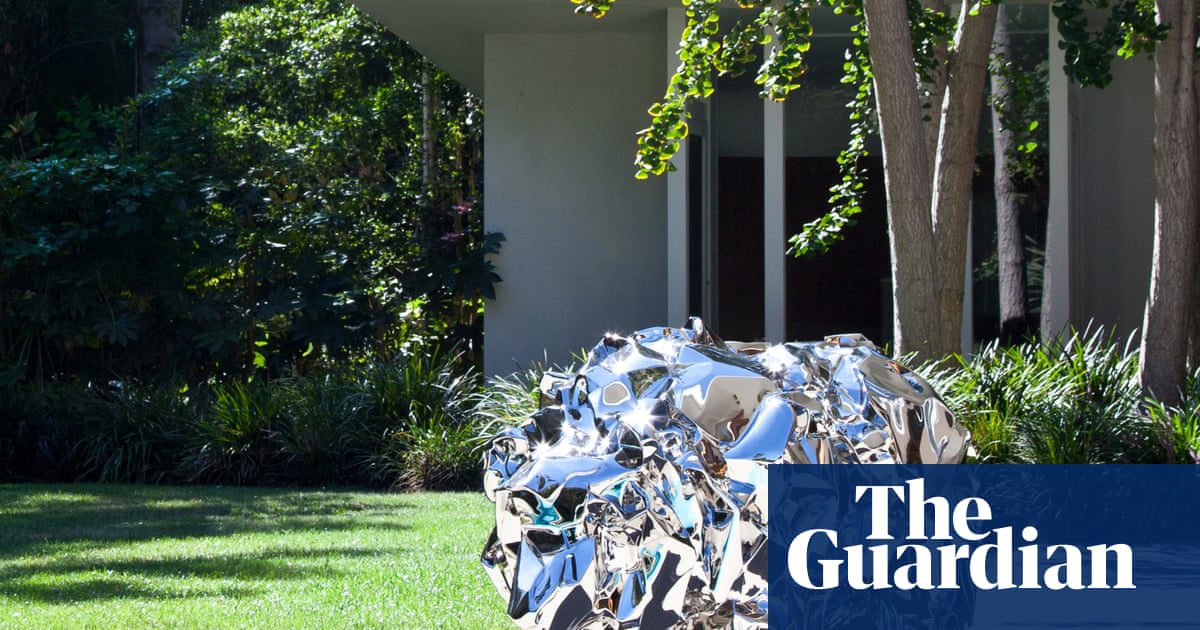
Although Frank Gehry is best known as a world famous architect with iconic creations such as the Walt Disney Concert Hall, he also made art pieces. Springing out of his fascination with the fluidity of animal forms and creative properties inherent to various substances, Gehry created works including fish, bears, crocodiles, and snakes.
As a celebration of Gehry, who died in 2025 at age 96, Gagosian now offers a suite of his non-architectural work, built mainly around the artist’s graceful play with the forms of fish. Simply titled Frank Gehry, it offers moments of beauty and whimsy in the gallery’s Beverly Hills space.
“As soon as I processed Frank’s passing I wanted to do an exhibition that was still in this moment,” said Deborah McLeod, a personal friend of Gehry’s who has led several shows of his work for Gagosian. “It’s a love letter to Frank Gehry.”
Although Gehry is known for enormous sculptural buildings studded with gigantic pieces of stainless steel twisted at vertiginous angles, these large-scale works share creative inspiration with the much more intimately sized pieces featured at Gagosian. According to McLeod, Gehry believed the shape of a fish to be a “perfect form”, and he drew inspiration from the smooth curves of a fish’s form to make his late architectural masterpieces, starting with the Guggenheim Museum in Bilbao, Spain.
“He said it many times, the fish is the perfect form, and he integrated it into his architecture, of course,” said McLeod. “One sees it starting in the late 80s, and by the year 2000 we have Bilbao – it’s very nautical, very much like the slashing forms of a fish.”
With dozens of fish, a bear, snakes and a nearly 10-foot-long crocodile, Gagosian’s Gehry is a testament to the potential found in the animal kingdom. These pieces are remarkable for how the architect crystallized the characteristic movements of these creatures, effectively channeling the unique kinetic intelligence that makes them so instantly recognizable. According to McLeod, utilizing energetic and emotionally resonant animal forms helped Gehry imbue his architecture with warmth and personality.
“The fish is simple and it’s dynamic,” she said. “It implies movement at once glance, and the movement puts emotion into the architecture. This was Frank’s intention – he wanted you to look at a building and get chills.”
The pieces also play brilliantly with various forms of light. The fish lamps are lit by LED bulbs carefully selected by Gehry, and he positioned each fish’s scales in such a way as to intricately scatter the light, taking on different weights and aspects depending on if they are freestanding, pedestaled or hanging from the walls or ceiling.
“Gehry was always thinking about the art talking to the architecture,” said McLeod. “My favorite is when the light scatters on the wall next to or behind the art work. The gallery will be darkened, and it will be atmospheric and immersive.”
In the exhibition’s other gallery stands Gehry’s 7-ft-long, stainless steel Bear with Us, sporting a posture reminiscent of the brown bear on California’s flag. Gehry’s bear is placed to soak up the sunlight filtering into its gallery, with light dazzling off the piece’s seemingly innumerable facets.
The piece originated with an odd request made of Gehry by one of his patrons. As McLeod recounted it, this individual had seen a bear-shaped award that Gehry had designed, about the size of a loaf of bread. The patron told Gehry: “I love this, I wish this was a full-size sculpture,” so Gehry made it so. Larry Gagosian fell in love with the work and began working with Gehry to plan two separate editions of the bears, four in stainless steel and four in electroplated gold. Because of the exorbitant cost of fabrication, Gagosian is making them as they are purchased.
Bear With Us makes an ideal counterpoint to the fish lamps – the light in its gallery comes from outside the space, scattering around in a light-filled room, while the light in the show’s fish gallery comes from within the art works themselves, projecting outward into an ethereal, darkened space.
Among other things, Gagosian’s Frank Gehry show is a testament to the storied gallery’s career-long relationship with the architect – his first fish lamps were shown at Gagosian’s Los Angeles galleries in the 1984 show Frank Gehry: Unique Lamps, and there have been numerous other shows since. According to McLeod, the lamps became one important point of contact in the career-long relationship between Gehry and his ardent friend and artistic supporter Larry Gagosian.
In order to make his fish lamps, Gehry largely drew on Formica as a construction material, fascinated by how the laminate reminded him of the texture of fish. McLeod recalled that Gehry had an “aha” moment when he broke a piece of Formica in his hands and saw fish scales in the material’s rough edges. “That was the ground zero moment,” said McLeod. “He saw fish scales and I don’t think he ever stopped.”
The show is also a celebration of a creator who was widely known for his kindness and generosity. McLeod noted how Gehry prioritized doing pro bono work in low income communities, as well as his warmth and engagement with the artistic world. “I think he sets the bar high for citizenship, for being love forward,” said McLeod. “He wants you to cry when you see those buildings.”
McLeod hopes that Gagosian’s show will be a gathering place for Gehry’s many friends and fans, helping channel the grief that so many in Los Angeles are still feeling after the architect’s death. “There’s been so much interest for this show, he’s really missed. I hope it’s a great experience for everyone. It’s good to come in and commune with his art and see it presented in a fresh way.”
For McLeod, this intimate, personal show is also a moving tribute to a close friend who she is still mourning six months after his passing. One imagines it will not be the last that she undertakes. “I want his legacy to be vibrant,” she said. “I want him to be here in every way that he can be. I want him to be remembered as the incredibly warm and engaged human being that he was.”
Source: https://www.theguardian.com/artanddesign/2026/may/12/frank-gehry-exhibition-tribute
About the Author