Key events

Hannah Ellis-Petersen
Here’s the full list of members of the Iranian delegation.
-
Mohammad Bagher Ghalibaf, the head of the delegation and the Iranian parliamentary speaker;
-
Seyed Abbas Araghchi, the foreign minister;
-
Reza Amiri Moghadam, the ambassador to Pakistan;
-
Ali Akbar Ahmadian, a member of the Supreme National Security Council of Iran;
-
Ali Bagheri Kani, the deputy to the Supreme National Security Council and former acting foreign minister;
-
Esmael Ahmadi Moghadam, the president of the National Defense university;
-
Mohammad Jafari, the assistant to the secretary of the Supreme National Security Council;
-
Naser Hemati, the governor of Iran’s central bank;
-
Kazim Gharibabadi, a deputy foreign minister;
-
Majid Takht e Ravanchi, a deputy foreign minister;
-
Valiollah Nouri, a deputy foreign minister;
-
Esmail Baghaei, a deputy foreign minister and spokesperson for the Iranian ministry of foreign affairs;
-
Abolfazl Amouei, an Iranian MP;
-
and Mohammad Nabavian, an Iranian MP.
As we wait for the Islamabad talks to commence, the conflict in the Middle East continues as we see in these images from the last 24 hours.
The UK will host a strait of Hormuz meeting next week, bringing together multiple countries aiming to restore free movement of ships through the strait, which has been blockaded by Iran since the beginning of the war and inflicted heavy damage on the global economy.
A British official told AP that the meeting will oppose the idea of tolls being charged for passage through the waterway, as proposed by Iran as part of ceasefire negotiations.
The meeting follows a foreign minister’s call on 2 April involving about 40 countries and a military planning meeting attended by about 30 nations. The UK prime minister, Keir Starmer, said that it is essential to have a “viable plan” to reopen the strait and get the global economy moving.
Photograph: Morteza Nikoubazl/NurPhoto/Shutterstock
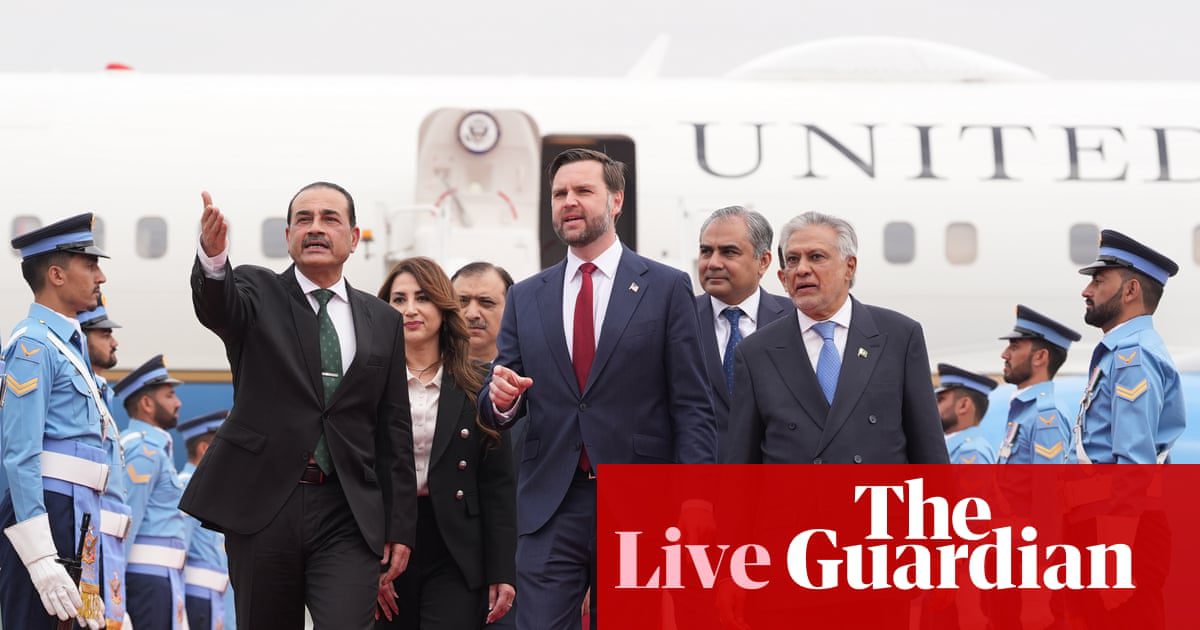
US delegation touches down in Islamabad
A plane carrying the US envoys headed for talks with Iran has touched down in Pakistan’s Islamabad, sources told Reuters.
The delegation is led by the US vice-president, JD Vance, and includes president Donald Trump’s special envoy, Steve Witkoff, and son-in-law, Jared Kushner. The Iranian delegation had already arrived earlier.
About 100 members of an advance US team are already in the city, a Pakistani source told Reuters.
The meeting is the first since the outbreak of the war more than a month ago. Both sides have claimed conditions before the onset of negotiations, with Iran demanding an end to Israeli strikes in Lebanon and the US concerned with nuclear weapons and the fate of transit through the strait of Hormuz.
The Athens-based Marine Traffic said on Friday that only 14 vessels – only half of which were loaded – have crossed the strait of Hormuz since a ceasefire was declared, according to AP.
Vessels exiting the Gulf accounted for 70% of vessels, the group posted on X, with “sanctioned or shadow-fleet-linked vessels account[ing] for nearly two-thirds of all crossings”.
Before the conflict, over 100 ships passed through the strait each day – most with oil outbound to Asia.
US intelligence reports China preparing to send air defence systems to Iran in next few weeks
US intelligence indicates China is preparing to deliver new air defence systems to Iran within the next few weeks, CNN reports, citing three people familiar with recent intelligence assessments, according to Reuters.
The network said Beijing could be routing shipments of shoulder-fired anti-air missiles known as MANPADs through third countries to mask their origin, citing unnamed sources. The US state department, the White House and the Chinese embassy in Washington did not immediately respond to requests for comment from Reuters.
President Trump and Pakistani officials have confirmed that China helped step in to push Iran to accept a tentative ceasefire. But while the Chinese government says it backs the ceasefire, it has not to date tried to claim any diplomatic credit as a security guarantor, with a spokesperson for the Chinese embassy in Washington merely saying “as a responsible major power, China will continue to play a constructive role and make efforts to de-escalate tensions”.
Lebanon’s health ministry say the provisional death toll from Israeli strikes on Wednesday had risen from 303 to 357, with 1,223 people wounded, AFP reports, with Israel claiming to have killed 180 militants in those attacks. The Israeli military say Hezbollah had fired around 30 projectiles into Israel and claims to have “dismantled” more than 4,300 Hezbollah sites in Lebanon since fighting began.
Digital monitor Netblocks says Iran’s internet blackout has lasted over a thousand hours, AFP reports.
While Iran’s domestic intranet remains operational, access to the global internet has been restricted since February.
“It is the Israeli public that holds Netanyahu’s fate in its hands,” writes Jonathan Freedland, writing on the role of the Israeli PM in the current Middle East tensions.
“What record will he be able to present to that domestic electorate, the one that judges him by his own lights? … Netanyahu-ism has gained nothing, and it has come at a monstrously high price.”
Read more of his analysis below:
In Islamabad, mutual mistrust remained the order of the day, Agence France-Presse reports.
“We have good intentions but we do not trust,” Iranian state TV quoted the head of the Iranian delegation, parliamentary speaker Mohammad-Bagher Ghalibaf, as saying upon his arrival. “ Our experience in negotiating with the Americans has always been met with failure and broken promises”.
JD Vance, the US vice-president and head of their delegation, was equally wary. “If [the Iranians are] going to try and play us, they’re going to find the negotiating team is not that receptive,” he told reporters.
Donald Trump has said his top priority is to ensure the Islamic republic cannot have a nuclear weapon – “That’s 99% of it” – but stopping the continuing Israeli strikes on Lebanon, a key demand from Iran as a condition of the truce, as well as the precise terms for allowing shipping traffic through the blockaded strait of Hormuz will also play a key part.
The Iranian side say negotiations cannot begin without commitments on Lebanon and on unblocking Iranian assets seized as part of sanctions. Israel and the US’s position is that that Lebanon is not part of the ceasefire.
Trump, posting on social media, said “The Iranians don’t seem to realize they have no cards, other than a short term extortion of the World by using International Waterways. They only reason they are alive today is to negotiate!”
Pakistan’s prime minister Shehbaz Sharif says making progress will be hard work. “This is the stage which, in English, is called the equivalent of ‘make or break’,” he said.
In Islamabad, all routes leading to the Serena hotel, which is hosting the talks, were blocked off with heavy security, with banners and signs along the expressway heralding the “Islamabad Talks”. But in Tehran, a 30-year-old local told AFP he was skeptical negotiations would be successful, describing most of what Trump says as “pure noise and nonsense”.
Islamabad continues to prepare for the upcoming ceasefire talks and the arrivals of delegates in Pakistan’s capital. Here are some new images coming into the newsroom today.
Opening summary
Hello, and welcome to our live coverage of events in the Middle East with talks between Iranian and US officials scheduled to begin in Islamabad in just a matter of hours.
Stay tuned here for all the updates. If you are just joining us, below is a quick recap of the latest news
-
Iran’s delegation has arrived in Islamabad ahead of high-stakes talks with the United States on Saturday, which the Pakistani prime minister described as “make or break” for achieving a permanent ceasefire. The delegation is headed by Iran’s powerful parliament speaker Mohammad Bagher Ghalibaf, and he is reportedly accompanied by Abbas Araghchi, Iran’s foreign minister, Ali Akbar Ahmadian, secretary of Iran’s defence council, Abdolnaser Hemmati, governor of Iran’s central bank, and several members of the Iranian parliament. Ghalibaf said earlier on Friday that two previously agreed measures – a ceasefire in Lebanon and the release of Iran’s blocked assets – “must be fulfilled before negotiations begin”.
-
US vice-president JD Vance, who is en route to Islamabad, said he was “looking forward to negotiations” and expected them to be positive – though he warned Iran not to “play” the US. He is leading the US delegation and will be accompanied by Donald Trump’s special envoy Steve Witkoff and Trump’s son-in-law Jared Kushner.
-
The planned talks come as Trump threatened fresh strikes if talks fail, adding that the Iranians “have no cards” and the only reason they are alive “is to negotiate”. Trump told the New York Post that the US is loading its warships with the “best weapons” in case talks with Tehran fail. “And if we don’t have a deal, we will be using them and we will be using them very effectively,” he said.
-
Meanwhile, Lebanon and Israel have agreed to meet in Washington on Tuesday to discuss a ceasefire and to set a date to begin talks. The conversation on Tuesday will be mediated by the US and take place at the state department.
-
Lebanon’s health ministry has updated the death toll from Israel’s most brutal strikes on the country in years on Wednesday to 357 killed. It brings the total killed in Lebanon since Israel renewed its offensive on 2 March to more than 1,953 people. The number of people wounded stands at 6,303, the health ministry added.
-
Lebanon’s president, Joseph Aoun, said on Friday that 13 state security personnel were killed in an Israeli strike on a governmental building in the southern city of Nabatieh. In a statement, Aoun condemned continued Israeli attacks and said targeting state institutions would not deter Lebanon from defending its sovereignty.
Source: https://www.theguardian.com/world/live/2026/apr/11/middle-east-crisis-live-iranian-officials-arrive-in-islamabad-for-conditional-peace-talks-with-us
About the Author