Trump attends supreme court birthright citizenship arguments, first sitting president to do so
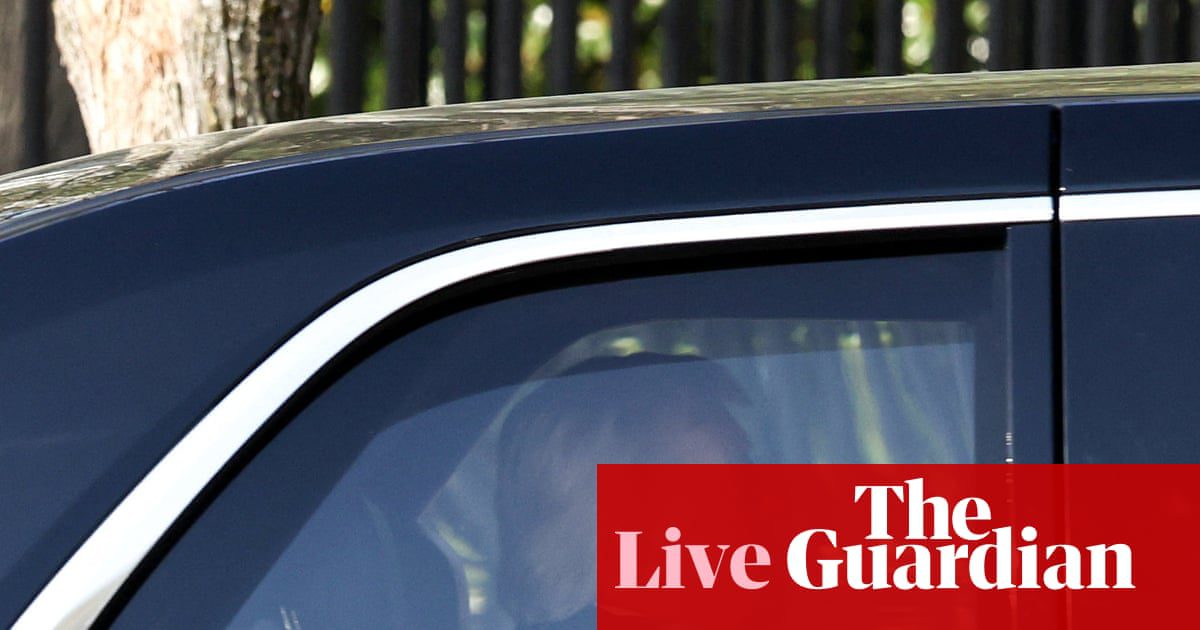
We’re starting to get pictures from outside the US supreme court ahead of oral arguments in Trump v Barbara, which will decide if the administration’s attempts to restrict birthright citizenship are unconstitutional.
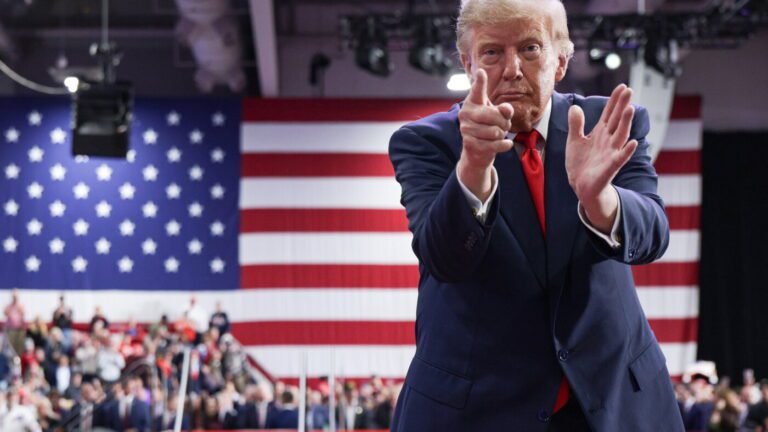
Donald Trump has just arrived, and plans to listen to arguments at the court – the first time a sitting president has attended arguments.


Key events
Joseph Gedeon
Robin Galeraith, who travelled from Maryland to join Tuesday’s demonstration outside the supreme court, was heartened by the size of the crowd gathered to defend birthright citizenship but cautious about what the day’s ruling might bring.
“It’s very nice to see so many people defending the constitution and defending what makes our country great – we are an immigrant nation, and that is why we thrive for so long,” she said.
She dismissed Trump’s appearance at the court as the behavior of someone acting out of fear rather than strength.
Robin stopped short of full confidence in the outcome, voicing concern that the court’s conservative majority had been unduly shaped by wealthy interests. It’s a worry, she said, that cuts to the heart of what kind of nation America is meant to be.
“Unfortunately, our supreme court has kind of been bought and paid for by the super rich,” She said. “And so that’s really concerning, because our nation is not supposed to be a nation of just only rich.”
If you’re listening along to the oral arguments at the supreme court today, you’ll have heard a particular case mentioned frequently – US v Wong Kim Ark.
This is the landmark decision on birthright citizenship, which made clear that a child born to parents of Chinese descent who had permanent “domicile” in the US would be a US citizen at the time of birth under the fourteenth amendment.
The Trump administration is arguing that “domicile”, meaning a permanent residence, is a critical part of the interpretation, despite the word not appearing in the citizenship clause itself.
Justice Elena Kagan said that the rationale of the Wong Kim Ark decision was clear.
“Everybody got citizenship by birth, except for a few discrete categories,” she said. “What the fourteenth amendment did was accept that tradition and not attempt to place any limitations on it. And so that was the clear rationale, a clear rationale that is diametrically different from [the administration’s] rationale.”
Kagan ultimately said that the administration’s “revisionist theory” requires the court to change what “people have thought the rule was for more than a century”.
When it comes to the matter of birth tourism, which Sauer argues is a key side-effect of unrestricted birthright citizenship, the solicitor general contends that “no one knows for sure” how significant a problem it is. He cites a number of media reports about estimates, and a report by congressional Republicans in 2022 which says that changes to state department policies over the last decade have made birth tourism more accessible.
Joseph Gedeon
Outside the supreme court, Carol Rose, executive director of the ACLU of Massachusetts, joined a loud and excitable crowd Wednesday as the case against Trump’s executive order targeting birthright citizenship – filed by the ACLU chapters of Massachusetts, Maine, and New Hampshire alongside the national ACLU – is argued before justices.
The impact of the case even drove Trump to hear today’s arguments at the court –a first for a sitting president.
“Trump wants to make the story be about him, but that’s not what the story is today – the story today is about the constitution and the Bill of Rights,” Rose said.
She added that besides Trump’s in-person appearance at the court, the mood among demonstrators was one of joy and optimism.
Rose said when thinking of the core identity of the US, a nation built by immigrants, there was little doubt about how she expects the day to end.
One key point here, the administration is arguing that since noncitizens who are in the country temporarily aren’t “domiciled” they aren’t pledging “allegiance” to the US, and that subsequently invalidates their children’s claims to citizenship.
However, justice Elena Kagan questioned the solicitor general and asked where this principle comes from, since the language of “domicile” isn’t part of the citizenship clause.
“The text of the clause, I think, does not support you,” Kagan told Sauer. “I think you’re sort of looking for some more technical, esoteric meaning.”
Conservative justice Neil Gorsuch chimed in, following up on Kagan’s line of questioning, and probed Sauer about what qualifies as domicile in 2026, as opposed to 1868, when the fourteenth amendment was ratified.
Sauer pushed back and said that domicile is a “high level concept has been pretty consistent over centuries – which is lawful presence with the intent to remain permanently”.
Oral arguments begin in case challenging Trump’s attempts to restrict birthright citizenship
Oral arguments have begun, and solicitor general D John Sauer is arguing on behalf of the Trump administration. In his opening argument, Sauer notes that the citizenship clause – which the challengers say Trump’s executive order violates –“does not extend citizenship to the children of temporary visa holders or illegal aliens”.
He adds that unsrestricted birthright citizenship “demeans the priceless and profound gift of American citizenship”, and suggests that it operates as “a powerful pull factor for illegal immigration and rewards illegal aliens who not only violate the immigration laws, but also jump in front of those who follow the rules”.
Sauer also argues that the established precedent of birthright citizenship has “spawned a sprawling industry of birth tourism” and created “a whole generation of American citizens abroad with no meaningful ties” to the US.
Trump attends supreme court birthright citizenship arguments, first sitting president to do so
We’re starting to get pictures from outside the US supreme court ahead of oral arguments in Trump v Barbara, which will decide if the administration’s attempts to restrict birthright citizenship are unconstitutional.
Donald Trump has just arrived, and plans to listen to arguments at the court – the first time a sitting president has attended arguments.
Ahead of the oral arguments at the supreme court today on the Trump administration’s attempts to restrict birthright citizenship, it’s worth noting a how the concept of children born on US soil being considered American citizens came to be.
In this particular case – Trump v Barbara – the challengers also argue that the president’s efforts run afoul of the citizenship clause of the fourteenth amendment, which was ratified after the Civil war, to overturn the supreme court’s Dredd Scott decision of 1857. This ruling that stated enslaved people were not citizens of the US, and therefore were not entitled to protection from the federal government.
The Trump administration argues that it’s not trying to gut birthright citizenship at large, but rather return to the original meaning of the citizenship clause, instead of applying to “the children of aliens who are temporarily present in the United States”.
Trump says Iranian regime has asked for ceasefire
On Truth Social, Donald Trump claimed that the president of Iran’s new regime, who he characterized as “much less Radicalized and far more intelligent than his predecessors”, has asked the US for a ceasefire.
However, Trump said he would only consider the offer when the strait of Hormuz is “open, free and, clear”.
Until then, the president said, “we are blasting Iran into oblivion or, as they say, back to the Stone Ages!!!”
You can read the latest updates on the Iran war in our live blog on the Middle East crisis:
A reminder that my colleagues are covering the latest developments out of the Middle East, particularly Donald Trump’s comments to The Telegraph that he is considering pulling the US out of Nato.
“I would say [it’s] beyond reconsideration,” Trump said in an interview. “I was never swayed by Nato. I always knew they were a paper tiger, and Putin knows that too, by the way.”
The president has been levelling insults at allies in recent weeks for not helping to reopen the strait of Hormuz, which has been effectively shut down by Iran as the Middle East war rages on.
As we noted earlier, Donald Trump will be in Washington today. After he attends oral arguments in the blockbuster birthright citizenship case at the supreme court, he’ll be back at the White House for closed door meetings.
We won’t hear from the president again until 9pm ET, when he addresses the nation with “an important update” on the war on Iran.
Ramon Antonio Vargas
A former video editor and field producer for Alex Jones’s Infowars has said his work for the notorious conspiracy theorist was “nonsense” and “lies”, but he kept at it for four years in his 20s because the far-right media company’s founder was a magnetic presence and it earned him good money.
Josh Owens made those revealing remarks in an NPR interview published on Tuesday promoting his new memoir about once having been an employee of Jones and Infowars – a conversation that also detailed the hand he said he had in fabricating a video of an operative of the Islamic State (IS) terror group sneaking into the US from Mexico immediately after a beheading.
“In Jones’s world, it was all about making things look cinematic,” Owens, who left Infowars in 2017, said to NPR. Likening the aesthetic to that seen in pieces by Vice News, he continued: “We would go out there, we would shoot videos … like we were in the weeds, we were showing what was really going on.
“But it was nonsense. It was lies.”
To illustrate the point to the outlet, Owens recounted how Infowars deployed him to El Paso, Texas, after a conservative website alleged that IS had erected a training base right on the other side of the US-Mexico border, specifically in Ciudad Juárez, Chihuahua.
Rachel Leingang
President Trump cannot unilaterally overturn a constitutional amendment; that requires congressional action.
But the administration is arguing not that they’re overturning the amendment, but rather interpreting it according to its intended meaning.
The Trump administration wants the supreme court to reinterpret the amendment and allow the order to be enforced, overriding more than 125 years of legal precedent.
The landmark decision on birthright citizenship, United States v Wong Kim Ark, made clear that a child born to parents of Chinese descent who had permanent “domicile” in the US would be a US citizen at the time of birth under the 14th amendment.
The Trump administration argues “domicile”, meaning a permanent residence, is a critical part of the interpretation, despite the word not appearing in the amendment itself.
“Birthright Citizenship was not meant for people taking vacations to become permanent Citizens of the United States of America, and bringing their families with them, all the time laughing at the ‘SUCKERS’ that we are!” the president wrote on Truth Social last year.
The Supreme Court is expected to rule by the end of June.
The court last year gave Trump an initial victory in the birthright citizenship context in a ruling restricting the power of federal judges to curb presidential policies nationwide.
Though arising from early-stage judicial rulings declaring Trump’s directive unconstitutional, the court’s ruling did not resolve its legality.
The court, which has a 6-3 conservative majority, has backed Trump on other major immigration-related policies since he returned to the presidency.
It let Trump expand mass deportation measures on an interim basis while legal challenges play out, such as ending humanitarian protections for migrants or allowing them to be deported to countries where they have no ties.
The administration has said that granting citizenship to virtually anyone born on US soil has created incentives for illegal immigration and led to “birth tourism,” by which foreigners travel to the United States to give birth and secure citizenship for their children.
An eventual ruling by the supreme court endorsing the administration’s view could affect the legal status of as many as 250,000 babies born each year, according to some estimates, and require the families of millions more to prove the citizenship status of their newborns, Reuters reported.
The 14th amendment was ratified in 1868 in the aftermath of the Civil War of 1861-1865 that ended slavery in the United States, and overturned a notorious 1857 supreme court decision that had declared that people of African descent could never be US citizens. Concord, New Hampshire-based US district judge Joseph Laplante last July let the challenge to Trump’s order by these plaintiffs proceed as a class, allowing the policy to be blocked nationwide.
The challengers have said the supreme court already settled the question of birthright citizenship in an 1898 case called United States v Wong Kim Ark, which recognized that the 14th amendment grants citizenship by birth on US soil, including to the children of foreign nationals.
The administration contends that the 1898 precedent supports Trump’s order because, according to the court’s ruling in that case, at the time of his birth, Wong Kim Ark’s parents had permanent domicile and residence in the United States.
Trump expected to attend supreme court arguments on birthright citizenship
President Donald Trump is expected to watch the US supreme court hear a landmark case today weighing the constitutionality of his contentious bid to end birthright citizenship – an extraordinary and possibly unprecedented move for the nation’s highest office.
Trump signed an executive order on his return to the White House decreeing that children born to parents in the United States illegally or on temporary visas would not automatically become US citizens.
Lower courts blocked the move as unconstitutional, ruling that under the Citizenship Clause of the 14th Amendment nearly everyone born on US soil is an American citizen, AFP reported.
“All persons born or naturalized in the United States, and subject to the jurisdiction thereof, are citizens of the United States,” the amendment states. It does not apply to persons who are not subject to US jurisdiction – foreign diplomats, for example, and sovereign Native American tribes.
“I’m going,” Trump told reporters Tuesday when asked about the supreme court hearing. He had attended the investiture ceremony of his first supreme court justice nominee, Neil Gorsuch, in 2017, months into Trump’s first term.
But it would be an exceptional milestone for a sitting president to be present for oral arguments in a case their administration is actively arguing.
The Trump administration argues that the 14th amendment, passed in the wake of the 1861-1865 Civil War, addresses the rights to citizenship of former slaves and not the children of undocumented migrants or temporary visitors.
Trump’s executive order is premised on the notion that anyone in the United States illegally, or on a visa, is not “subject to the jurisdiction” of the country and therefore excluded from automatic citizenship.
Trump will attend the supreme court hearing from oral arguments from 10am ET today. He is then due to deliver an update on the Iran war in an address to the nation at 9pm ET.
In other developments:
-
Trump signed an executive order seeking to restrict mail-in voting across the US with a series of new requirements, including the establishment of a national voter list.
-
The move was unprecedented and likely unconstitutional, according to experts. The Brennan Center said in response, “He has no lawful authority to write the rules that govern our elections. He tried a year ago; we sued him; we won. A year later, he has tried again. He can expect the same result.”
-
Several states and Democratic officials criticized the order, describing it as an illegal attack that amounted to voter suppression ahead of the midterms, and said they will take legal action to stop the president, including California.
-
Trump continued to fume over today’s ruling from a US judge that halted the construction of his $400m White House ballroom, and sharply criticized the decision during a press briefing and on social media.
-
Pete Hegseth lifted the suspension of the crew of the military helicopters that hovered near the home of singer Kid Rock, and said there would be no investigation.
Source: https://www.theguardian.com/us-news/live/2026/apr/01/donald-trump-supreme-court-birthright-citizenship-case-us-politics-latest-news-updates
About the Author