Morning opening: Let’s talk about Viktor

Jakub Krupa
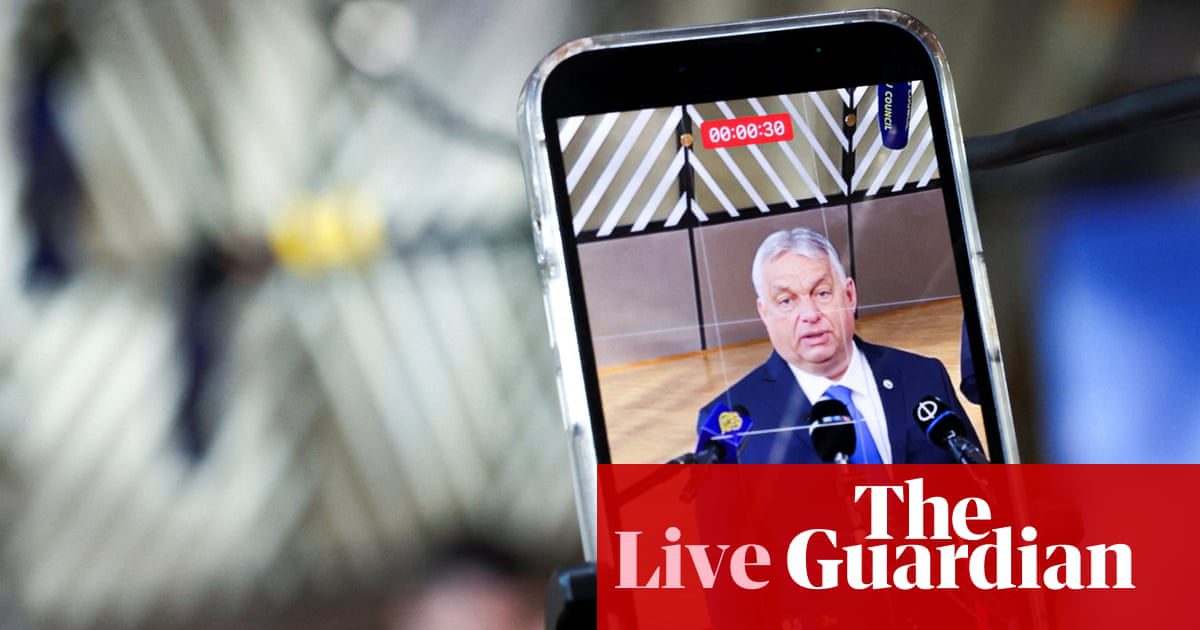
EU leaders are meeting in Brussels this morning for what was meant to be a discussion on the bloc’s competitiveness and economy, but “events, my dear boy, events” mean they will have to focus on Hungary’s ongoing spat with Ukraine and the Middle East instead.

Less than four weeks before a key parliamentary election in Hungary, Viktor Orbán will once again come under pressure to unblock the EU’s €90bn loan to Ukraine, which he is blocking over a dispute about the Druzhba pipeline.
But arriving in Brussels just a few minutes ago, Orbán has made it clear that he is not in a mood to compromise.
He said:
“We would like to get the oil which is ours from the Ukrainians and which is … blocked by the Ukrainians. I will never support any kind of decision here which is in favour of Ukraine [as long as] the Hungarians are not able to get the oil which belong to us.”
Asked if there is any other option to agree a way forward, he said: “No.”
“Sorry, no other option. We need it because it’s existential. What we are speaking about is not politics. It’s existential for Hungary to get the oil. … Without getting that oil, all the households, Hungarian companies will go to bankruptcy.
So you know, it’s not a joke, not a political game. Zelenskyy should understand it that this is not a game. This is absolutely existential for the Hungarians.”
The leaders will also have to discuss the situation in the Middle East amid growing concerns about the impact the conflict will have on Europe, including on energy prices.
Finland’s Petteri Orpo warned that Russia is the only beneficiary of this chaos and rising energy prices, as he urged leaders to step up pressure on Moscow.
He also pointedly criticised Orbán saying “he is using Ukraine as a weapon in his election campaign, and it’s not good.”
Orpo’s comments come just days after Belgium’s prime minister Bart de Wever appeared to suggest that the EU should look to improve its relationship with Moscow to get cheaper energy.
It should be a lively day in Brussels and I will bring you all the latest here.
It’s Thursday, 19 March 2026, it’s Jakub Krupa here, and this is Europe Live.
Good morning.
Key events
European parliament’s trade committee votes to progress EU-US trade deal

Lisa O’Carroll
Meanwhile, the European parliamentary trade committee has voted to progress legislation to ratify last summer’s trade deal with Donald Trump ending months of delays.
It means the deal, which sees 15% tariffs on most exports from the EU, will now go for a full vote at the European parliament.
The 15% tariffs were ruled illegal by the US supreme court but much of the deal relates to tariffs that were imposed under different laws which were not examined by the American judges and still pertain.
These include 15% tariffs on cars and 50% on steel.
In exchange for a deal, the EU agreed to improve access for US agriculture produce and buy $750m worth of energy from the US over three years.
The trade committee had blocked progress earlier this year, freezing talks following Trump’s threat to take control of Greenland.
Its latest vote also came following concessions promissed by the US including a reduction in the list of products that faced 50% tariff for any steel content.
The so-called steel derivatives on everything from knitting needles to wind turbines and aluminium doors were considered a breach of the good faith deal and the EU had consistently been lobbying the US adminstration to remove what they considered tariffs by stealth.
Czech Republic’s Babiš wants to talk competitiveness, ETS, energy impact of Middle East war
Czech Republic’s prime minister Andrej Babiš comes for this morning’s summit with a different focus as he primarily wants to talk competitiveness and reforming the EU Emissions Trading System.
Asked about his views on Viktor Orbán’s block, he says “this is his issue, not mine.”
“I am here to fight for the European industry, and we are losing time,” he says.
He also talks about the impact of the Middle East crisis on Europe, not just on energy prices, but also on fertiliser and ammonia supplies. “Everything is blocked,” he warns.
EU experts arrive in Ukraine to check Druzhba pipeline, Kyiv says
Meanwhile, European Union experts have arrived in Ukraine to assess the condition of the Druzhba oil pipeline, state energy firm Naftogaz said, after its closure caused a row with Hungary that is blocking an EU loan to Kyiv, Reuters reported.
The EU last week proposed sending a mission to inspect the pipeline. Ukraine later said it had accepted the EU offer of technical support and funding to restore oil flows through the damaged pipeline.
Hungary and Slovakia have been cut off from Russian oil deliveries via Druzhba since late January, after Kyiv said a Russian strike hit pipeline equipment in western Ukraine and would require time for repairs.
And Hungary’s Viktor Orbán repeatedly said he would continue to block all decisions in favour of Ukraine until the pipeline gets fixed.
Russia ‘gaining from war in Middle East,’ Kallas says, as she accusses Orbán of not cooperating in good faith
EU foreign policy chief Kaja Kallas has similarly warned that Russia is “gaining from the war in the Middle East,” as she called for ‘an exit from this war, not an escalation.”
On Hungary, she said she was “not very optimistic” that something can be agreed with Viktor Orbán. “There are alternatives,” she said, but added that “it also needs political courage from all of us.”
She also accused Orbán of not cooperating with the EU in good faith, meaning the EU needs to figure out a way to “force the implementation of the agreement we made in December.”
Kallas said other EU leaders and foreign ministers were “very strongly” critical of Hungary and pushing for a solution, but warned that “at the time of elections, people are not that rational” with Orbán facing the biggest test of his 16-year rule next month.
Middle East crisis can take attention away from Ukraine, Lithuania’s Nausėda warns
Lithuanian president Gitanas Nausėda said he worried that “the events in Middle East can overshadow the war in Ukraine,” with the world’s attention shifting to the Middle East.
“I don’t think this is [right], because we are at a very, very critical stage of the war, … with a lot of casualties … and I think we are still far away from any peace deal,” he said.
Nausėda said that Russia continued to stall the talks as it hopes to “occupy as much territory as possible” and is “probably not ready for any kind of compromises.”
“This is the reason why we require to strengthen the sanctions regime. It’s unexplainable, and unfortunately [regretable], that we still doesn’t have the 20th package of sanctions on the table, and we have to complete this as soon as possible,” he said.
He added:
“It’s very difficult to convince Orbán, but it’s regrettable that we are losing so much time and we could proceed much earlier … It is no secret that Ukraine badly needs the €90bn … [as] they are under huge pressure fighting, not only on the battlefield, but also in the economic field.”
Dutch PM Jetten makes EU debut backing Ukraine, warning against Iran impact
The new Dutch prime minister, Rob Jetten, is making his European Council debut this morning.
Asked about Viktor Orbán’s position, Jetten insisted that “it is obvious that Ukraine needs out full support to win this war against the Russian aggression,” as he stressed the EU loan “is crucial to make sure Ukraine can prepare for the next winter.”
He said he expected all leaders to respect decisions made at previous summits, adding he was hopeful that a technical fix to the pipeline could be found quickly “so that this loan can take effect as soon as possible.”
Jetten also spoke about the war in Iran, warning about “higher energy prices, so we have to look how to protect out consumers and companies against big impact of this war.”
On another big issue of this summit, the push to reform the European Union Emissions Trading System, he said he was “willing to look how to improve our climate policies, but … not going to revoke policies that are … crucial to making sure that this continent is greener and stronger in the long term.”
Morning opening: Let’s talk about Viktor
Jakub Krupa
EU leaders are meeting in Brussels this morning for what was meant to be a discussion on the bloc’s competitiveness and economy, but “events, my dear boy, events” mean they will have to focus on Hungary’s ongoing spat with Ukraine and the Middle East instead.
Less than four weeks before a key parliamentary election in Hungary, Viktor Orbán will once again come under pressure to unblock the EU’s €90bn loan to Ukraine, which he is blocking over a dispute about the Druzhba pipeline.
But arriving in Brussels just a few minutes ago, Orbán has made it clear that he is not in a mood to compromise.
He said:
“We would like to get the oil which is ours from the Ukrainians and which is … blocked by the Ukrainians. I will never support any kind of decision here which is in favour of Ukraine [as long as] the Hungarians are not able to get the oil which belong to us.”
Asked if there is any other option to agree a way forward, he said: “No.”
“Sorry, no other option. We need it because it’s existential. What we are speaking about is not politics. It’s existential for Hungary to get the oil. … Without getting that oil, all the households, Hungarian companies will go to bankruptcy.
So you know, it’s not a joke, not a political game. Zelenskyy should understand it that this is not a game. This is absolutely existential for the Hungarians.”
The leaders will also have to discuss the situation in the Middle East amid growing concerns about the impact the conflict will have on Europe, including on energy prices.
Finland’s Petteri Orpo warned that Russia is the only beneficiary of this chaos and rising energy prices, as he urged leaders to step up pressure on Moscow.
He also pointedly criticised Orbán saying “he is using Ukraine as a weapon in his election campaign, and it’s not good.”
Orpo’s comments come just days after Belgium’s prime minister Bart de Wever appeared to suggest that the EU should look to improve its relationship with Moscow to get cheaper energy.
It should be a lively day in Brussels and I will bring you all the latest here.
It’s Thursday, 19 March 2026, it’s Jakub Krupa here, and this is Europe Live.
Good morning.
Source: https://www.theguardian.com/world/live/2026/mar/19/europe-ukraine-russian-eu-loan-orban-hungary-tariffs-iran-nato-latest-news-updates
About the Author