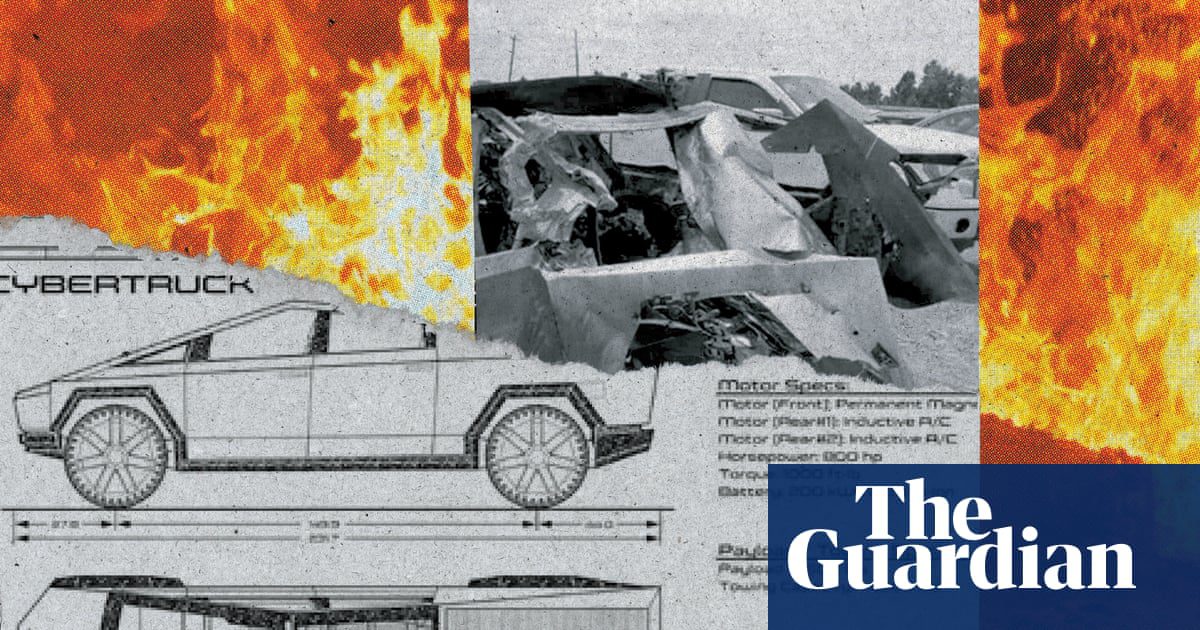
When sheriff deputies arrived at the scene of a late-night crash off a desolate Texas road in August 2024, they could see a giant pyre through heavy smoke.
According to police reports detailing the events of that night, the officers tried to approach the vehicle, but the fire burned too intensely. They saw it was a Tesla Cybertruck and couldn’t see anyone inside. So they combed the surrounding area for the driver.
As flames leapt more than 10ft high, one deputy attempted to use his fire extinguisher to combat the blaze, to no avail. When firefighters arrived, they tapped into a hydrant – but quelling the fire in the electric vehicle took time. The truck’s batteries kept reigniting.
Once the blaze was finally out, officers cautiously inspected the Cybertruck. That’s when they discovered human remains.
“The body inside was severely burnt and was completely unidentifiable,” one officer wrote in his report. “You could see a pelvic spine and ribcage laying across the front two seats, mostly in the passenger seat,” another wrote.
In the aftermath of the fiery scene, officers found paperwork scattered near the vehicle on which was the name Michael Patrick Sheehan. He was a 47-year-old nurse practitioner who had owned the Cybertruck for just three months. As his widow and parents work to uncover what fully happened, a look at other cases bearing the same grim hallmarks might provide clues.
The blaze in Baytown, Texas, was one of five known Cybertruck fires that the Guardian has tracked – a significant amount, considering the vehicle has only sold 60,000 units and debuted just two years ago. These incidents involve four fatalities, including the deaths of three college students in California, and have been the subject of three wrongful death lawsuits against Tesla. In a comprehensive look at fire danger, particularly of Cybertrucks, the Guardian has obtained hundreds of pages of police, fire and autopsy reports and court filings and company manuals, as well as interviewed lawyers and safety experts. They – as well as the families suing Tesla – allege the Cybertruck’s design led to these worst-case scenarios where fires rapidly ignite, the vehicle’s electric door handles won’t unlock and passengers are trapped inside.
“He burned to death at 5,000°F – a fire so hot his bones experienced thermal fracture,” reads the complaint from Sheehan’s family. The lawsuit contends Sheehan could have survived the crash, if he had been able to open the doors and escape the blaze, which flared to temperatures hotter than most cremation ovens. “The crash forces themselves were survivable,” the lawyers wrote.
Fires that entrap passengers are a well-documented and recurring problem with every model in Tesla’s lineup of vehicles, but Cybertrucks appear to have a disproportionate number of known deaths. Safety experts have told the Guardian that the truck’s unique design amplifies the deadly issue. The vehicles come with high-density laminated windows that are harder to break than regular car windows, making escape and rescue difficult when doors won’t unlock. And the trucks are built with materials not commonly used in the industry, like stainless steel, which can complicate the work of emergency responders. The Cybertruck is also the first Tesla model to entirely eliminate door handles on the outside of the vehicle.
The hulking trapezoidal automobiles are a passion project for Tesla’s CEO, Elon Musk. Despite having been subject to 10 recalls, most notably over faulty accelerators that would stick at full throttle, Musk constantly praises the Cybertruck, calling it an “incredible vehicle” and “our best ever from Tesla”. He says the trucks are “apocalypse-proof” and claims they can withstand bullets and have “armor glass” windows.
“Trucks should be manly. They should be macho,” Musk told podcaster Joe Rogan in an October interview. “And bulletproof is maximum macho.”
Michael Brooks, the executive director of the non-profit Center for Auto Safety, sees these traits differently: “A lot of it is this whiz-bang, cool tech features that might look really cool and might sell cars, but it’s like they didn’t do the backup human-factors research … to see how they would function in safety-critical incidents.”
Tesla did not return multiple requests for comment. In court filings, it has denied any wrongdoing and said the Cybertruck is compliant with federal safety standards and the company has satisfied its duty to warn customers about the risks and dangers of using its product.
Thermal runaway
Last April, just before sunrise, firefighters responded to reports of an uncontrolled blaze in a residential neighborhood in Los Angeles. They arrived at a paradoxical scene in which a crumpled Cybertruck engulfed in flames was being showered by a fire hydrant spewing water 50ft into the air. Laying in the water-soaked street was Alijah Arenas, an 18-year-old basketball star for the University of Southern California.
He’d been rescued from inside the burning Cybertruck after passersby worked to peel back one of the truck’s windows and pull him out. Because of severe smoke inhalation, though, Arenas had to be temporarily placed in a medically induced coma.
The basketball player later recounted the crash during a June press conference, saying he was driving home from the gym when the steering wheel became unresponsive. Unable to control the Cybertruck, he careened into the fire hydrant and a tree. Looking back at the camera feed, he said the vehicle caught fire upon impact.
“I wake up in the car after about three minutes,” Arenas said. “I had heard cracking noises like I was at a campfire.”
Arenas said it felt like an overheated sauna, and the passenger-side dashboard was on fire. The smoke was so thick, he couldn’t see outside. He tried opening the doors, but they wouldn’t budge. “I start kind of panicking and rushing to get out,” he said. He passed out once, then woke up. To stay awake, he bit his lips and dug his fingernails into his palms and started kicking a window working to get free. The window was slightly open and he could hear someone trying to break through it from the outside. Then he passed out again.
“It felt like I was in there for a couple hours, and it was only a couple minutes,” Arenas said.
When electric vehicles catch on fire, they burn much faster and hotter than gas-powered cars. If the internal cells in lithium-ion batteries become overheated, they can quickly combust in an uncontrollable domino-like effect. The term for the phenomenon, which can happen when there’s physical damage to the batteries, is “thermal runaway”. Battery fires also reach much higher temperatures than gasoline fires, making it easier for other parts of the vehicle to ignite.
“We have this new world of electric vehicles and most of the safety data suggests that the vehicles are as safe as internal combustion engines and don’t raise unique problems,” said Ann Carlson, a former acting administrator of the National Highway Traffic Safety Administration and University of California, Los Angeles law professor. “But obviously, the batteries – when they catch on fire – are different.”
All of the five Cybertruck fires the Guardian has tracked burned with severe intensity. Two ended in fatalities, and it was a near miss with Arenas. Two of the incidents didn’t involve harm to humans. One in Harlingen, Texas, happened when a Cybertruck struck a fire hydrant, burst into flames and burned for hours. The other involved a Cybertruck towing a wood chipper in rural Colorado that caught fire and nearly started a brush fire – it took 30 firefighters to put out the blaze.
Tesla’s emergency response guide for Cybertrucks says “large amounts of water” must be applied directly to the battery to fight a fire – between 3,000 and 8,000 gallons for one vehicle battery. The company warns “there is always a risk of battery re-ignition”.
According to a report from the Los Angeles fire department, Arenas’s Cybertruck battery caught fire and then lit up the engine, suspension and wheels. The copious amount of water ejecting out of the damaged fire hydrant did little to halt the blaze. Firefighters kept dousing the wrecked vehicle until it could be removed from the scene. But after taking it to the tow yard, it exploded into flames again, according to the Los Angeles Times.
Arenas spent six days in the hospital and recovered without major injuries. His father, former NBA player Gilbert Arenas, said in a podcast interview that he believes the crash was due to the Cybertruck malfunctioning, which was made worse when his son couldn’t escape.
“If you are a parent and your teen has this car, you may want to put a hammer in that joint,” Arenas said. “Something that would break the window.”
Trapped inside a Cybertruck
When Tesla designed its first car in the early 2000s, Musk was deeply involved in the details. One element he insisted on was retractable electric door handles that sit flush with the car body. The Roadster, Tesla’s first vehicle, initially had latching handles like other cars, but Musk wanted something sleek that could open with a touch.
“They kept asking me why I was being so hardcore about every little curve of this car,” Musk told his biographer Walter Isaacson in the book Elon Musk. “And what I told them was, ‘Because we have to make it beautiful.’”
Decades later, more than a hundred incidents have been recorded in the US showing that when something cuts Tesla’s electrical system, doors can lock and trap people inside. Bloomberg has tracked more than 140 consumer complaints about Tesla’s locking door handles since 2018, a period during which Tesla sold around 3m cars. When doors lock, first responders on the outside have no easy way of getting in. And for passengers inside, the emergency manual-release levers – used to open doors when power is lost – can be hard to locate, according to safety experts.
Brooks, from the Center for Auto Safety, said most manufacturers have an intuitive mechanism to unlock doors from the inside during an emergency. Some vehicles open when someone pulls the door handle twice, and others work when someone yanks the handle extra hard.
“Those are motions of a person who is trying to escape,” Brooks said. “In Teslas, that doesn’t work, you have to find the manual release location to open the door.”
That manual release, which is detailed in the owner’s manual, is different in each Tesla model. The releases haven’t always been marked, but now the company is starting to add an open-door icon to the mechanism in some of its vehicles. According to an investigation by Bloomberg, the lever can be hidden inside door panels or speaker grills and underneath floor mats.
In Cybertrucks, the front door release is a lever by the window switches, and in the back, it’s inside the door pocket. To open the rear door, someone would have to remove the rubber mat at the bottom of the door pocket, then locate and pull a cable inside the door interior, according to Tesla’s emergency response guide. From outside the vehicle, the guide doesn’t offer any method to open Cybertruck doors, instead saying, “Extrication may be required.”
This system proved fatal for a group of Bay Area friends in November 2024. It was after midnight when Soren Dixon, home from college and partying with friends, decided to take his grandfather’s Cybertruck for a ride. As he sped through the hilly town of Piedmont with three passengers, another friend, Matthew Riordan, drove along behind. For reasons still unknown, Dixon’s Cybertruck plowed into a tree at around 58mph and immediately ignited, according to witnesses and a California highway patrol investigation.
Riordan jumped out of his car and ran to the chaotic smoke-filled scene, trying unsuccessfully to open the Cybertruck’s doors, according to lawsuit complaints and interviews with family lawyers. He could see his friends inside, desperate to get out. Riordan grabbed a tree branch and started hammering on a front side window.
“It’s not like one strike, he said it took 10 to 15 strikes with this very large branch,” said Roger Dreyer, a lawyer representing the family of one of the victims, Krysta Tsukahara, in a lawsuit against Tesla. “And you can imagine, just the level of adrenaline and endorphins that were firing in this young man, and how hard he was hitting on these windows. These were his very best friends.”
Riordan was able to rescue one friend from the front and then tried to pull Tsukahara, who was screaming for help, from the back, according to the complaint. As Riordan reached for her, they grasped hands, but the fire flared and they had to retreat. Riordan started banging on the back window with the branch, Dreyer said, and tried to peel away the glass with his bare hands.
“The fire was absolutely an inferno,” Dreyer said. “There was no way, humanly, he could stay there.”
Tsukahara, along with Dixon and a third friend, Jack Nelson, didn’t survive. According to autopsy reports, none of them had blunt force injuries from the impact of the crash. Instead, the reports note, they died of asphyxia from smoke inhalation and severe “thermal injuries”.
Matthew Davis, a lawyer representing Nelson’s family in a lawsuit against Tesla, said there is no way passengers are going to know how to manually open doors in a fire. And, he alleged, the lack of an intuitive escape mechanism is a major design flaw.
“The kids bear responsibility for the crash … They get in a vehicle, or drive a vehicle, when they’re intoxicated. That is inexcusable,” Davis said. “But after they crashed, it’s inexcusable that they couldn’t get out. And that’s Tesla’s fault.”
In court filings, Tesla puts the blame on the group of friends, saying they were negligent and “knowingly and voluntarily placed themselves in an unsafe and dangerous position and therefore assumed all of the resulting risks of injuries”.
The company has indicated, however, that it’s looking into the door handle issue. Franz von Holzhausen, the chief designer for Tesla, told Bloomberg in a September podcast that the company was working on a mechanism to open doors if power is lost. “The idea of combining the electronic one and the manual one together into one button, I think, makes a lot of sense,” he said. “You intuitively just grab the same thing, and you’re free.”
Tesla also revamped its safety page in December, adding a new section about “safer aftermath”. The company now says its doors will automatically unlock during a serious collision. Safety experts say that even if the doors are unlocked, it can still be impossible to use Tesla’s door handles without power, since there’s no latch to actuate.
The company didn’t respond to questions about whether these changes are in effect or when they will be made available.
Investigations and lawsuits against Tesla pile up
Cybertrucks score high ratings when it comes to crash tests. The National Highway Traffic Safety Administration (NHTSA) gave the vehicles five stars in overall safety for the past two years. The fires tracked by the Guardian show passengers didn’t suffer severe injuries from the impacts of the crashes. But safety experts say that when it comes to egress – being able to get out of a vehicle after a crash – Cybertrucks can be dangerous.
The NHTSA hasn’t yet developed standards for egress, so it’s not factored into safety tests. After the Piedmont crash, the agency said it was gathering information from Tesla and law enforcement but stopped short of opening an investigation. The agency did, however, open recent investigations into Tesla’s electric door handles for its 2022 Model 3 and 2021 Model Y sedans. Regulators in Europe and China have gone a step further with plans to tighten rules around flush door handles.
Lawsuits against Tesla involving entrapment in its sedans have also piled up, with cases brought in Pennsylvania, Florida, Ohio, Wisconsin and Washington. A Massachusetts wrongful death suit filed last month involved a 20-year-old man who died after being trapped in a Model Y that caught fire.
“How could Tesla keep selling vehicles that they know trap people inside their cars after a crash? They could have fixed it, but they refused,” Jacquelyn Tremblett, the victim’s mother, said in a statement. “Now my son is dead after suffering unmercifully.”
Tesla has fewer Cybertrucks on the road than sedans, but the trucks appear to have a higher rate of known deaths from entrapment. The company’s sedans are the top-selling electric vehicles in the US market, with more than 350,000 Model Y units sold in 2025. That’s compared with fewer than 60,000 Cybertrucks ever sold, according to Kelley Blue Book, with annual sales halving from 2024 to 2025.
Bloomberg tracked at least 15 people who’ve died in Teslas over the past decade after being trapped. At least four of those fatalities happened in Cybertrucks. And an investigation by the Washington Post analyzed at least a dozen cases since 2019 in which people were unable to open Tesla doors during fires, two of which involved Cybertrucks. With the five Cybertruck fires that the Guardian has tracked, at least three involved vehicle entrapment.
Complaints have been lodged against Rivian, Volkswagen, Ford, Fisker and Dodge over their electric door handles too, which have imitated Tesla’s aesthetic. There isn’t a compilation of how many complaints these manufacturers have received, however, making a direct comparison with Cybertrucks challenging.
The NHTSA maintains the database of consumer complaints for vehicles sold in the US. A spokesperson for the agency said it is aware of all the Cybertruck fires detailed by the Guardian and “is in touch with the manufacturer”. The spokesperson added that “the agency continually analyzes consumer complaints to determine whether a potential vehicle safety defect exists and will not hesitate to act to protect public safety”.
The Baytown crash
In the days after the late-night crash in Baytown, Texas, authorities began to piece together what happened. They determined Sheehan had been drinking at a local bar and was intoxicated. After 1am, he hopped into his Cybertruck and sped down that lone dark road. Just after an intersection, he veered off-course, hit a concrete culvert and flipped the truck.
There are still unknowns that could be revealed as his family’s lawsuit works its way through the courts. Their lawyers have requested records from Tesla for all camera, sensor and vehicle movement data to figure out why the Cybertruck crashed and why Sheehan was unable to escape. Tesla has been fighting to transfer the case to private arbitration, and has refused to turn over this documentation until the arbitration matter is decided.
In legal filings, the company has said Sheehan’s own negligence contributed to his death and has called the family’s requests for more information on the crash “dilatory” and “futile”, saying the case doesn’t belong in open court.
Lawyers for Sheehan’s widow and parents are adamant they are entitled to these records, which they say could provide vital details about the final moments of their loved one’s life.
Source: https://www.theguardian.com/technology/2026/mar/18/tesla-cybertruck-crashes-battery-fires
About the Author