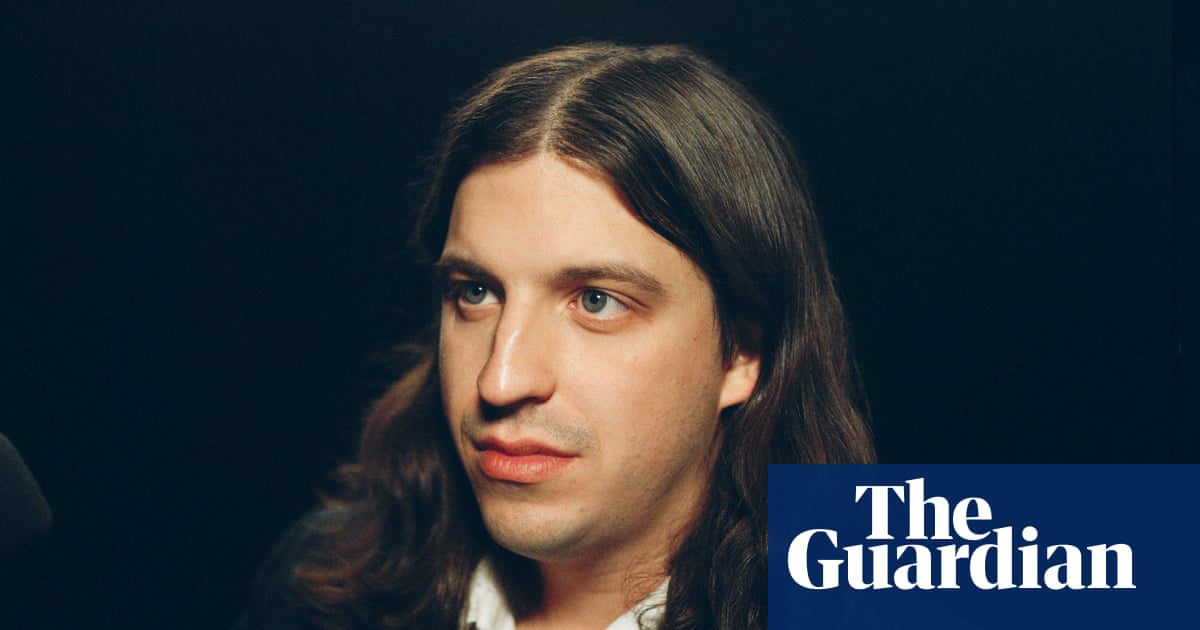
Most episodes of Sam Fragoso’s interview podcast Talk Easy begin with a disarmingly simple question: “How are you doing today?” It primes his high-profile guests – Patti Smith, Gwyneth Paltrow, Salman Rushdie – to be met where they’re at, and sets the stage for what has, over the decade since it began, become a masterclass in interviewing, a singular property in a market so waterlogged that people commonly joke that microphones should be taxed.
Fragoso, 31, eschews the gimmicks and pally celebrity chat of many podcasts. With its crackly jazz theme and commitment to depth, Talk Easy oozes class; in 2020, Fragoso pressed a vinyl record of his interview with US writer Fran Lebowitz. Describing himself as where underground journalist Nardwuar (disarmingly well researched) meets NPR legend Terry Gross (sensitive, direct) meets late talkshow host Dick Cavett (intellectual, sophisticated), he is a freakishly intuitive listener. “The way you construct the narrative of my life is so true that it’s just a little startling,” actor Michelle Williams told him in 2023. In December, the Obamas signed Talk Easy to their production company.
Over a three-hour conversation in mid-February, it becomes clear that Fragoso’s cogs never stop turning. When I ask how he’s doing today, he deconstructs his opening gambit, and mine in turn. “Before I started making podcasts, I was writing profiles,” he concludes, talking from his Los Angeles apartment, one coffee down. “So I’m always imagining how you’re gonna piece things together. I should probably just let that go.”
Interviewing an interviewer about interviewing can get meta, and Fragoso is a little neurotic about turning the tables. He fixates on how he’s coming across, my intentions and how I might approach a question better. He says he’s just anxious about trying to get this right for me. “I’m always writing the story,” he says. It’s stressful and endearing. Fragoso hasn’t historically shared much about himself. “I don’t want to be in the way of someone’s story,” he says. “I’m trying to clear the runway, I want someone to be able to take off.” It’s the difference between him and Marc Maron, who recently ended his personality-centric interview show WTF. But Fragoso says he’s game to share today, conscious that he’s been trying to “be a lot more like myself” on Talk Easy.
One Fragoso trademark is having guests reflect on past quotes. “The confluence of past and present, there’s something about it that’s getting closer to the truth, as elusive as it always is,” he says. Whenever I do it to him, he either knows where I sourced his comments, or gets me to paste them into the chatbox for his scrutiny. He’s mortified after I read his 2013 advice to aspiring writers, when, then an 18-year-old film critic already scoring national bylines, he lamented that he had “seen many gifted wordsmiths not find paying work because they lacked the ability to converse and be sociable with people”. I wanted to know about his hustle instinct. “Can you send me that?” he says, and surmises of his younger self: “What an absolute fucking asshole!” But when he recovers, he tells me “you overlooked the better thing” from the end of the quote, about critic Michael Phillips telling him to “remember to be smarter than the jackass writing somewhere else on the same film”. That, he says, is how he got here.
Chicago-born Fragoso found his calling early. His parents divorced before he turned one, and he lived much of his childhood with his mother, a lawyer. When she relocated to California in his early teens, he stayed to finish the school year and lived with his father, a teacher. They would watch At the Movies, the film review show co-hosted by famed critic Roger Ebert, which inspired Fragoso to start his own reviews blog, Duke and the Movies. When he eventually joined his mum out west, he initially struggled to connect at school, and spent lunchtimes watching Ebert clips and writing. “In your retelling it sounds so sad!” he laughs. Was writing reviews a way to be heard as a lonely teenager? “Oh, that’s a good question, but it’s a reach,” he says. “I do this all the time, where you’re so deep into the research you start going: ‘I think This plus this equals this.’ I really appreciate that you’re doing that, but no, I felt plenty heard.”
Before he finished high school, Fragoso attended Ebertfest with his father, who convinced him to stop dilly-dalling and give his hero his business card. Soon after, he got an approving email that also advised him to stop telling people how old – how young – he was. He founded another website, Movie Mezzanine, and wrote for outlets including Vanity Fair, the Atlantic and NPR.Fragoso studied journalism at San Francisco State University, and aged 21 got hired to programme the city’s historic Roxie cinema. “It was probably a bit of a leap,” Fragoso concedes. He was let go after eight months. But he had been doing onstage interviews with visiting directors, day in, day out: “It didn’t matter if the movie had sold out or there were four dudes there.” Talk Easy was born. “Obviously to a much less significant degree, and with less talent, it was a real 10,000 hours Beatles-in-Hamburg situation,” says Fragoso – citing the theory of former guest Malcolm Gladwell, whose production company was the first to pick up Talk Easy. “Please,” he adds, “include that I do think the Beatles are much better at music than I am at interviewing.”
Fragoso had always been an avid listener. As a kid he loved driving home from parties with his dad’s Mexican family and getting the gossip, and his parents always answered his questions about their divorce. “They were, from a very young age, game to be honest about a thing that was probably painful for both of them,” he says. As a teenager, he counselled his mother through a second divorce. The recent uptick in therapised language made him think about how terms like “‘boundaries’ were not parts of my childhood. There were no boundaries, and I didn’t want them. I wanted to know about all of it.” Today he sees his interview style as the meeting point between his parents’ jobs: lawyerly case-building, teacherly understanding.
Talk Easy’s first episode, with actor Don Cheadle, was released on 7 April 2016. In the introduction, Fragoso outlined his mission statement, citing Ebert’s memoir. “‘We must try to contribute joy to the world. That is true no matter what our problems, our health, our circumstances. We must try.’ All right, Roger, let me try to do that.” It’s a huge sense of purpose for a culture podcast. “But Roger felt that there was a greater sense of purpose,” Fragoso says. “I was moulded in his vision. To read Roger was to read about the world, and his view was so empathic and expansive.”
He wants to see the citation. “Yeah, that was a real April 2016 quote,” he sighs. “A little pre-Trump. Harder now. I don’t know any more with that one, but it’s a beautiful idea. I thought that could be part of the interviews. Felt like a good foot to lead with.”
It was: Fragoso’s show is a special thing. His impressed guests spread the word: when he wanted to nab a rare conversation with writer Chimamanda Ngozi Adichie, director Ava DuVernay talked him up. “My publicist booked Talk Easy for me, and said something like: ‘Sam goes deep, so be ready’,” director Edgar Wright, a guest in November, tells me. “I was immediately disarmed because I could see how much he’d prepped and cross-referenced previous interviews, which no one does. I really enjoyed it, especially in the middle of a press tour where you really feel the Chinese water torture of doing the same interview every 15 minutes for four weeks – Talk Easy was the opposite of that. He puts you at ease, perhaps in a Louis Theroux-type way where you probably open up a lot more than you’d planned.”
The show has proud moral fibre: when the pandemic hit, Fragoso started interviewing healthcare and politics experts. These days, he often starts an episode with a fireside chat-style acknowledgment of the horrors in the US. As we speak he’s about to release an episode about ICE with an immigration journalist. “My family being Mexican, that’s personal to me,” he says. Author Michael Pollan once said any writer has “a set of final questions” – perennials they’re always trying to figure out. Fragoso considers his. “I’m always wondering how people keep going,” he says. “Life is such a pain in the ass. It’s so bruising and forgiving and amazing.”
In August 2025, Fragoso invited David Mamet on. After a testy conversation in which the playwright denounced pro-Palestine student protests and DEI, and incorrectly surmised that his host had never been punched in the face, Mamet walked out. “You don’t know what the fuck you’re talking about,” he said, pointing aggressively. Almost immediately, Fragoso says now, his concern was for Mamet, 78, driving home to his wife after it had gone badly. “I am proud of the interview, but I felt for him, even though he threatened me. It’s hard for me not to see the full picture.”
Talking to George Saunders recently, Fragoso admitted that he was feeling the limits of peacemaking given the state of US politics. I’m surprised he still felt sorry for Mamet. “I really object to some of his thinking and his politics, they’re dangerous and conspiratorial and wrong,” Fragoso says. “But also the man who’s gone through a certain amount of experiences as a Jewish man of a certain age – I still cared about that. I always believe that there is a human rattling around in there. It would do us both a great disservice to not try to recognise it.”
The incident didn’t hurt Talk Easy, prompting the show’s first major headlines. A month later, Fragoso scored a huge personal coup by convincing his hero Terry Gross, host of NPR’s interview show Fresh Air since 1975, to sit for a rare interview. In December, Gross brought Fragoso on as a guest host for Fresh Air – at 75, she has stepped back from helming it alone – calling him a “terrific interviewer” in her introduction.
“I’m so indebted to her,” he says now. “It is such a genuine honour.” He’s not sure what it means for Talk Easy. “I’m proud to have made my own thing, and I wouldn’t want to ever …” He pauses. “I don’t want to say that,” he says, seemingly stopping short of pledging never to abandon ship.Even as Talk Easy celebrates its 10-year anniversary, Fragoso isn’t inclined to bask in success. “You don’t come from a family that doesn’t come from money and go: ‘Man, I can’t believe this happened!’” he says. “No, I remember the hundreds of emails I wrote that received rejections; banging my head against the wall at hour 35 researching for an episode. It’s not a mystery – I put the time in.” His ambitions seem earnestly rooted in his craft. The beauty of an interview, he says, is that “you only get one crack at it. I don’t want to leave going: ‘If only I’d spent more time.’ I’m so fuelled by not wanting to have regrets.”
He has a deeper ambition, too, to get closer in everyday life to the “the focus, presence of mind and decency” that he brings to hosting. Part of the joy of listening to Talk Easy is indulging in the fantasy of being heard with such incredible compassion. “I think the aim is for everyone to hear it and go: ‘How can I be a little more attentive?’” says Fragoso. “‘Can I have the wherewithal to ask someone a question?’”
Talk Easy will mark its 10th anniversary this April.
Source: https://www.theguardian.com/tv-and-radio/2026/mar/12/talk-easy-podcast-sam-fragoso-interview-winslet-patti-smith-oscar-isaac-chimamanda-ngozi
About the Author