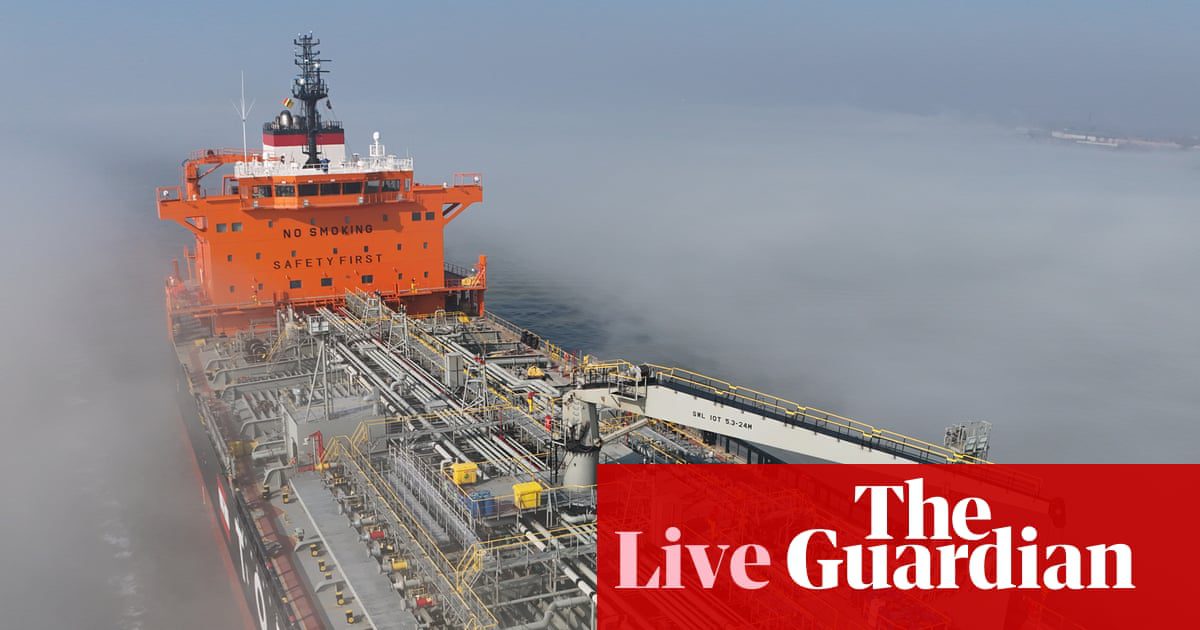
Introduction: Oil heading for biggest weekly gain in four years
Good morning, and welcome to our rolling coverage of business, the financial markets and the world economy.
The oil price is on track for its biggest monthly gain in four years, fuelling fears of an inflation spike that will reignite the cost of living crisis and hurt growth around the globe.
The Iran conflict has driven Brent crude, the international benchmark, has soared by 17.65% this week to over $85 a barrel. That would be the biggest jump since the week to 4 March 2022, after Russia invaded Ukraine.
Oil has been driven up to the highest levels in 19 months by shortages worries, following attacks on refineries in the region by Iran this week, and on ships in the region.
Ship traffic in the strait of Hormuz has ground to a near-complete halt, according to the Joint Maritime Information Center, the multinational naval advisory group.
The JMIC said in a note that only two confirmed commercial transits had been observed through the strait in the past 24 hours, which were cargo ships and not tanker vessels.
In normal times, around 138 vessels would pass through the strait in a 24-hour period. Now, though, a high concentration of vessels remain at anchor, drifting and at berth in the Arabian Gulf ports, it says.
JMIC’s security threat rating for the area remains “CRITICAL”, which indicates an attack is almost certain.
The agenda
-
7am GMT: Halifax house price index for February
-
1.30pm GMT: US non farm payrolls employment data for February
-
1.30pm GMT: US retail sales report for January
Key events
Gold, traditionally seen as a safe-haven asset, has dropped this week.
Gold is down over 3% since the Iranian war began, partly due to a rally in the value of the US dollar.
Today, gold is up 0.7% at $5,112 an ounce.
IMF: 10% oil rise for a year would add 40bps to inflation
International Monetary Fund managing director Kristalina Georgieva has warned that a 10% increase in energy prices that persists for a year would push global inflation up by 40 basis points and slow economic growth by 0.1-0.2%.
Speaking to Bloomberg TV, Georgieva said:
“The world economy has been remarkably resilient. Shock after shock, and yet growth is at 3.3%.
But this resilience is being tested yet again.”
Another energy development: the US has granted Indian refiners a 30-day waiver to buy Russian oil after the US-Israel war on Iran sparked fears of a supply crunch
The US treasury secretary, Scott Bessent, insisted this temporary waiver, designed “to enable oil to keep flowing” into the market, “will not provide significant financial benefit to the Russian government”.
Our main Iran war liveblog has more details:
After a volatile week, Asia-Pacific stock markets are on track for their worst week since the Covid-19 pandemic struck.
MSCI’s broadest index of Asia-Pacific shares outside Japan was on track for a 6.6% drop for the week, Reuters reports, which would mark its steepest weekly drop since March 2020.
Today, Australia’s S&P/ASX 200 index has dropped by 1%, but Japan’s Nikkei is 0.6% higher, and Hong Kong’s Hang Seng is up 1.6%.
Introduction: Oil heading for biggest weekly gain in four years
Good morning, and welcome to our rolling coverage of business, the financial markets and the world economy.
The oil price is on track for its biggest monthly gain in four years, fuelling fears of an inflation spike that will reignite the cost of living crisis and hurt growth around the globe.
The Iran conflict has driven Brent crude, the international benchmark, has soared by 17.65% this week to over $85 a barrel. That would be the biggest jump since the week to 4 March 2022, after Russia invaded Ukraine.
Oil has been driven up to the highest levels in 19 months by shortages worries, following attacks on refineries in the region by Iran this week, and on ships in the region.
Ship traffic in the strait of Hormuz has ground to a near-complete halt, according to the Joint Maritime Information Center, the multinational naval advisory group.
The JMIC said in a note that only two confirmed commercial transits had been observed through the strait in the past 24 hours, which were cargo ships and not tanker vessels.
In normal times, around 138 vessels would pass through the strait in a 24-hour period. Now, though, a high concentration of vessels remain at anchor, drifting and at berth in the Arabian Gulf ports, it says.
JMIC’s security threat rating for the area remains “CRITICAL”, which indicates an attack is almost certain.
The agenda
-
7am GMT: Halifax house price index for February
-
1.30pm GMT: US non farm payrolls employment data for February
-
1.30pm GMT: US retail sales report for January
Source: https://www.theguardian.com/business/live/2026/mar/06/oil-biggest-weekly-gain-four-years-strait-of-hormuz-traffic-halt-stock-markets-dollar-imf-news-updates
About the Author