
If you happen to be in need of an escape — from the lingering grip of winter, say, or you know, [gestures expansively] all of this — it’s important to recall there are productive alternatives to doomscrolling.
This month alone, the books that are soon to line library shelves promise to deposit readers’ imaginations in the Sierra Madre or coastal Thailand, the Australian wilderness — or even in the distant legendary past or the techno-dystopian near-future that impatiently awaits us with open arms.
But wait, before you get bogged down again by that pesky ol’ despair — books! Here are some of the publishing highlights to keep an eye out for in March.

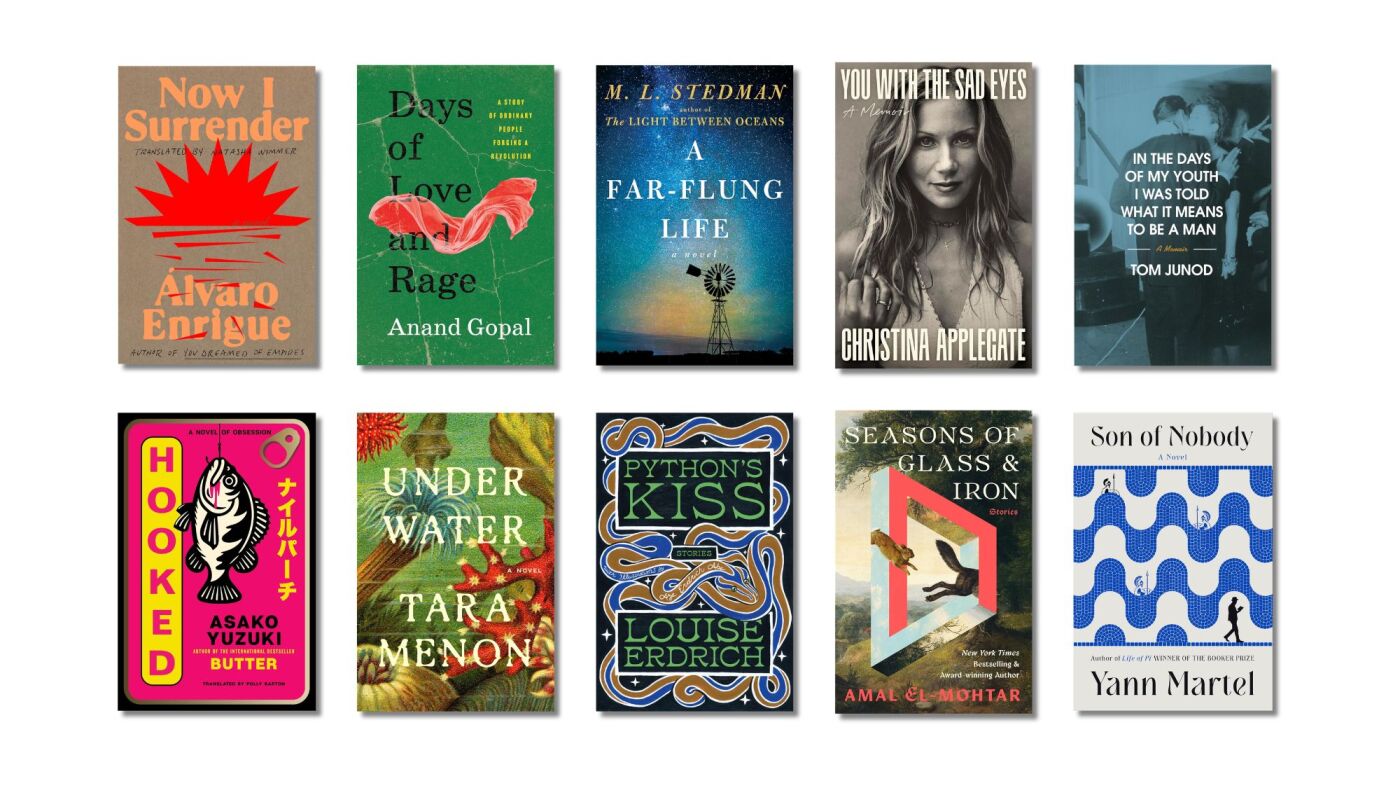
Now I Surrender, by Álvaro Enrigue, translated from Spanish by Natasha Wimmer (3/3)
Few memoirs have matched the pithiness of Geronimo’s statement of surrender: “Once I moved like the wind,” the legendary Apache told U.S. military officers. “Now I surrender to you and that is all.” About 140 years later, Enrigue has plucked some of these words to title his kaleidoscopic vision of the final years of Apacheria — that inhospitable patch of U.S.-Mexico borderlands where Geronimo’s dwindling warrior people clung tenaciously to this last vestige of sovereignty. Enrigue’s previous novel, an account of the Spanish conquest of the Aztecs, more closely resembled a psychedelic “mushroom trip” than its neighbors on the historical fiction shelf. This time, he has crafted a kind of cubist Western, snarling convenient cultural narratives from a dizzying array of eras and perspectives.

Days of Love and Rage, by Anand Gopal (3/3)
A veteran war correspondent, Gopal earned finalist nods for the Pulitzer Prize and National Book Award for what the Pulitzer jury described as his “vivid, haunting and courageous” first book, No Good Men Among the Living, which conveyed the fallout of the war in Afghanistan through the personal stories of just a few Afghans. Gopal’s follow-up sees him apply a similar approach to the violence in Syria, bringing home the broader struggle by focusing on the utopian ambitions of a small group of Syrians in the dawning days of a turbulent era.

A Far-flung Life, by M.L. Stedman (3/3)
Nearly a decade and a half separates us from Stedman’s debut, The Light Between Oceans, a multigenerational, island-bound epic that found an adoring international audience and inspired a middling Hollywood adaptation. Now, the Australian novelist returns with another epic redolent of Thomas Hardy — fit with realist grit, relentless family calamity and a remote Western Australian setting that, like Hardy’s brooding English moors, radiates such beauty and hostility, it’s almost a character in its own right.

Little, Brown and Company
You With the Sad Eyes: A Memoir, by Christina Applegate (3/3)
Up until a few years ago, Applegate’s was a life lived squarely in the public gaze. She debuted on television before developing object permanence, and had become a primetime network fixture by her mid-teens. But the star of Married… with Children and Dead to Me largely withdrew from the spotlight after revealing a multiple sclerosis diagnosis in 2021. Out of sight is not out of mind, however. The Emmy winner is now hosting a podcast about living with MS, and she’s putting her life story in print, too, with this lively — and at times harrowing — account of all that the viewers at home never got to see.

In the Days of My Youth I Was Told What It Means to Be a Man, by Tom Junod (3/10)
Junod has won two National Magazine Awards and earned nearly a dozen nominations for a reporting career featuring plenty of daunting conversations — with a serial rapist, an American member of the Taliban, even Fred “Mr.” Rogers, in the GQ profile that forged their friendship and inspired 2019’s A Beautiful Day in the Neighborhood. But one difficult conversation will always elude him, the candor he had always wanted to share with his father before he died. Junod’s memoir is an attempt to understand his father anyway — that puzzle of a flawed man so obscured by philandering, fabricating and posturing.

Hooked: A Novel of Obsession, by Asako Yuzuki, translated from Japanese by Polly Barton (3/17)
Don’t call it a sophomore effort, exactly. Hooked is just Yuzuki’s second novel to enter the English-language market, after Butter — a heady concoction of cooking and good old-fashioned serial killing — found an insatiable international audience. But Yuzuki is no novice. The Japanese writer already has more than 20 novels to her name in her native country — including this propulsive tale of desperate friendship, obsessive fixation and fish, which actually came out in Japan before Butter, but now receives a translation on the strength of Yuzuki’s surprise smash hit.

Under Water, by Tara Menon (3/17)
“There is no place in our language for grief about friends, or love for them.” This observation, tendered by the narrator early in Under Water, doubles as a statement of the novel’s defining challenge: How to grieve the death of a best friend — someone closer than family, surer than a love interest, yet bereft of the same pedestal given to lovers and family members in the social hierarchy of whose grief is worthy. Menon’s fiction debut — her day job is teaching literature at Harvard — proffers one elegant attempt to articulate this loss: an elegy to platonic love pinned between two natural disasters — the 2004 tsunami that killed the best friend of narrator Marissa, and the memory-dredging onset of Hurricane Sandy eight years later.

Python’s Kiss: Stories, by Louise Erdrich (3/24)
Given Erdrich’s track record, any new release of hers represents a literary event at this point. Already the recipient of a National Book Award, a Pulitzer Prize and the National Book Critics Circle Award, the Ojibwe novelist returns later this month with a collection of short stories culled from the past two decades of her writing. Here readers will find her characteristic mix of sympathetic eccentrics, her knack for crafting compelling plots only polished and sharpened by the shorter form. And expect the occasional speculative leap, too — see: “Domain,” with its wry glimpse of the digital afterlife that wouldn’t have felt out of place in an episode of Black Mirror.

Seasons of Glass and Iron: Stories, by Amal El-Mohtar (3/24)
“I like things that proceed from a sense of wonder and inquiry, and that explore the human condition with a toolkit that’s interested in going beyond what exists around us in our everyday,” El-Mohtar said on NPR’s Pop Culture Happy Hour in 2021. “I like things that invite you to say ‘what if’ a lot.” At the time, El-Mohtar had joined the show in the capacity of a reader — as a book critic for NPR and one of the judges of its reader poll that year. Now, it’s her name on the cover, but the “what ifs” loom as large as ever. This collection comprises more than a dozen of the accomplished sci-fi author’s stories over the past decade, including several — such as the title story — that have earned her some of the genre’s highest honors.

Son of Nobody, by Yann Martel (3/31)
Martel’s best-known novel, the Booker Prize-winning Life of Pi, bears unmistakable echoes of the Odyssey. Both depict the homeward journey of a seagoer beset by bad luck and fantastic misadventure. (Martel also added what was sorely missed in Homer’s epic: a tiger.) Martel’s latest novel evokes Homer again — this time the Iliad — by imagining the recovery of another account of the Trojan War, this one told from the commoner’s perspective. Paired with the imagined epic is still another story altogether, as the life of the academic annotating the text bleeds into a parallel tale that unfolds in the footnotes, a la Vladimir Nabokov’s Pale Fire.
Source: https://www.npr.org/2026/03/03/nx-s1-5729089/new-books-march
About the Author