UK considering sending warship to Cyprus to defend RAF airbase

Dan Sabbagh
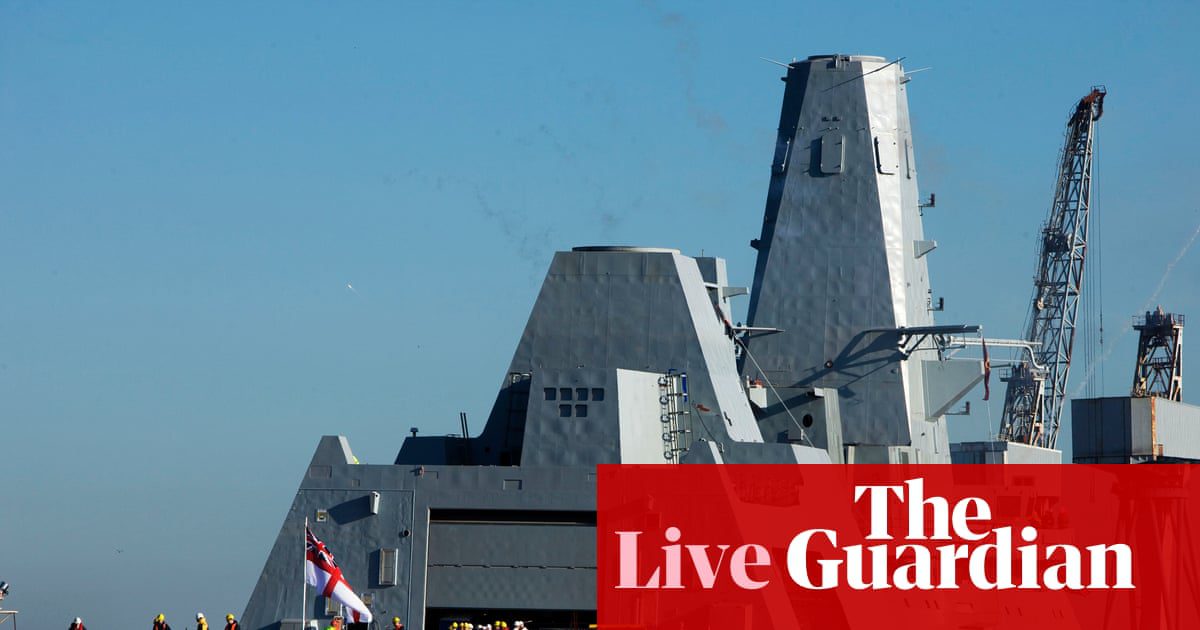
John Healey, the defence secretary, is considering sending Royal Navy destroyer HMS Duncan to Cyprus to help defend the Akrotiri RAF airbase from any future drone attacks.
Though a final decision has not been made, multiple sources said a deployment of the warship, currently in Portsmouth, was under discussion as a way to better protect the base in Cyprus
HMS Duncan is specialised in counter drone operations and last month was engaged on a test exercise off the coast of Wales facing swarms of drones, before hosting a family day on Friday.
No major Navy warships are currently in or have been sent to the Middle East, even though the conflict is now in its fourth day, while concerns have been raised about the ease of which Akrotiri’s air defences were breached.
One drone, thought by Cypriot authorities to have been flown from Hezbollah controlled territory in Lebanon, crashed on to the runway at around midnight yesterday and two other drones were intercepted thereafter.
It would take several days for the HMS Duncan to reach Cyprus from Portsmouth as it travels at about 30 knots (34.5mph).
Key events
Answering questions in the Commons, the foreign secretary, Yvette Cooper, stressed the importance of continuing to support Ukraine.
“This is about our security as well as Ukraine’s security,” Cooper said, as she outlined the UK government’s military support to Kyiv and the sanctions imposed on Russia, targeting Moscow’s shadow fleet, along with sectors of the country’s economy.
The government has estimated that UK, EU and US sanctions have denied Russia access to at least $450bn since February 2022, when the full-scale invasion of Ukraine was launched.
UK considering sending warship to Cyprus to defend RAF airbase
Dan Sabbagh
John Healey, the defence secretary, is considering sending Royal Navy destroyer HMS Duncan to Cyprus to help defend the Akrotiri RAF airbase from any future drone attacks.
Though a final decision has not been made, multiple sources said a deployment of the warship, currently in Portsmouth, was under discussion as a way to better protect the base in Cyprus
HMS Duncan is specialised in counter drone operations and last month was engaged on a test exercise off the coast of Wales facing swarms of drones, before hosting a family day on Friday.
No major Navy warships are currently in or have been sent to the Middle East, even though the conflict is now in its fourth day, while concerns have been raised about the ease of which Akrotiri’s air defences were breached.
One drone, thought by Cypriot authorities to have been flown from Hezbollah controlled territory in Lebanon, crashed on to the runway at around midnight yesterday and two other drones were intercepted thereafter.
It would take several days for the HMS Duncan to reach Cyprus from Portsmouth as it travels at about 30 knots (34.5mph).
Speaking in the House of Commons yesterday, Ellie Chowns called for a parliamentary vote on “any UK involvement in this war”.
“We are not at war,” Keir Starmer responded, adding: “We are not getting involved in offensive action that the US and Israel are taking.”
Ellie Chowns, the Green party’s foreign affairs spokesperson, has said she has tabled an “armed conflict (requirements) bill’” which would require any UK military intervention to have a lawful basis, viable objective and approval from MPs.
In a letter addressed to the prime minister, which she shared to X, Chowns, who is the Green’s MP for North Herefordshire, wrote:
In recent days we have seen a deeply concerning escalation in conflict in the Middle East following a series of illegal and dangerously irresponsible airstrikes on Iran by the United States and Israel.
You have now confirmed that UK bases will be used by the US for their operations in the area. This is a significant concession to President Donald Trump and one which risks drawing the UK into a dangerous conflict.
During your campaign to be elected leader of the Labour party, you spoke compellingly about learning the lessons of the Iraq war. In particular, you set out legislation you would pass as prime minister, ensuring that military action is only taken if:
– The lawful case for it is made
– There is a viable objective
– Consent is given by the House of Commons.
We agree that such legislation is needed to prevent the UK from being dragged into destructive, illegal and dangerous wars abroad, and so we have today tabled the Armed Conflict (Requirements) Bill.
More than 100,000 Britons were stranded in the Gulf on Monday, with airspace in the region still closed to most flights and overland evacuation regarded as risky while Iran continues to launch missile and drone strikes across the region.
Downing Street said UK officials were considering all options to get citizens home safely, including using commercial, charter and military flights and bussing evacuees across land borders into Saudi Arabia and Turkey.
“The increasingly reckless strikes from the Iranian regime targeting Gulf allies, including strikes on bases, airports and on hotels, directly put British lives at risk,” Keir Starmer’s spokesperson said.
“The safety and security of those British nationals remains this government’s top priority.
“We know people right across the country will be deeply concerned by the scale of this crisis, in particular the British nationals, including holidaymakers and transit passengers who are currently in the region and being told to shelter in place.
“We always recommend they follow FCDO [Foreign, Commonwealth & Development Office] advice but want people to get back home as quickly as possible, and we are looking at all options.”
The Foreign Office has set up 24/7 consular support to assist Britons in the region to manage the fast-evolving situation, including deploying teams of extra staff to work with the travel industry and governments.
You can read the full story by my colleagues Pippa Crerar and Gwyn Topham here:
Green party overtakes Labour in YouGov poll
A new YouGov voting intention survey for The Times and Sky News shows a surge in support for the Green party, which climbed to second place in the poll as Labour slumped to its lowest figure to date.
The survey of 2,073 people on Sunday and Monday showed Reform UK leading with 23% support (down by one point), the Greens on 21% (up by four points), Labour and the Conservatives tied on 16% (down by two points), and the Lib Dems unchanged on 14%.
Our latest voting intention (1-2 March 2026) has the Greens on their highest figure ever recorded by YouGov, significantly ahead of Labour, who are on their lowest figure to date
Reform UK: 23% (-1 from 22-23 Feb)
Greens: 21% (+4)
Conservatives: 16% (-2)
Labour: 16% (-2)
Lib… pic.twitter.com/C7tL21tzBv— YouGov (@YouGov) March 3, 2026
The poll points to the widespread dissatisfaction with the traditional parties and came after the Green party won a landmark victory in the Gorton and Denton byelection, in what was a significant blow to Keir Starmer.
Starmer is now under pressure to appeal to more left-wing voters to counter the rise of the Green party but it may be too late for the prime minister, who has spent much of his time in No 10 trying – but seemingly failing – to appeal to socially Conservative voters who may be inclined to vote for Reform.
On Monday night, the prime minister told Labour MPs that “politics is changing, and changing decisively … (but) I believe, and continue to believe, that there is a mainstream majority in this country who neither want Nigel Farage of Zack Polanski as their prime minister.”
The foreign secretary, Yvette Cooper, and her department’s ministers are facing oral questions in the House of Commons from 11.30am today. We will bring you the key lines as they come.
Spring statement to be delivered amid turmoil in financial markets caused by Iran war
The chancellor, Rachel Reeves, is expected to claim later today that she has rebuilt the country’s public finances so they can withstand economic shocks as she delivers her spring statement.
As the US-Israel war on Iran continues to cause major disruption to production and supplies, Reeves is expected to lay out how she believes her plan is the best one for a world “that has become yet more uncertain”.
But economists have warned that soaring global energy prices as a result of the widening conflict could jeopardise the chancellor’s plan to rekindle growth and could drive inflation rises.
Ministers have repeatedly sought to play down the significance of the spring statement, and have said it will not contain any new tax and spend policies.
Reeves will speak in the House of Commons at about 12.30pm. The Office for Budget Responsibility, the independent body that monitors the government’s spending plans, will publish its economic and fiscal outlook at about 12.50pm.
The forecasts are not expected to account for the economic impacts caused by the airstrikes on Iran. You can read our business blog for the latest.
Starmer’s ‘failure to be a reliable ally’ puts UK-US relationship ‘under strain’, Jenrick says
Reform UK’s treasury spokesperson, Robert Jenrick, has said Keir Starmer’s “failure to be a reliable ally” has placed the US-UK relationship “under a lot of strain”.
Jenrick – who left the Conservative frontbench in January – told Times Radio:
It’s bigger and deeper than one prime minister and one president and so I’m sure it can be built up again in the future.
But it’s quite clear that the prime minister’s failure to be a reliable ally to the United States in this moment has placed it under a lot of strain, and that is a cause for concern.
I’m actually more concerned about British interest, rather than what another leader, albeit a very important ally of ours, thinks of the United Kingdom.
And there again, I think Starmer has got it wrong, because we’ve seen the drone attacks on our base in Cyprus, putting in danger our troops and the service families who live there.
The prime minister’s response has been too slow. He should have made our bases available sooner and he should have used what military assets we have to defend that base more rigorously than he did.
Nigel Farage, the Reform party’s leader and a Trump ally, has said that he supports regime change in Iran and that the RAF and Royal Navy should be deployed to support US strikes on Iran.
Many legal experts say that the US-Israel strikes on Iran were unlawful, as they were a violation of the ban on the use of force under the UN charter and international law. The UK government published a summary of legal advice on Sunday night which said:
The UK’s actions and related support to its allies is solely focused on ending the threat of air and missile attacks against regional allies unlawfully attacked by Iran and who have not been involved in hostilities from the outset.
UK not going to get involved in a ‘wider conflict in the Middle East’, minister says
Asked whether the so-called “special relationship” had changed, Darren Jones told BBC Radio 4’s Today programme:
The UK-American relationship is important. It has been for a long time and will continue to be, and we’re working in collaboration right now in the Middle East on defensive action to protect British citizens.
I think the President’s frustration, from the way he’s articulated it, has been that we were not involved in the initial American and Israeli strikes in Iran, but as the prime minister said to the House of Commons yesterday, we will only engage British armed forces when it’s in British interests with a clear plan and on a legal basis.
We’re now doing that for defensive action, but we’re not going to be getting involved in a wider conflict in the Middle East.
Asked whether the initial attacks were lawful or not, he said: “Well, that’s a question for the Americans and the American administration.”
In his interview with The Sun last night, Donald Trump also suggested that Keir Starmer was “pandering” to Muslim voters in formulating his policy regarding Iran, a baseless claim which the chief secretary to the prime minister, Darren Jones, has been asked about on BBC Radio 4’s Today programme this morning.
Jones said:
That’s just, that’s not right. The UK will act in the interests of British citizens, regardless of their faith or where they are in the United Kingdom.
I think the public would rightly say they don’t want to be involved in a wider war in the Middle East, but they would expect us to do whatever we can to defend British citizens.

Jessica Elgot
Keir Starmer has often been praised previously for his ability to maintain a relationship with the volatile US president but on Monday in the House of Commons, the prime minister expressed doubt about the US action in Tehran and its legality.
“We all remember the mistakes of Iraq, and we have learned those lessons. Any UK actions must always have a lawful basis, and a viable thought-through plan,” he said. “That is the principle that I applied to the decisions that I made over the weekend.”
Speaking in the Commons on Monday, Starmer said the UK was deploying planes and allowing the use of bases for defensive purposes because of Iran launching strikes on the UK’s allies in the region in its retaliation.
He said the RAF had intercepted an Iranian drone strike heading for a coalition base in Iraq where UK forces were stationed. Two drones were also fired at the British base in Cyprus, RAF Akrotiri, which Starmer said were launched before Sunday night’s statement on the US use of UK bases.
The UK is expected to allow the US to use RAF Fairford in Gloucestershire and Diego Garcia in the Chagos Islands to bomb Iran’s “missile cities”, sites where high-speed ballistic missiles, Iran’s most dangerous weapons, are stored and can be launched from.
You can read more from the Guardian’s deputy political editor, Jessica Elgot, here:
Trump says he is ‘very sad’ that the UK-US relationship is ‘not what it was’
Good morning and welcome to our live coverage of UK politics. The US president, Donald Trump, has said he is “very sad” to see that the UK-US relationship is “not what it was” after criticising Keir Starmer for taking “far too long” to allow US forces to use its airbases to attack Iran.
In a telephone interview with The Sun’s political editor Harry Cole, Trump said:
It’s a different world, actually. It’s just a much different kind of relationship that we’ve had with your country before.
It’s very sad to see that the relationship is obviously not what it was.
Speaking to The Sun from the White House on Monday evening, Trump compared Starmer’s actions unfavourably with France’s support for the strikes and with the backing of the Nato secretary general, Mark Rutte.
“He has not been helpful. I never thought I’d see that. I never thought I’d see that from the UK. We love the UK,” he said.
In a significant and rare break from Washington on foreign policy, Starmer said on Monday that the UK did not believe in “regime change from the skies” as he defended his decision not to allow the use of UK bases for the initial wave of attacks.
But the prime minister said the situation changed on Sunday when Iran’s “outrageous” response became a threat to British people and British allies.
He has now agreed to the US request to use British military bases for “defensive” strikes on Iranian missile sites.
The Tory leader, Kemi Badenoch, accused the government of being “too scared” to take a stronger stance against Iran.
We will mainly be focusing on the UK political reaction to the rapid developments in the Israel-US war on Iran today, as the conflict spirals across the region with the Israeli military launching new strikes on Tehran and Beirut.
You can follow our business live blog to keep up with market reaction as the war drives up oil and gas prices after Iran expanded its retaliatory attacks on American targets in the Gulf region.
Source: https://www.theguardian.com/politics/live/2026/mar/03/trump-starmer-us-special-relationship-iran-yvette-cooper-labour-uk-politics-latest-news-updates
About the Author