Burnham backs Starmer staying on as PM, saying UK needs ‘stability’, while also urging PM to be more ‘inclusive’
Burnham highlighted rail nationalisation as an example of the new economic approach he thinks the UK needs.
And then, in a reference to Keir Starmer, he went on:
Having frozen rail fares, we now need to start talking about lowering rail fares. That’s the benefit that public control can bring, and I believe it’s what we should be working towards, together with the government, and also bringing pace and focus to lowering the cost of other of life’s essentials.
To do that requires stability, and I make my own call for that today across the Labour party.
Of course, stability comes from greater unity, and that would be helped by a more inclusive way of running the party. But recent events makes that now feel possible.
That was an endorsement – but a relatively cautious one. In his speech, Burnham did not refer to Starmer directly.

Key events
Burnham says Britain will only be able to build ‘new economy’ with wholesale electoral reform
Andy Burnham ended his contribution by recalling the Labour MP Paul Goggins, who represented Wythenshawe and Sale East and who died in 2014. He said Goggins was his mentor when he was a young MP. Goggins “was just dedicated to the underdog”, he said.
Burnham went on:
When I came into parliament, I remember [Goggins] said something to me very early on that I’ve never forgotten. He said ‘The point of being here is you’ve got power and you should use all of it, every bit of it, for people who have little power or none at all. But what you will find is most people in here are using their power for people who’ve already got too much.’
And the truth of what he said become more and more apparent to me during my time in parliement.
And I do just finish on that … I think we’ve had a political culture that hasn’t served the common good for quite a while. And I’m not making this a right and left thing. It’s been there in all parties. And it hasn’t serve the interests of Unsung Britain.
And I just think Britain needs to really refocus in this moment. It is a generational moment. If we’re not going to rethink things now, then when are we going to do it?
And I do come back to it. We have to rethink the whole way of working of politics.
The power in too few hands in Whitehall, in Westminster, creates that situation where the manipulation of power by vested interests works against the common good … I have seen that far too much in my political life, and I believe strongly now we need electoral reform, political reform, the replacement with the House of Lords with an elected senate of the nations and regions.
We need root and branch reform across Whitehall and Westminster. And it is only by a new politics we will we start to build a new economy. I don’t think you can do one without the other.
Burnham says Labour needs to ‘dial down’ on constant briefing against each other
Q: Was Anas Sarwar wrong to call for Keir Starmer to resign? Do you think the government can deliver the promises you want? And would you rule out a leadership challenge?
Burnham replied:
What I’m calling for very clearly today is for the unity, to create the stability to give the government the platform to focus on all of the things that I’m talking about today.
I think we’ve got to get away from the sense that everything is a challenge. I put myself forward [as a byelection candidate] but I was saying – I spoke to the prime minister, I spoke to the government – we need to get a strong sense of a stronger team again than there has been in recent times. And that, I think, is what needs to come from this.
We need to dial down all of this constant briefing. It’s seemingly a bit endless some of the anonymous briefing going round.
Burnham said he would like to see Labour focusing on ensuring Reform UK does not in the Gorton and Denton byelection.
Burnham says he hopes Mandelson scandal will end political culture ‘too close to wealth and power’
Q: Is your support for Keir Starmer qualified?
Burnham said his support for Starmer “wasn’t qualified or guarded”. He went on:
I praised the government. I think they have broken with the governments I was in that didn’t allow people to reregulate buses, that didn’t renationalise at the railways, that didn’t have as ambitious plans around housing.
So they’ve come forward with the big ambitions.
He said there was a need for “greater unity” in the Labour party. He went on:
I think we are at a generational moment in politics. Actually, I do feel recent events have drawn a heavy line under a political culture that was too close to wealth and power and too distant from the lives of people that we’re talking about today.
So the government, in my view, should just now lean completely into that theme, and work with devolved authorities like the one I lead.
Burnham is now taking questions.
Q: Does Keir Starmer have your full support? And how long has he got to turn things around?
Burnham says Starmer has his support. And he did when Burnham applied to be a candidate in the Gorton and Denton byelection, he says.
He says the government is doing things that support working-class Britain. He says it has supported initiatives he is pursuing in Manchester, such as giving 16-year-olds free bus travel, which is important for education, and developing the MBacc (Manchester baccalaureate).
Burnham backs Starmer staying on as PM, saying UK needs ‘stability’, while also urging PM to be more ‘inclusive’
Burnham highlighted rail nationalisation as an example of the new economic approach he thinks the UK needs.
And then, in a reference to Keir Starmer, he went on:
Having frozen rail fares, we now need to start talking about lowering rail fares. That’s the benefit that public control can bring, and I believe it’s what we should be working towards, together with the government, and also bringing pace and focus to lowering the cost of other of life’s essentials.
To do that requires stability, and I make my own call for that today across the Labour party.
Of course, stability comes from greater unity, and that would be helped by a more inclusive way of running the party. But recent events makes that now feel possible.
That was an endorsement – but a relatively cautious one. In his speech, Burnham did not refer to Starmer directly.
Burnham says he has never argued politicians can ignore bond markets
Burnham said that he had never said politicians should ignore the bond markets.
To be clear about something, I have never said Britain should ignore the bond markets, or even blamed them.
What I do say is that it is the decisions of politicians from the 1980s onwards that have left us in hock to them, with little headroom and room for manoeuvre.
It is only politicians who can take us out of that position with better choices.
Burnham is referring to a comment he made in an interview with the New Statesman last year.
Burnham says government should commit to building 500,000 council and social homes by end of decade
Burnham said that privatisation led to “a huge transfer of power away from unsung Britain and, towards, if you like, the better off half”.
He said it was time to reverse this.
Following recent events, I think the time has come to call an end to this era in British politics, when politicians got too close to wealth, too seduced by the notion that deregulated markets would provide the solution when in fact they have been the problem for those on the lowest incomes.
Burnham said he would like to see the government commit to building 500,000 council and social homes by the end of this decade.
Burnham said that “Unsung Britain” stopped being a priority for the Westminster government around 40 years ago.
Before that, “a collective approach defined public policy in terms of repairing the basics,” he said. He added that created “the health, wealth and life chances of working-class Britain”.
Burnham said that, when he was growing up in the 1970s, “it was the combination of available council housing and good technical education which provided the foundations for working-class aspiration”.
Those foundations for prosperity were both broken up, he said.
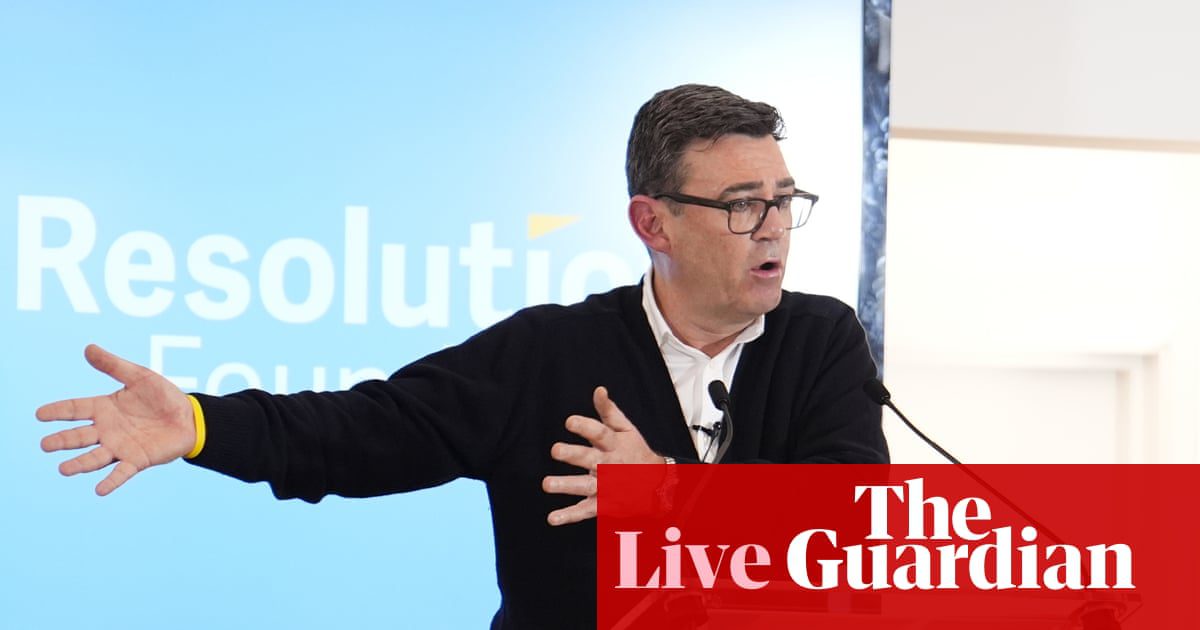
Burnham speaks at Resolution Foundation conference on ‘Unsung Britain’
At the Resolution Foundation Andy Burnham, the mayor of Greater Manchester, is speaking at a conference on “Unsung Britain”. There is a live feed here.
The conference covers issues raised in this report from the thinktank. The RF uses “Unsung Britain” to refer to the poorer half of working-age families.
Here is a summary of its key points.
Starmer tells cabinet Sarwar’s comments yesterday won’t stop Labour fighting to make him first minister
Keir Starmer chaired a meeting of the political cabinet today, as well as normal cabinet. Labour has sent out a readout, and it says that Starmer thanked his colleagues for their support yesterday. He also said he wanted Anas Sarwar to become first minister in Scotland, despite Sarwar saying yesterday he no longer backed Starmer. And Starmer said the government would continue with a “relentless focus” on the priorties of voters.
A Labour spokesperson said:
The prime minister thanked political cabinet for their support. He said they were strong and united.
He highlighted the ways ministers are delivering on their mandate to change the country, including investing in local communities through Pride in Place and restoring economic stability, which has led to six interest rate cuts and lower mortgage costs for families.
He said the government would continue its relentless focus on the priorities of the British people, including tackling the cost of living.
The prime minister said that the whole of the Labour party wants Anas Sarwar to become first minister and will fight for a Labour government in Scotland.
Scottish Tories say it’s ‘ludicrous’ for Douglas Alexander to campaign alongside Sarwar given Starmer disagreement
The Scottish Conservatives say it is “ludicrous” for Douglas Alexander, the Scottish secretary, to campaign alongside Anas Sarwar, the Scottish Labour leader, when Alexander backs Keir Starmer and Sarwar doesn’t.
In an interview this morning Alexander defended this arrangement. (See 11.59am.)
But Rachael Hamilton, the deputy Scottish Tory leader, has released an open letter to Alexander urging him to take a side. She says:
With less than three months to go until polling day at Holyrood, Douglas Alexander must choose whether he wants to remain in Keir Starmer’s cabinet or run Scottish Labour’s election campaign – because he can’t credibly do both.
If he’s backing Starmer to remain as prime minister, he is completely at odds with Sarwar and his fellow campaign co-chair Jackie Baillie and must relinquish this role.
The idea that he can stand alongside Sarwar, who wants Starmer to go, and remain in the PM’s cabinet is for the birds. It’s ludicrous, contradictory and unsustainable.
Douglas Alexander insists Starmer and Sarwar can work together despite leadership row – citing Blair/Brown precedent

Libby Brooks
Libby Brooks is the Guardian’s Scotland correspondent.
Keir Starmer and Anas Sarwar remain united in their determination to oust the SNP from government in Scotland – according to Scottish secretary Douglas Alexander this morning, less than 24 hours after Sarwar called for Starmer to step down.
Asked what on earth Scottish Labour voters should make of the chaotic scenes of yesterday, Alexander told BBC Radio Scotland:
There was a sincere and genuine disagreement between the Scottish Labour leader and the UK prime minister yesterday, but the task at hand remains the same, which is that there’s a judgment to be made in just over three months’ time as to who we want to be the government of Scotland.
Referring to his own previous experience of the ongoing battles during the New Labour years, he added:
There have been some pretty tough days in the Labour family over the years, and I can attest to that having observed the differences, to put it mildly, between Gordon Brown and Tony Blair – but together they were able to change the country.
Alexander insisted that Starmer and Sarwar were “both individuals who have strong and clear opinions, but who do not bear grudges”. He went on:
I’ve spoken to the prime minister in the last few hours. I’ve spoken to Anas, and I can tell you sincerely and authentically that there is a willingness to work together.
I know both of these men, I talked to them both last night. Kier Starmer was on the phone to me yesterday evening making very clear he remains determined that Anas Sarwar is the first minister of Scotland after May. Equally, Anas is clear that he has set out his position, he will work hard to take the fight to the SNP in the coming months.
Source: https://www.theguardian.com/politics/live/2026/feb/10/keir-starmer-labour-leadership-uk-live-updates-politics-cabinet-latest-news
About the Author