Key Takeaways
A spectacular meteor lights up the night sky over Japan’s iconic Mount Fuji, captured on video. Discover the science behind celestial colors and global interest in space phenomena.
Overview
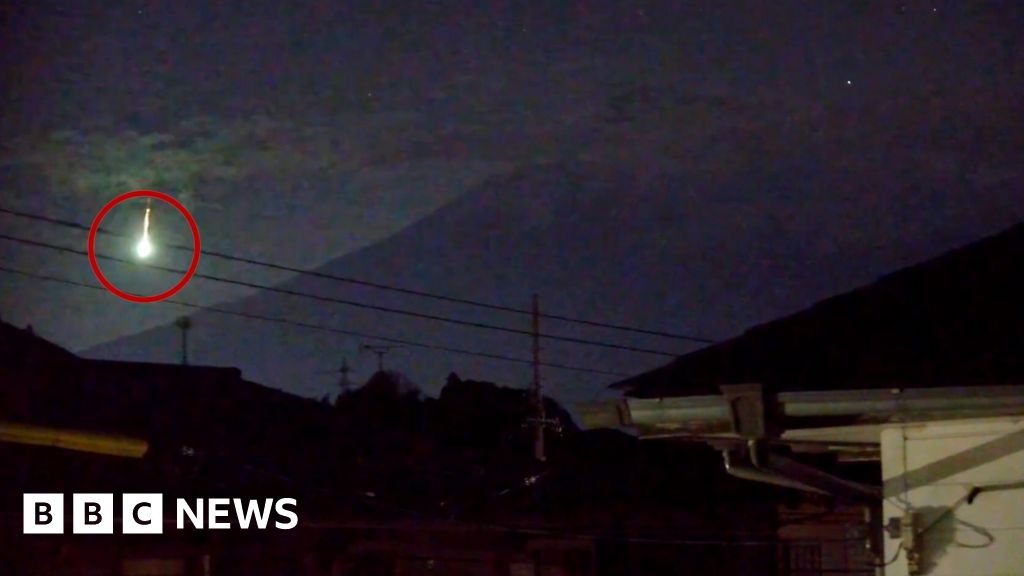
A celestial spectacle recently captivated onlookers as a meteor lights up sky over Japan’s iconic Mount Fuji on Friday, December 27, 2025. This striking current affair was captured vividly by CCTV footage from the Hiratsuka City Museum, offering a rare glimpse into the dynamic beauty of our solar system.
Such astronomical events frequently draw global attention, highlighting the enduring human fascination with space phenomena and the wonders visible in our night sky. For general readers and news consumers, these moments serve as compelling reminders of Earth’s cosmic environment.
While most meteors typically manifest as white streaks across the firmament, this particular event, like others of its kind, demonstrated a captivating array of hues. The vibrant colors observed, which can include green, yellow, red, or blue, directly depend on the specific chemical elements present in the material as it combusts upon entering Earth’s dense atmosphere.
This visual update prompts a deeper exploration into the science behind these dazzling displays, offering context on atmospheric interactions and the broader implications for understanding our universe, fostering continued interest in global news and today’s updates from scientific fields.
Detailed Analysis
The recent meteor sighting above Japan’s majestic Mount Fuji offered a powerful reminder of the continuous celestial ballet occurring far above our heads. While such events are not uncommon in the vast expanse of space, their clear visibility and stunning visual impact, particularly when captured on camera, transform them into a moment of collective awe. For generations, cultures worldwide, including those contributing to India News and global current affairs, have looked to the skies with a mix of wonder and scientific curiosity, making every visible meteor a shared experience.
Meteors, often colloquially known as ‘shooting stars,’ originate from meteoroids—small rocky or metallic fragments of comets or asteroids. These cosmic debris particles constantly traverse our solar system. When Earth’s gravitational pull draws a meteoroid into its atmosphere, the extreme friction generates intense heat, causing the meteoroid to vaporize and ionize the surrounding air, producing the brilliant streak of light we observe. This specific meteor, recorded by CCTV footage from Hiratsuka City Museum, provided a unique and verifiable account of this natural phenomenon against the breathtaking backdrop of Mount Fuji, adding significant interest to today’s updates on natural events.
The science behind the meteor’s dazzling display is rooted in its chemical composition and the physics of atmospheric entry. As the source content confirms, the color of a meteor largely depends on the specific elements within its material that burn up in Earth’s atmosphere. While many meteors emit a common white light, others glow vividly in shades of green, yellow, red, or blue. For instance, the presence of magnesium might lead to a blue-green hue, while sodium often produces a yellowish-orange glow. Iron tends to burn with a yellow light, and calcium can yield a violet tint. The altitude at which these elements burn, combined with the atmospheric pressure and the meteor’s speed, all contribute to the final visual spectacle. This particular event near Mount Fuji likely featured a mix of elements, creating a memorable, colorful streak for those fortunate enough to witness it, and for those who later saw the breaking news footage.
Such detailed observations, especially through modern recording technology like CCTV, are invaluable for scientific study. They allow researchers to analyze the meteor’s trajectory, estimate its size, and even infer its potential composition from the observed colors, providing insights into the broader inventory of space debris impacting our planet. Beyond scientific data, these events hold immense cultural significance, inspiring art, literature, and folklore across civilizations. The distinct glow against the iconic silhouette of Mount Fuji, a symbol of natural beauty and spiritual importance in Japan, elevated this incident from a mere astronomical occurrence to a profound shared cultural moment.
Historically, humanity’s interaction with meteors has evolved from mythological interpretations to rigorous scientific inquiry. Ancient civilizations often viewed meteors as omens or divine messages, attributing deep meanings to their fleeting appearance. Today, while the scientific understanding is profound, the primal sense of wonder remains. This modern sighting over Mount Fuji, like other significant astronomical observations such as meteor showers or cometary passes, serves as a poignant reminder of our place within a dynamic cosmos. It reinforces the universal human desire to observe, understand, and appreciate the natural world, linking seemingly disparate events across global current affairs.
The clear documentation from Hiratsuka City Museum is crucial for validating the sighting and ensuring its accuracy, preventing speculation and enhancing trust in the reported event. In an age of rapid information dissemination, verifiable footage of such natural spectacles becomes essential for credible news reporting, distinguishing it as a factual breaking news item rather than an anecdotal report. This contributes to the collective knowledge base and fuels public interest in astronomy and Earth sciences.
Compared to other celestial events, a solitary, clearly visible meteor, particularly one exhibiting distinct colors, offers a more intimate and direct connection to space than, for example, a distant nebula or a faint galaxy. While large-scale meteor showers like the Perseids or Leonids are predictable and provide numerous fleeting streaks, a single, bright fireball like the one seen over Mount Fuji is often more striking due to its intensity and singular focus. This unique visual impact makes it highly shareable and resonates widely, reaching audiences far beyond immediate observers, including news consumers interested in India and global events.
This event also contrasts with the extremely rare and potentially dangerous phenomenon of a meteorite impact. While meteors burn up completely in the atmosphere, a meteorite is a fragment that survives entry and reaches Earth’s surface. The Mount Fuji meteor, by all accounts, was a magnificent atmospheric burn, posing no threat and leaving behind only a trail of light and lingering wonder. The distinction is vital for accurate reporting and public understanding, ensuring that today’s updates are both informative and reassuring.
For general readers and news consumers, the Mount Fuji meteor sighting underlines several key takeaways. Firstly, it highlights the constant, albeit often unseen, interaction between Earth and the vastness of space. Our planet’s atmosphere acts as a protective shield, incinerating countless space particles daily, with only the largest occasionally making it through. Secondly, it showcases the power of visual documentation in bringing distant or fleeting phenomena closer to home. The CCTV footage transformed a momentary flash into a lasting record, accessible to millions worldwide.
Moreover, such events inspire a renewed appreciation for scientific inquiry and observation. Understanding why a meteor glows, and why it changes color, demystifies the spectacle while simultaneously deepening its wonder. It encourages citizens to look up, to question, and to engage with the natural world around them. Upcoming celestial events, from meteor showers to planetary conjunctions, remain key metrics and opportunities for continued public engagement. This event, firmly in the realm of current affairs and breaking news, serves as a beautiful reminder of the cosmic dynamism constantly unfolding, urging a continued awareness of our place in the universe and the continuous stream of today’s updates from beyond our world.
About the Author