Key Takeaways
PM Modi joins Christmas service as BJP strengthens minority outreach. Analyze the political strategy, stakeholder implications, and electoral impact for 2025.
Overview
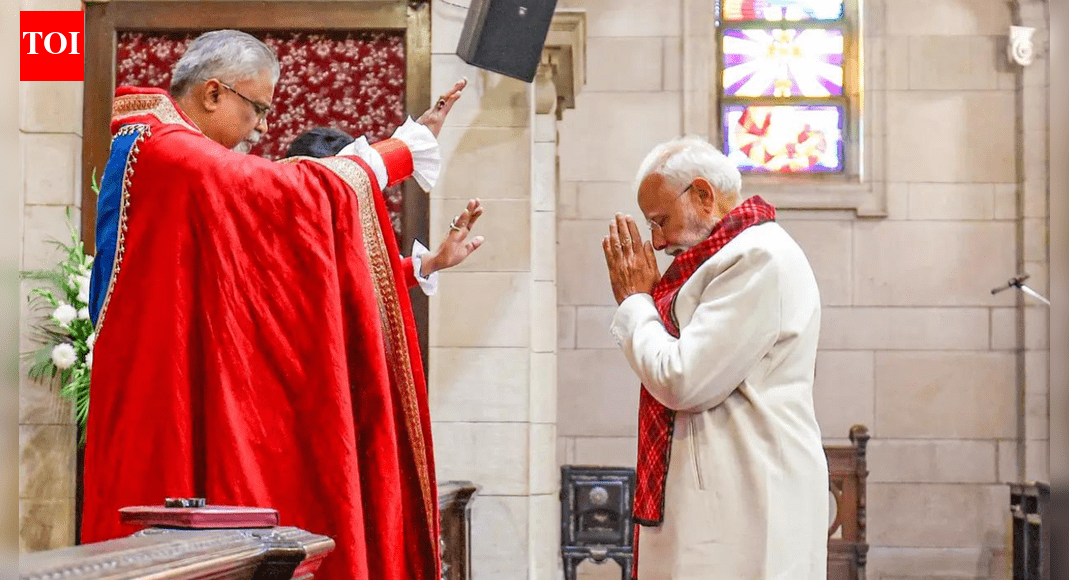
Prime Minister Narendra Modi marked a significant political gesture on Thursday by participating in a Christmas service at the Cathedral Church of the Redemption in New Delhi. This event underscores the governing BJP’s concerted efforts to strengthen its connect with the Christian minority community, reflecting an evolving strategic emphasis within India Politics.
The engagement is part of a continuous outreach initiative, which holds particular relevance for News Readers and Political Analysts observing government strategy towards diverse demographics. Such overtures can signal broader shifts in political messaging and stakeholder engagement, particularly ahead of crucial state elections.
Key data points from the source indicate PM Modi’s previous engagements, including attending an Easter event in 2023 and hosting a Christmas program the same year, alongside BJP President JP Nadda’s participation in related celebrations. The Christian population is notably significant in states like Kerala (over 18%), Tamil Nadu (over 6%), and Goa (over 25%), while holding dominant majority status in several Northeastern states.
This engagement prompts a deeper look into the ruling party’s evolving PM Modi minority outreach strategy, its implications for inter-community relations, and the underlying electoral dynamics, which will be explored in the subsequent analysis.
Key Data
| State/Region | Christian Population (2011 Census) | Political Influence Status |
|---|---|---|
| Kerala | Over 18% | Significant presence, assembly polls approaching |
| Tamil Nadu | Over 6% | Second highest Christian population, assembly polls approaching |
| Goa | Over 25% | Significant presence |
| Northeast States (Nagaland, Mizoram, Meghalaya) |
Dominant Majority | Maximum political influence due to dominant status |
Detailed Analysis
The BJP’s recent outreach to the Christian community, exemplified by PM Modi’s participation in a Christmas service, marks a noticeable strategic shift in India’s political landscape. Historically, the party has often been perceived as having a strained relationship with certain minority communities, particularly in the context of issues such as religious conversions. However, since 2014, there has been a discernible effort by the current Government to engage more broadly with various sections of society. This evolving approach is particularly significant in states like Kerala and Tamil Nadu, which possess substantial Christian populations and are slated for assembly polls in the coming months, highlighting a calculated political strategy to broaden its electoral base beyond its traditional strongholds.
PM Modi’s attendance at the Christmas service is not an isolated event but part of a pattern of sustained engagement. He previously addressed a Christmas celebration organized by the Catholic Bishops’ Conference of India in 2024, attended an Easter event at the Sacred Heart Cathedral in 2023, and hosted a Christmas program at his residence in the same year. Complementing this, BJP President JP Nadda also participated in Christian celebrations, focusing on development initiatives in the Northeast, a region with a significant Christian demographic. Despite these overtures, the party faces considerable hurdles. The opposition, specifically the Congress, quickly highlighted incidents of vandalism and harassment targeting Christians, such as a reported incident in Raipur, Chhattisgarh, casting a shadow of distrust. The Sangh Parivar’s long-standing antipathy to conversion, which has led to stringent laws in several BJP-governed states, continues to be a contentious issue for a segment of the Christian community, complicating the effectiveness of such outreach.
Comparing the BJP’s current proactive minority outreach with its historical engagement patterns reveals a strategic pivot, yet the success remains limited in certain sections. While the party is actively signaling inclusivity, the lingering distrust, rooted in policy decisions related to conversion and incidents of alleged religious harassment, continues to temper the impact of these efforts. This dynamic creates a complex political environment, especially when considering states like Kerala and Tamil Nadu, where the Christian community represents a significant electoral bloc (over 18% and over 6% respectively). The engagement is a long-term strategic play rather than a quick win, attempting to bridge historical divides and demonstrate a more inclusive face of governance, but it must contend with entrenched perceptions and past actions. The table above provides a comparative overview of Christian population strength and political influence in key states, underscoring the strategic calculus behind such engagements.
For News Readers, this development offers insight into the nuanced and evolving strategies employed by major political parties to cultivate broader electoral support across India’s diverse religious landscape. Policy Watchers should monitor how this outreach translates into tangible policy shifts, particularly concerning religious freedom and minority rights, and whether it leads to a reconsideration of existing anti-conversion laws. Informed Citizens and Political Analysts will find it crucial to observe the upcoming assembly polls in Kerala and Tamil Nadu, as the outcomes there could serve as an important indicator of the actual success and acceptance of the BJP’s PM Modi minority outreach efforts. The sustained nature of these engagements suggests a long-term political objective, but its efficacy will depend on balancing symbolic gestures with genuine resolution of underlying concerns and fostering enduring trust within the community.
About the Author