Key Takeaways
India-New Zealand FTA finalised, set to double bilateral trade in 5 years with $20B NZ investment. Explore policy impacts & opportunities.
Market Introduction
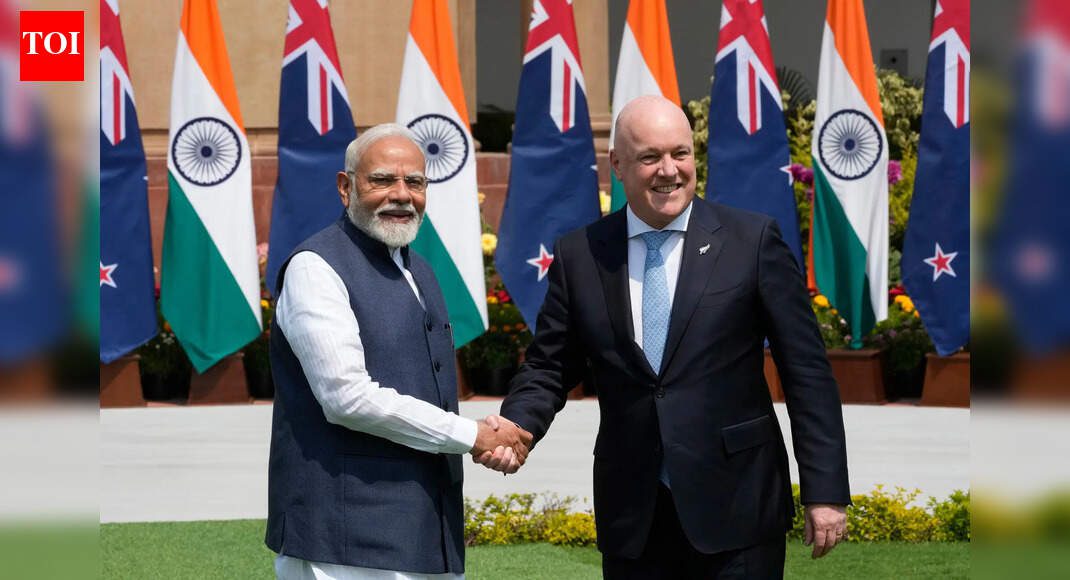
In a significant geopolitical and economic development, India and New Zealand finalised a Free Trade Agreement (FTA) on Monday, culminating nine months of rapid negotiations. This landmark accord, announced following a telephone conversation between Prime Minister Modi and New Zealand’s PM Christopher Luxon, is poised to reshape bilateral economic engagement.
For News Readers, Policy Watchers, and Political Analysts, this agreement signifies a robust commitment to economic diplomacy, reflecting India’s assertive strategy to forge new alliances and diversify trade partnerships within the Indo-Pacific region. The swift conclusion underscores a strong political alignment and a shared vision for mutual prosperity.
Key metrics highlight the ambitious scope: bilateral trade is projected to double within five years, and New Zealand commits to investing $20 billion in India over the next 15 years. India has secured market access across 118 services sectors and Most Favoured Nation (MFN) treatment in 139 service sub-sectors, alongside significant tariff reductions.
This comprehensive agreement sets a precedent for future bilateral trade relations, offering critical insights into India’s evolving trade policy and its strategic implications for global commerce, warranting close observation of its implementation and economic outcomes.
Data at a Glance
| Key Economic Area | Pre-FTA Context (Implied) | Under FTA Provision/Projection |
|---|---|---|
| Bilateral Trade Growth | Steady Growth (specific details not in source) | Expected to double in 5 years |
| New Zealand Investment in India | Existing flows (specific details not in source) | $20 Billion over 15 years |
| India’s Services Market Access in NZ | Limited access across sectors | Access in 118 sectors, MFN in 139 sectors |
| Tariff Reduction (NZ Exports to India) | Varying existing tariffs | 95% eliminated or reduced |
| Tariff Reduction (India Exports to NZ) | Varying existing tariffs | 57% duty-free Day 1, rising to 82% fully implemented |
In-Depth Analysis
The finalisation of the India-New Zealand FTA marks a notable moment in India’s contemporary trade policy landscape. In recent years, the Indian government has actively pursued Free Trade Agreements, moving beyond traditional partners to engage with key economies across various regions. This strategy aims to bolster India’s economic resilience, diversify its export markets, and integrate more deeply into global supply chains. The swift negotiation period of merely nine months for this particular agreement underscores a strong political will and an efficient diplomatic machinery, reflecting a broader commitment to expedited economic partnerships. This approach mirrors other recent agreements, such as those with the UAE and Australia, signalling a proactive stance in leveraging bilateral pacts for strategic economic gains and strengthening India’s position in global affairs.
Breaking down the specific provisions, the FTA offers significant advancements, particularly in services and investment. India’s acquisition of market access in 118 services sectors and Most Favoured Nation (MFN) treatment in an additional 139 services sub-sectors for Indian professionals represents a modern, comprehensive approach to trade liberalisation. This focus on services is crucial for India, a major global service provider. Furthermore, the inclusion of an annex on health and traditional medicine services is pioneering, being New Zealand’s first such agreement with any country. This potentially opens new avenues for India’s traditional medicine systems and healthcare service exports. On the goods front, tariffs will be eliminated or reduced on 95% of New Zealand’s outflows to India, while 57% of India’s exports to New Zealand will be duty-free from day one, rising to 82% over time. This structured tariff reduction mechanism aims to provide immediate relief and gradual integration for businesses. The $20 billion investment commitment from New Zealand over 15 years, as part of the India-New Zealand FTA, further cements a long-term economic partnership, indicating substantial capital flows and potential job creation across key sectors in India.
Comparing this agreement to previous Indian FTAs reveals its strategic emphasis on services and a remarkable speed of negotiation, showcasing an adaptive policy framework. While other FTAs might have taken longer, this rapid conclusion signals a shared urgency and mutual benefit. This proactive stance is aligned with India’s broader diplomatic efforts to strengthen ties within the Indo-Pacific, diversifying its trade portfolio away from over-reliance on a few major partners. Stakeholders across both nations stand to benefit. Indian service professionals, particularly in IT, healthcare, and education, will find expanded opportunities in New Zealand. MSMEs and export-oriented industries in India, and corresponding sectors in New Zealand, can anticipate improved market access and reduced trade barriers. Conversely, sectors in both countries facing new competition will need to adapt. The agreement’s focus on diverse sectors aims to mitigate singular risks by fostering growth across multiple economic fronts, ensuring a balanced and mutually advantageous outcome. [Suggested Matrix Table: Comparison of India’s Recent FTAs by Negotiation Duration, Key Sectors Covered, and Projected Trade Growth]
For News Readers, Policy Watchers, Informed Citizens, and Political Analysts, the India-New Zealand FTA carries significant policy implications and warrants continuous monitoring. It underscores the Indian government’s resolve to drive economic growth through strategic global partnerships, enhancing its footprint in international trade and economic diplomacy. The policy’s success will be evident in the tangible doubling of bilateral trade within the stated five-year timeframe and the realisation of the $20 billion investment. Key metrics to monitor include quarterly trade figures between the two nations, sector-specific growth rates, and the actual utilisation rates of market access provisions for Indian service providers. The agreement also sets a precedent for future bilateral engagements, potentially paving the way for similar comprehensive pacts with other partners. This policy move is a clear signal of India’s commitment to liberalised trade and its proactive role in shaping a new global economic order, with long-term structural changes in bilateral relations extending beyond commerce to defense, education, and cultural exchanges.
About the Author