Key Takeaways
Mohan Bhagwat clarifies RSS’s distinct identity from BJP. Understand the political implications, historical context, and policy perspectives for India’s governance in 2025.
Market Introduction
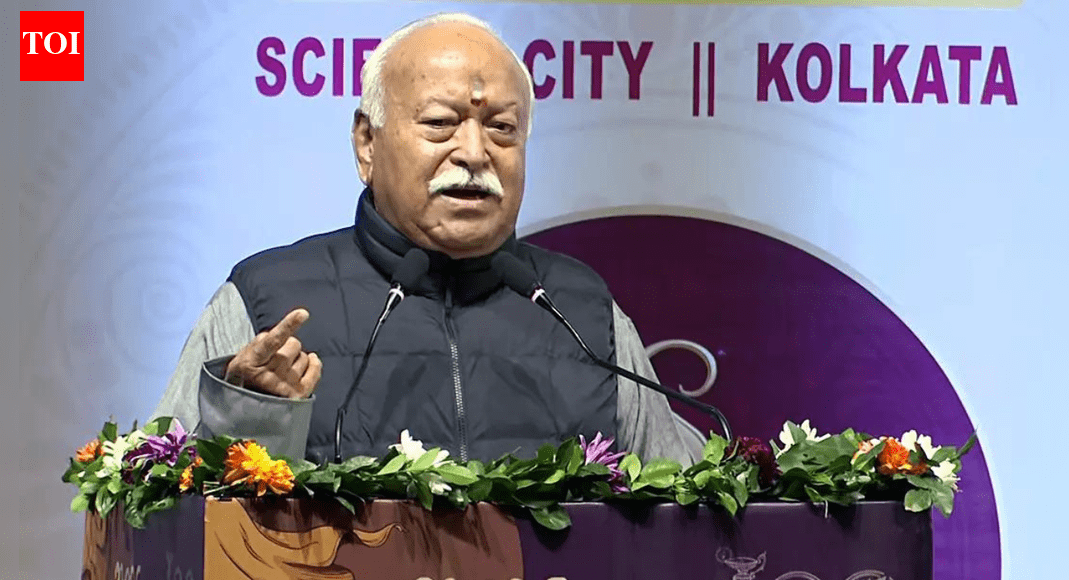
Rashtriya Swayamsevak Sangh (RSS) chief Mohan Bhagwat recently asserted that viewing the Sangh solely through the lens of the BJP constitutes a significant misinterpretation. Speaking at the Kolkata Vyakhyanmala, an interactive session marking the RSS centenary, Bhagwat underscored the independent identity and broader objectives of the socio-cultural organization, aiming to clarify its role within India’s political landscape.
This statement holds considerable weight for News Readers, Policy Watchers, Informed Citizens, and Political Analysts, offering a crucial perspective on the complex relationship between India’s dominant political party and its ideological parent. The clarification comes amidst ongoing public discourse regarding the influence of the Sangh on government policy and political strategy in India Politics.
Bhagwat defined ‘Hindus’ as those who respect their motherland, irrespective of language or rituals, and stressed the RSS’s goal to organize Hindu society without opposing others. He also controversially labelled the Babri Masjid issue a ‘political conspiracy’ driven by ‘votes’ and opposed government funding for religious structures.
The ensuing analysis delves into the historical context, stakeholder perspectives, and policy implications of Bhagwat’s remarks, providing a balanced political analysis for a comprehensive understanding of these statements.
In-Depth Analysis
Mohan Bhagwat’s recent clarification in Kolkata regarding the distinction between the Rashtriya Swayamsevak Sangh (RSS) and the Bharatiya Janata Party (BJP) revives a long-standing debate central to understanding India’s socio-political fabric. The RSS, founded in 1925, posits itself primarily as a cultural organization dedicated to nation-building and character development among Hindus, aiming for societal regeneration through its vast network of swayamsevaks (volunteers). Its emergence predates the BJP significantly, with the political party itself evolving from the Jan Sangh, founded in 1951, which shared ideological roots with the RSS. Historically, this relationship has been characterized by an ideological mentorship, where the RSS provides the foundational philosophy and a cadre of dedicated workers, some of whom eventually enter politics. Bhagwat’s remarks, delivered during the Sangh’s centenary celebrations, underscore the organization’s attempt to delineate its functions and outreach as distinct from the day-to-day governance and electoral politics pursued by the BJP, an important nuance for observers of India Politics.
Bhagwat explicitly stated, “Many have a tendency to understand Sangh through the lens of BJP. That is a big mistake.” He elaborated that “Swayamsevaks in Sangh work in varied fields. Some are in politics. Some are in the party in office (at the Centre),” highlighting the diverse engagement of its members across various societal sectors beyond mere political participation. This distinction is crucial for the RSS, as it seeks to maintain its image as a broad-based social movement rather than merely the political arm of a party. Furthermore, Bhagwat defined the goal of the Sangh as the “organisation of the entire Hindu society,” clarifying that this objective is “not aimed at opposing others.” This re-emphasis attempts to counter prevalent narratives that often portray the Sangh as anti-minority. He proffered an inclusive definition of ‘Hindu’ as an attribute for those who respect their motherland, embracing diverse languages, rituals, and customs. In a significant ideological stance, he also noted that while Muslims might differ “in terms of worship,” they are integral to the unified “nation, culture and society.” Bhagwat’s criticism of the proposed Babri Masjid as a “political conspiracy” driven “for the votes,” rather than for genuine communal or religious benefit, further distanced the Sangh’s ideological position from politically motivated religious disputes. He reaffirmed the principle that the Government should not fund the construction of religious structures, citing the Somnath Temple and Ram Mandir as examples built through societal contributions, a clear policy implication for future decisions.
The current statements by Mohan Bhagwat represent a consistent, yet strategically re-emphasized, position that the RSS has often articulated, particularly when public perception closely intertwines its identity with the BJP’s governmental actions. This delineation attempts to broaden the RSS’s appeal beyond the BJP’s electoral base and mitigate the criticism often directed at the ruling party by portraying the Sangh as a larger, more encompassing cultural entity. From the perspective of News Readers, this provides context for how various policies and societal initiatives are ideologically framed. For Policy Watchers, the stance on government non-funding of religious sites, for instance, offers insight into an underlying ideological principle that could influence debates on state secularism and public expenditure on religious affairs in India. Opposition parties, meanwhile, often find it politically advantageous to portray the RSS and BJP as a singular, monolithic entity, making Bhagwat’s clarification a direct challenge to this narrative. The statement regarding Muslims being part of the ‘unified entity’ also seeks to engage diverse communities, albeit through a specific cultural lens. Analysts must monitor how effectively this distinction is communicated and received, especially given the shared cadre and the undeniable ideological alignment between the two organizations across various aspects of India Politics.
For News Readers, understanding this distinction is vital for a more nuanced interpretation of political developments in India. It highlights that while the BJP draws heavily from the RSS’s ideological wellspring and volunteer base, the Sangh itself seeks to operate on a broader canvas of social and cultural mobilization. Policy Watchers should closely observe how the principle of state non-involvement in religious construction translates into actual Government policy or public debate, particularly concerning cultural heritage and secular funding. Informed Citizens can use Bhagwat’s re-articulation to critically evaluate political rhetoric, discerning between the specific policies of the ruling party and the broader ideological aspirations of its parent organization. Political Analysts will find these remarks critical for assessing the long-term strategy of the RSS to cement its cultural influence, expand its social footprint, and manage its public image amidst an increasingly complex political environment. Future statements from both RSS and BJP leadership, along with the government’s actions in areas like cultural funding and communal harmony, will serve as key metrics to monitor the practical implications and acceptance of this asserted distinction within the intricate dynamics of India’s political landscape. This ongoing narrative shaping will continue to be a central feature of India’s governance discourse.
About the Author