Key Takeaways
President Murmu assents to VB-G RAM G Bill, replacing MGNREGA. Understand the new rural employment policy, opposition concerns, and implications for India’s workforce.
Market Introduction
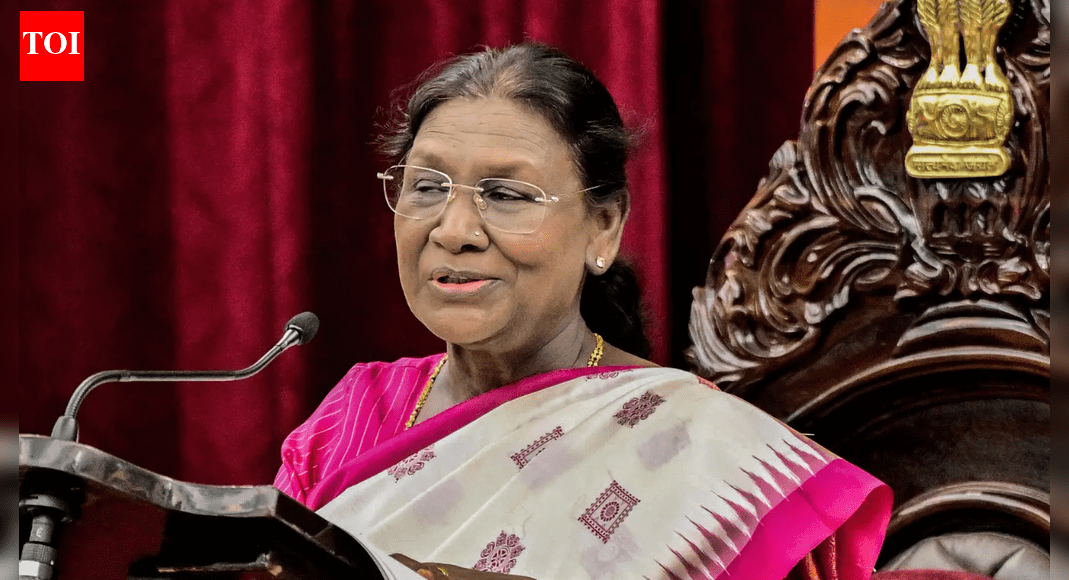
In a significant development for India Politics, President Droupadi Murmu on Sunday gave her assent to the Viksit Bharat—Guarantee for Rozgar and Ajeevika Mission (Gramin) (VB—G RAM G) Bill, 2025. This pivotal legislation replaces the Mahatma Gandhi National Rural Employment Guarantee Act (MGNREGA), a cornerstone policy for rural employment for two decades.
This policy shift is crucial for News Readers and Policy Watchers alike, signaling the government’s renewed approach to rural employment and development, aligning with the broader ‘Viksit Bharat 2047’ vision. The move has ignited a contentious debate, drawing strong criticism from opposition parties.
The new law statutorily guarantees 125 days of wage employment annually to every rural household where adult members volunteer for unskilled manual work. The Lok Sabha passed the bill amidst sustained opposition protests and House disruptions just days prior.
The passage of this Bill prompts a closer examination of its implications, stakeholder reactions, and the future trajectory of rural employment schemes in India, particularly for Informed Citizens and Political Analysts.
In-Depth Analysis
The enactment of the Viksit Bharat—Guarantee for Rozgar and Ajeevika Mission (Gramin) (VB—G RAM G) Bill, 2025, marks a significant legislative moment, effectively sunsetting the Mahatma Gandhi National Rural Employment Guarantee Act (MGNREGA), a program instituted over two decades ago. MGNREGA had been a crucial social safety net, providing a legal guarantee for rural employment and aiming to alleviate poverty. Its historical implementation has seen varying degrees of success and criticism, yet its fundamental premise of guaranteed work in rural areas remained a key aspect of India’s social welfare framework. The current government’s move to replace it stems from a stated ambition to create a “modern statutory framework aligned with Viksit Bharat 2047,” suggesting a recalibration of approach towards rural development and employment generation within the broader national vision for a developed India by 2047. This legislative shift brings to the forefront a new era of policy discourse concerning labor, welfare, and central government initiatives.
The core provision of the newly assented VB-G RAM G Bill, 2025, guarantees 125 days of wage employment in a financial year to every rural household where adult members are willing to undertake unskilled manual work. This provision, as per official statements, is designed to align with a vision for Viksit Bharat 2047, establishing a contemporary legal structure for rural employment. However, this legislative progression was not without significant political contention. The Lok Sabha witnessed repeated disruptions and protests from opposition parties during the bill’s passage. Leaders from the Congress party, notably Sonia Gandhi and Rahul Gandhi, vehemently criticized the government, characterizing the move as an attempt to “bulldoze” MGNREGA and accusing the government of undermining Mahatma Gandhi’s legacy by removing his name and enacting a “black law” without adequate consultation. Rahul Gandhi explicitly stated the Congress party’s intention to compel the government to withdraw the new law, highlighting the deep partisan divide surrounding this crucial piece of legislation in India Politics.
While the VB-G RAM G Bill maintains the core principle of guaranteed rural employment, its conceptual framing under “Viksit Bharat 2047” signals a potentially different strategic emphasis compared to MGNREGA’s original mandate. MGNREGA operated as a crucial demand-driven social safety net, particularly vital during agricultural lean periods. The opposition’s accusation of “undermining Gandhi’s legacy” highlights a perceived ideological divergence from the former scheme, which carried significant symbolic weight. Stakeholder perspectives diverge sharply: the government frames it as a modernization for India’s future, whereas the opposition views it as an assault on established welfare architecture and a politically motivated maneuver. This creates a critical debate on whether the new framework will genuinely enhance rural livelihoods and employment policy, or if it represents a dilution of existing entitlements.
For News Readers and Informed Citizens, the passage of the VB-G RAM G Bill signifies a major policy recalibration with potential widespread implications for rural India. Policy Watchers and Political Analysts will closely monitor the implementation details and efficacy of the 125-day employment guarantee under the new framework. Key metrics to watch include actual uptake rates, fund allocations, and any subsequent legislative changes or judicial challenges. The robust opposition, led by the Congress party, promises continued political scrutiny and potential grassroots movements to protest the new law, signaling ongoing parliamentary debates and public demonstrations. The evolving landscape of India’s rural employment policies will undoubtedly be a central theme in future political discourse, shaping both socio-economic outcomes and the dynamics between the ruling party and the opposition.
About the Author